

TreeTake Network
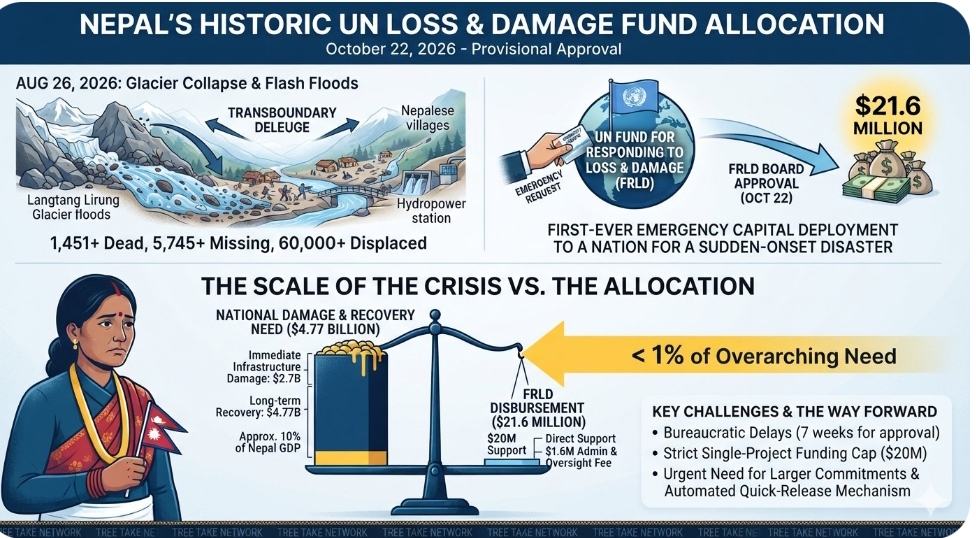
In a fundamental shift for global climate finance, the United Nations’ Fund for Responding to Loss and Damage (FRLD) has provisionally approved an allocation of 21.6 million dollars to assist Nepal in recovering from catastrophic, climate-induced transboundary flash floods. The landmark decision, finalised during an extraordinary board meeting on October 22, marks the first time the global mechanism has ever released emergency capital to a nation suffering from a sudden-onset climate disaster.
The disaster was triggered on August 26 when a massive rock-and-ice avalanche collapsed from a glacier on Langtang Lirung mountain near the Nepal-China border. The resulting deluge sent a torrent of water and debris crashing through the Bhote Koshi, Trishuli, and Narayani river systems, obliterating critical hydropower dams, destroying bridge networks, and sweeping away entire villages. The humanitarian toll is staggering, with over 1,450 people dead, more than 5,700 individuals still missing, and tens of thousands directly displaced.
The Finance Gap and Sovereign Demands
While the international allocation represents a massive institutional breakthrough, the package covers only a fraction of the actual economic wreckage. The Nepalese government's joint post-disaster needs assessment, conducted by the National Disaster Risk Reduction and Management Authority alongside the National Planning Commission, calculated immediate physical infrastructure damage at 2.7 billion dollars, with long-term adaptive recovery and reconstruction costs ballooning to 4.77 billion dollars—nearly ten per cent of the nation's total Gross Domestic Product.
The approved 21.6 million dollars includes 20 million dollars dedicated to direct structural recovery support and 1.6 million dollars earmarked for essential administrative oversight fees. However, because the current fund guidelines strictly cap single-project allocations at 20 million dollars, Nepal's initial disbursement addresses less than one per cent of its overarching fiscal rebuilding requirements. Under the formal procedures established by the board, the Nepalese government must now submit a final targeted project application ahead of the tenth FRLD Board meeting scheduled this December, where formal implementation clearance will be weighed.
Institutional Frustration Over Delays
The deployment comes after intense global lobbying and underscores growing systemic friction within multilateral climate bureaucracies. Civil groups and state officials have voiced extreme frustration regarding the speed of the global pipeline, pointing out that the emergency response took nearly two months to clear basic institutional hurdles following Nepal's formal application on August 31.
An official statement issued by the FRLD Secretariat sought to frame the timeline within the constraints of active diplomatic consensus-building:
“Following Nepal's formal letter on August 31, 2026 requesting support from the Fund, the FRLD Board commenced to assess available options. Backed by strong solidarity from the whole Board, intensive consultations were held throughout September and October,...”
However, global climate advocacy platforms have rejected this procedural justification, highlighting that bureaucratic delays actively compound local suffering. Harjeet Singh, the Global Convenor of the Fill the Fund campaign and founding director of the Satat Sampada Climate Foundation, issued a sharp critique regarding the mechanism's operational latency:
“No country should have to endure a catastrophe and wait seven weeks, through historic letters and relentless pressure, just to unlock the Fund's first-ever emergency meeting. We must set up a permanent rapid-response system that moves support in days, not...”
Further local context was provided by senior regional administrative analyses. An editorial review by The Rising Nepal underscored the systemic geopolitical awakening forced by the disaster:
“With the Fund for Responding to Loss and Damage (FRLD) announcing it will provide US$20 million (around Rs. 3 billion) in grant assistance to Nepal to support rehabilitation and reconstruction of places devastated by the Bhotekoshi flood, the international...”
Editor's Note
The provisional deployment of funds to Nepal marks a historic validation of climate justice, effectively shifting loss and damage from a theoretical negotiating chip into an active operational reality. However, the severe disparity between the 20 million dollar institutional cap and Nepal's 4.77 billion dollar recovery requirement exposes a dangerous systemic vulnerability. If multilateral funds cannot scale their frameworks to match the multi-billion-dollar realities of modern Himalayan climate disasters, vulnerable developing states will continue to face systemic fiscal destabilisation. The way forward requires the UNFCCC to drastically expand the pool of capital commitments and strip away bureaucratic bottlenecks, establishing an automated, trigger-based quick-release facility that delivers sovereign relief within hours of a verified climate anomaly.



Leave a comment