

TreeTake Network
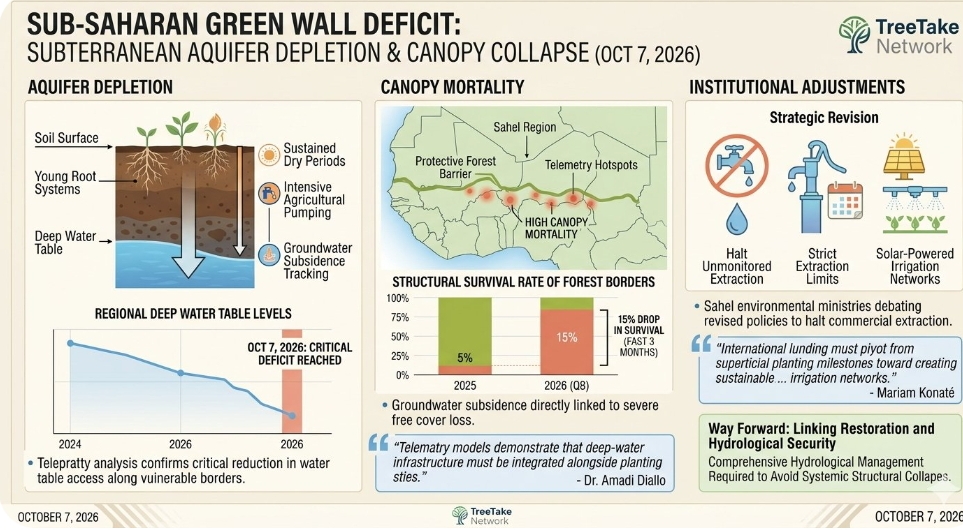
The expansion of defensive forest barriers across arid zones faces extreme ecological stress as severe groundwater deficits undermine regional conservation frameworks. On 7 October 2026, the Pan-African Green Wall Coalition released its quarterly telemetry analysis, confirming a critical reduction in water table access along vulnerable border corridors. The field data indicates that sustained dry periods coupled with intensive agricultural pumping have lowered deep water tables to depths that completely isolate young root systems from vital subterranean moisture.
Telemetry metrics and canopy mortality tracking
Recent satellite mapping and ground-level monitoring compiled throughout the third quarter of 2026 reveal a direct link between groundwater subsidence and tree cover loss. According to the data, the structural survival rate of newly established protective forest borders dropped by fifteen per cent over the past three months in areas experiencing severe aquifer depletion. Spatial ecology expert Dr Amadi Diallo noted during a regional environmental briefing that counting planted saplings is no longer a viable metric for success. He explained that telemetry models demonstrate that deep-water infrastructure must be integrated alongside planting sites to sustain the living infrastructure through prolonged seasonal droughts.
Strategic revisions and institutional adjustments
Regional planning councils are beginning to realise that massive land-restoration initiatives cannot succeed without strict regulation of shared water resources. In response to these structural challenges, environmental ministries across the Sahel are debating revised conservation policies to halt unmonitored commercial groundwater extraction near protected forestry corridors. Addressing an agricultural development forum, ecological restoration director Mariam Konaté emphasised that the survival of the living barrier depends entirely on hydrological security. She argued that international funding must pivot from superficial planting milestones toward creating sustainable, solar-powered irrigation networks to protect the existing biological canopy.
Editor's Note: The escalating tree-line mortality across the Sahel highlights the critical necessity of linking land restoration directly with regional water security frameworks. Moving forward, transnational bodies must enforce strict extraction limits on adjacent subterranean aquifers to preserve vital baseline moisture. The brief analysis suggests that unless administrative bodies transition from simple tree-planting campaigns to comprehensive hydrological management, the multinational protective barrier will face a systemic structural collapse, accelerating desertification trends across vulnerable border zones.



Leave a comment