

TreeTake Network
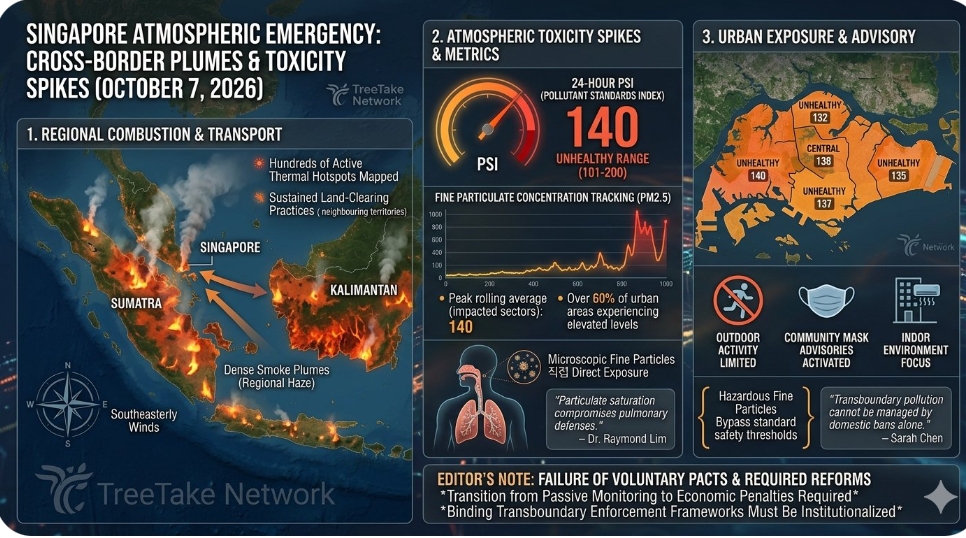
Severe environmental degradation and volatile atmospheric currents have thrust urban populations into a critical ecological emergency. On 7 October 2026, the National Environment Agency officially confirmed that particulate concentration tracking had crossed defensive boundaries, driving the islandwide Pollutant Standards Index firmly into the unhealthy range. A persistent lack of precipitation combined with shifting seasonal wind paths has transformed the regional atmosphere into a concentrated repository for toxic agricultural emissions.
Particulate saturation and urban exposure metrics
The latest spatial telemetry recorded across all five municipal quadrants reveals an alarming accumulation of respirable fine particles. Administrative records compiled on 7 October 2026 show that the 24-hour rolling average peaked at 140 in the most severely impacted sectors, easily exceeding the standard double-digit safety thresholds. Environmental health coordinator Dr Raymond Lim explained that the current concentration of microscopic fine particles directly compromises pulmonary defence mechanisms, prompting healthcare networks to activate emergency contingencies. The regional database indicates that over sixty per cent of urban areas are concurrently experiencing elevated hourly levels, severely limiting safe outdoor operations.
Regional combustion sources and regulatory limits
The ongoing crisis stems from sustained land-clearing practices across neighbouring territories where oversight remains severely limited. Specialised meteorological satellites have mapped hundreds of active thermal hotspots producing dense smoke plumes that strengthening southeasterly winds push directly into the urban corridor. Addressing a regional ecology forum, environmental safety director Sarah Chen emphasised that transboundary pollution cannot be managed by domestic bans alone. She argued that international frameworks must establish immediate legal accountabilities for corporate agricultural entities relying on cheap combustion methods for land preparation.
Editor's Note: The return of hazardous regional haze underscores the complete failure of existing voluntary regional environmental pacts. Moving forward, vulnerable nations must transition from passive monitoring to aggressive economic penalties targeting supply chains linked to unauthorised agricultural burning. The brief analysis suggests that as global weather anomalies intensify drying patterns, municipal zones will remain entirely defenceless against toxic air infiltration unless binding transboundary enforcement frameworks are institutionalised.



Leave a comment