

TreeTake Network
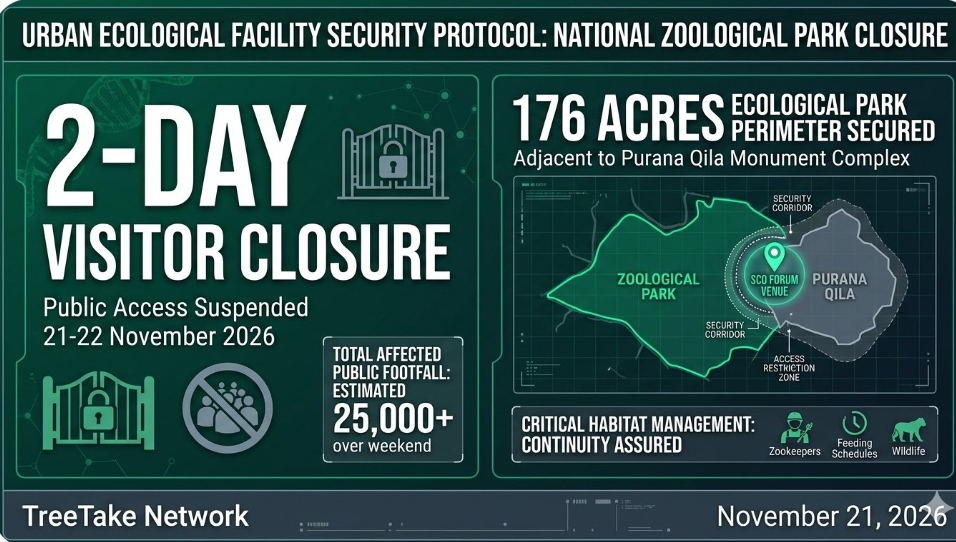
The National Zoological Park in New Delhi has implemented a total operational shutdown for public visitors on November 21 and November 22, 2026. This decisive administrative step was authorised directly by the Ministry of Environment, Forest and Climate Change following top-tier intelligence coordination to meet the unprecedented security parameters and sweeping spatial deployment frameworks required for the inaugural Shanghai Cooperation Organisation Civilisational Dialogue Forum. The high-profile multilateral event, being held at the immediate historical monument precinct of Purana Qila, directly shares extensive terrestrial boundaries with the sprawling 176-acre ecological conservation park, necessitating an absolute freeze on public movement across the perimeter.
Multi-Layered Perimeter Control Protocols Around Purana Qila
The convergence of global dignitaries, heads of state, and international cultural delegations at the adjacent 16th-century fortress has transformed the entire central New Delhi green corridor into an active, multi-tiered security zone. Because the zoological park offers extensive, dense foliage cover and unmonitored line-of-sight paths leading toward the core forum pavilions inside Purana Qila, specialised security agencies mandated an absolute vacancy of the public domain. Elite paratrooper divisions, electronic surveillance wings, and specialised tactical policing formations have established unified control centres within the outer park margins to monitor regional atmospheric and terrestrial parameters.
"The temporary closure of the National Zoological Park is an unavoidable security prerequisite dictated by the extreme geographical proximity of the forum venue," stated over radio bands Dr Sanjeev Kumar, Director of Security Coordination for the capital region. "With over 25 international delegations active within the Purana Qila complex simultaneously, our defensive network must maintain absolute operational clarity. The dense canopy and expansive layout of the zoo require intensive automated sensor sweeps and physical patrols, which can only be flawlessly executed in the complete absence of civilian footfall."
Continuity of Internal Ecological Care and Husbandry Mandates
While the public turnstiles remain firmly locked, the core wildlife management infrastructure within the facility continues to operate at maximum capacity under specialised protocols. Zoo administrators confirmed that the two-day public ban has not altered the precision timelines for animal enrichment programmes, dietary distribution networks, or veterinary diagnostic sweeps. A skeleton crew of dedicated zookeepers, technical handlers, and clinical wildlife doctors has been granted specialised biometric clearance passes to navigate the security grid, ensuring that the facility's 130 species remain completely insulated from external institutional disruption.
"Our fundamental commitment to animal welfare remains entirely absolute and unaffected by the external diplomatic framework," reported Dr Akshita Rana, Chief Veterinary Officer at the National Zoological Park. "All morning feeding regimens, targeted pharmaceutical interventions, and critical water-quality monitors across the aquatic enclosures are proceeding precisely on schedule. In fact, our internal diagnostic teams are utilising this rare window of complete public quietude to conduct specialised, stress-free health assessments of our highly sensitive breeding populations, including the white tiger pairs and migratory waterbird communities."
Diplomatic Continuity and Cultural Integration Strategies
The forum itself represents a landmark cultural milestone proposed initially during the multilateral summits of 2025 to foster deeper civilisational bonds across Eurasia. Ministry representatives emphasising the strategic location of the event remarked that the juxtaposition of India's premier biodiversity hub with the ancient seat of imperial governance perfectly encapsulates the overarching narrative of regional environmental and historical co-existence. Even as local political discussions spark debates regarding public access disruptions, the administrative core remains firmly focused on projecting absolute structural and diplomatic synchronicity.
"This forum serves as a critical bridge for cultural diplomacy, and the selection of this historic green enclave underscores India's civilisational continuum," remarked Randhir Jaiswal, Official Spokesperson for the Ministry of External Affairs. "While we highly regret the temporary inconvenience caused to local citizens and weekend tourists who planned their visits to the park, the global significance of these security frameworks cannot be overstated. We deeply appreciate the total cooperation and systematic understanding shown by the public as we manage this essential national endeavour."
Editor's Note
The closure of the National Zoological Park highlights the increasing intersection between global geopolitical event management and urban ecological facility operations. While securing international summits is paramount, this event serves as a clear proof of concept that large-scale institutional security overrides do not have to compromise the strict biological schedules required by captive wildlife ecosystems. The strategic way forward must involve the codification of automated, non-invasive digital security frameworks for eco-spaces adjacent to diplomatic zones, allowing future international events to proceed without requiring complete physical shutdowns that interrupt regional public engagement and eco-tourism revenue streams.



Leave a comment