

TreeTake Network
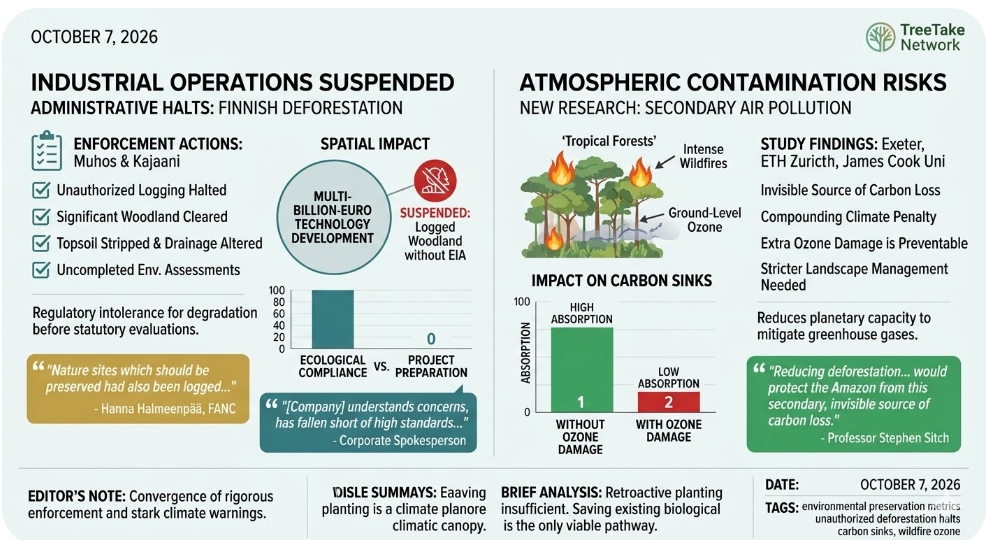
Industrial expansion and intensifying climate patterns have triggered unprecedented administrative interventions across the globe. On Tuesday, the Finnish Licensing and Supervision Authority issued an immediate suspension order halting preparatory operations on multi-billion-euro technology infrastructure developments due to unauthorised logging. The intervention highlights an escalating regulatory intolerance for significant environmental degradation occurring before mandatory statutory evaluations.
European deforestation mandates and corporate accountabilities
The enforcement actions in northern Europe target extensive preparatory measures taken by a subsidiary representing corporate digital development plans. Investigators confirmed that significant tracts of woodland had been cleared, topsoil stripped, and natural drainage systems altered in Muhos and Kajaani without completing required environmental impact assessments. Expressing the gravity of the situation, Hanna Halmeenpää, the chair of the Finnish Association for Nature Conservation, stated that nature sites which should be preserved had also been logged in a deforested area. In response to the regulatory findings, a spokesperson for the corporation acknowledged the operational shortcomings, stating that the company understands the concerns and has fallen short of its own high standards in this instance, while committing to study the official findings and fully follow the administrative guidance.
Atmospheric contamination and the deterioration of carbon sinks
Simultaneously, newly published atmospheric research reveals that secondary air pollution is actively undermining the planetary capacity to mitigate greenhouse gases. A joint study conducted by the University of Exeter, ETH Zurich, and James Cook University, published on 7 October 2026, establishes that ground-level ozone produced by intense wildfires is quietly eroding the ability of remaining tropical forests to absorb carbon dioxide. Environmental scientist Professor Stephen Sitch explained that reducing deforestation and forest degradation would cut direct fire emissions, but the study shows it would also protect the Amazon from this secondary, invisible source of carbon loss. The field data demonstrates that these atmospheric impacts interact closely, creating a compounding climate penalty where the extra ozone damage is largely preventable through stricter localised landscape management.
Editor's Note: The convergence of rigorous domestic enforcement and stark climate warnings underscores that global green infrastructure can no longer be sacrificed for rapid technological or industrial progress. Moving forward, national planning frameworks must integrate binding, pre-emptive environmental audits before any structural ground-breaking occurs. The brief analysis suggests that relying on retroactive tree-planting schemes is entirely insufficient; saving the existing biological canopy and enforcing absolute compliance from multinational entities remains the only viable pathway to prevent systemic ecosystem collapse.



Leave a comment