

TreeTake Network
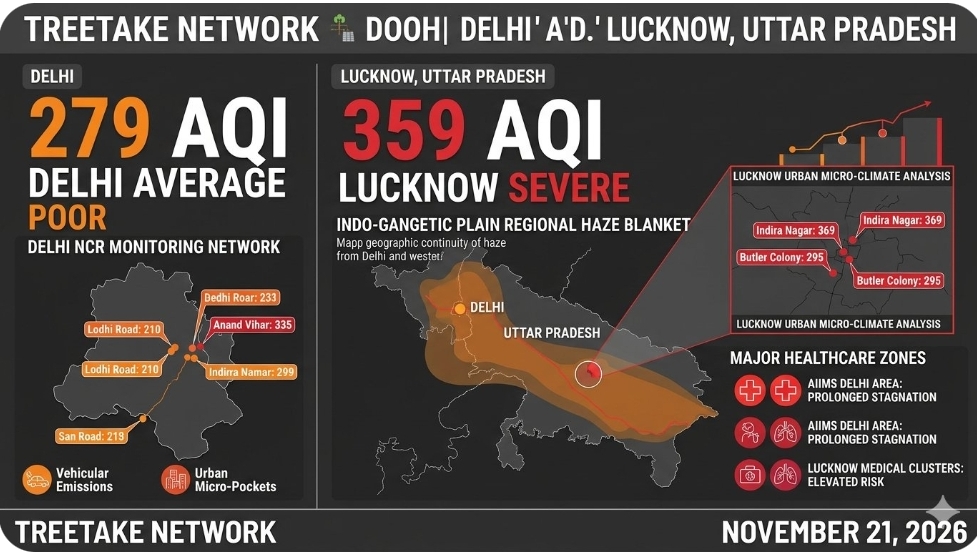
The ambient atmospheric quality across Northern India demonstrated a widespread, interconnected regional degradation on November 21, 2026, with citywide averages tracking deeply within unhealthy thresholds. Data compiled by the Central Pollution Control Board from real-time monitoring stations registered a consolidated 24-hour air quality index of 279 in the national capital, while neighbouring Uttar Pradesh witnessed severe particulate matter accumulation. The capital city of Lucknow experienced an even sharper atmospheric deterioration, with its consolidated urban monitoring network recording a severe citywide index of 359 at 0800 hours, driven by calm surface winds and the rapid onset of a dense trans-boundary haze layer.
Regional Thermal Inversion Enforces Particulate Stagnation Across Lucknow
Atmospheric telemetry arrays managed across Uttar Pradesh revealed that the Indo-Gangetic plain has entered an intense seasonal meteorological transition phase, creating a massive, continuous blanket of stagnant air from Delhi to central Uttar Pradesh. High-resolution sensor networks tracking Lucknow's urban hotspots mapped significant particulate matter surges, particularly across high-density residential and commercial belts. Indira Nagar emerged as a primary exposure pocket, registering a hazardous metric of 369, while central transit hubs like Kaiser Bagh and the historical Butler Colony logged indices hitting 271 and 295, respectively, trapping fine particulate emissions close to the breathing zone.
"The northern meteorological system is currently experiencing a profound temperature inversion that extends directly across the western borders into central Uttar Pradesh," stated Dr Dipankar Saha, Former Head of the Air Laboratory Division at the Central Pollution Control Board. "In Lucknow, the mixing height has shrunk to less than 400 metres, which effectively prevents any vertical dispersion of domestic and vehicular emissions. Consequently, fine particulate matter measuring less than two point five micrometres remains suspended for prolonged periods, causing these sharp localised spikes across the state capital."
Institutional Health Impact and Localised Micro-Climate Realities
The widespread atmospheric degradation has directly translated into heightened clinical risks near major institutional and medical hubs across both territories. Medical complexes within Lucknow, much like the All India Institute of Medical Sciences enclave in New Delhi, are reporting distinct micro-climates where traffic-induced emissions cannot escape the immediate structural canopy. Regional hospital wings have initiated emergency protocols to handle a steady rise in morning outpatient arrivals exhibiting acute respiratory distress, prompting regulatory wings to deploy specialised suppression tools around these critical public spaces.
"We are tracking a noticeable upward trend in immediate bronchial sensitivity cases among our vulnerable patient demographics over the last 48 hours," reported Prof Anurag Agarwal, Senior Pulmonary Specialist. "When the index enters these higher brackets within healthcare perimeters, it poses an immediate hazard to individuals recovering from cardiac or respiratory interventions. We have strictly advised all recovering outpatients across both New Delhi and Lucknow to limit their early morning physical exposure and utilise certified respiratory filtration masks while transiting through these high-emission micro-pockets."
Mechanical Suppression Mobilisation and Multi-District Enforcement
The Commission for Air Quality Management, in coordination with the Uttar Pradesh Pollution Control Board, has directed immediate district-level deployments to combat localised emission sources. Mechanical sweeping machines and anti-smog water-sprinkling trucks have doubled their operational frequency along Lucknow's high-traffic corridors to manually ground resuspended road dust. Environmental administrators emphasising the strict nature of the current regulatory enforcement window noted that preventing the regional haze from deteriorating into a multi-week crisis depends entirely on the total suppression of minor municipal burning and construction violations.
"Our monitoring network has been put on absolute high alert to identify and penalise any open emission sources within a two-kilometre radius of all major public hospitals," stated Prof Mukesh Khare, Air Quality Modelling Specialist at the Indian Institute of Technology Delhi. "While the current regional wind speed of approximately eight kilometres per hour is preventing a massive, multi-district smoke accumulation, any sudden drop in ventilation will cause these poor zones to coalesce into a widespread emergency. Immediate mechanical suppression of dust and a strict freeze on localised burning are the only viable buffer mechanisms available right now."
Editor's Note
The parallel surge in pollution levels across Delhi and Uttar Pradesh demonstrates that urban air quality management can no longer be handled through isolated municipal actions. The extreme particulate matter readings in Lucknow prove that regional meteorology and airshed dynamics dominate over localised boundaries during winter inversions. The strategic way forward must involve a unified inter-state airshed management framework that treats the entire Indo-Gangetic plain as a single regulatory zone. Prioritising automated, hyper-local dust suppression grids around healthcare zones and implementing synchronised transport restrictions between Delhi and major Uttar Pradesh urban centres will be vital to mitigating severe seasonal public health exposure.



Leave a comment