

TreeTake Network
The Uttar Pradesh Special Task Force, operating in close coordination with the Varanasi Forest Division, has dismantled a major interstate wildlife smuggling syndicate during a targeted tactical raid conducted in Varanasi on November 22, 2026. Enforcement personnel successfully intercepted and rescued 650 illegally captured wild birds packed into highly restrictive wire crates designed to avoid public detection. The joint operational team arrested three key operatives at the scene, identified as veteran wildlife traffickers who specialised in extracting rare avian species from the wetland habitats of Bihar and West Bengal to supply illegal luxury pet markets across northern India.
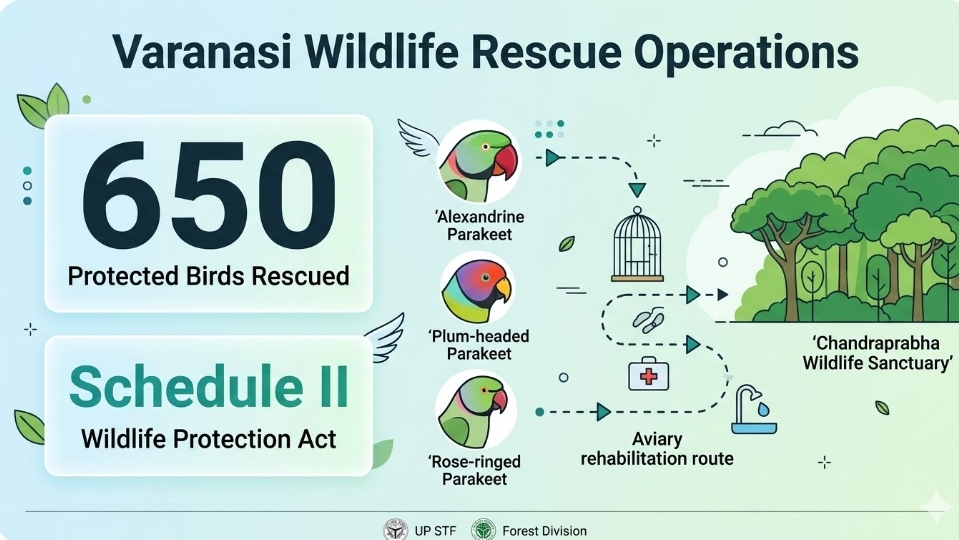
The seized consignment comprised several ecologically sensitive species protected under Schedule II of the Wildlife Protection Act 1972, including 50 highly valuable Alexandrine parakeets, 450 plum-headed parakeets, and 150 rose-ringed parakeets. Initial veterinary assessments conducted immediately after the seizure revealed that the birds were subjected to severe physical trauma, showing advanced dehydration and self-inflicted feather damage due to the cramped transport conditions. The rapid deployment represents one of the largest coordinated urban wildlife rescues executed in the region this year, dealing a significant operational blow to the commercial supply networks running through eastern Uttar Pradesh.
Smuggling corridors, irreversible physical harm, and clinical interventions
Intelligence gathered by regional forest protection units indicates that the intercepted shipment was intended for fragmented distribution across major metropolitan hubs, including Lucknow, Kanpur, and Delhi. The traffickers utilised public transport logistics, hiding the specialised transport cages beneath commercial agricultural produce to misdirect checkpoint inspectors. This operational method highlights an increasing trend where wildlife syndicates exploit high-volume transit routes to bypass regional forest checkpoints. The Varanasi Forest Division has initiated rigorous legal proceedings under the stringent penal provisions of the Wildlife Protection Act, filing formal complaints to block bail opportunities for the repeat offenders. Forensic teams have also been deployed to trace the financial trails of the syndicate, analysing digital payment logs found on the seized mobile devices to map out the secondary urban buyers orchestrating the domestic trade from luxury residential sectors.
The physical harm already inflicted upon the avian population is extensive and, in some cases, irreversible. To prevent the birds from crying out and alerting authorities at transit checkpoints, the poachers brutally clipped the flight feathers of the mature parakeets and crammed up to 40 unhatched chicks and fledglings into individual tiny cardboard modules, causing severe respiratory distress. Senior Veterinary Officer attached to the Varanasi Forest Division Dr Rajesh Kumar detailed the extensive trauma, stating that "the birds were packed so tightly that many suffered from muscle atrophy and wing fractures, whilst the lack of ventilation led to acute hyperthermia." He explained that "our immediate priority was stabilising the birds through intensive rehydration therapies and specialised nutrition feeds, and whilst more than 80pc of the parakeets have responded exceptionally well to our clinical interventions, they must remain under strict observation to minimise the risk of stress-induced mortality."
The rehabilitation pathway and long-term release protocols
Regarding what will happen to the birds now, the legal and clinical pathways dictate a meticulous, multi-stage rehabilitation programme. Following an explicit directive from the Varanasi Chief Judicial Magistrate, the rescued parakeets have been moved to a secure, undisclosed holding facility managed by the forest department to prevent any retaliatory theft by local poachers. The birds are currently being housed in large outdoor aviary enclosures where they can stretch their wings and slowly rebuild their flight muscles. For the fledglings whose flight feathers were completely hacked off by the traffickers, the recovery process will take anywhere from six months to a year, as they must undergo a complete natural moulting cycle before they can fly efficiently. Once the veterinary team certifies that the flock is entirely disease-free and structurally sound, the forest division will orchestrate a soft-release protocol, gradually introducing the birds back into the protected canopy zones of the Chandraprabha Wildlife Sanctuary.
Drawing from his extensive historical tracking of poaching networks across the state, prominent wildlife enforcement expert Dr Aravind Chaturvedi observed that "seizures of this magnitude show that illegal wildlife trade functions like a structured corporate enterprise rather than a loose ring of local poachers". He strongly emphasised that "to permanently disable these syndicates, state administrations must pair strict enforcement at transit corridors with aggressive public education programmes that actively criminalise the possession of protected native birds as household pets, because as long as urban households purchase these animals, poachers will continue to devastate our natural forest ecosystems." Supporting this perspective, Co-founder and Chief Executive Officer of Wildlife SOS Kartick Satyanarayan noted that "combating the supply side requires immediate infrastructure developments at local checkposts, ensuring field agents are equipped with real-time biometric profiling to identify protected species instantly."
Editor's Note
The successful rescue of 650 protected birds in Varanasi exposes the persistent vulnerability of India's native avian biodiversity to structured interstate smuggling networks. While the proactive coordination between the Special Task Force and regional forest divisions deserves praise, relying on reactive transit seizures cannot permanently eliminate illegal wildlife economies. True prevention requires a systematic expansion of field intelligence at the precise nesting and wetland habitats where poaching occurs. Furthermore, judicial authorities must enforce the maximum statutory penalties against habitual traffickers to build a credible deterrent, ensuring that the legal frameworks protecting endangered species are actively felt across all regional borders.



Leave a comment