

TreeTake Network
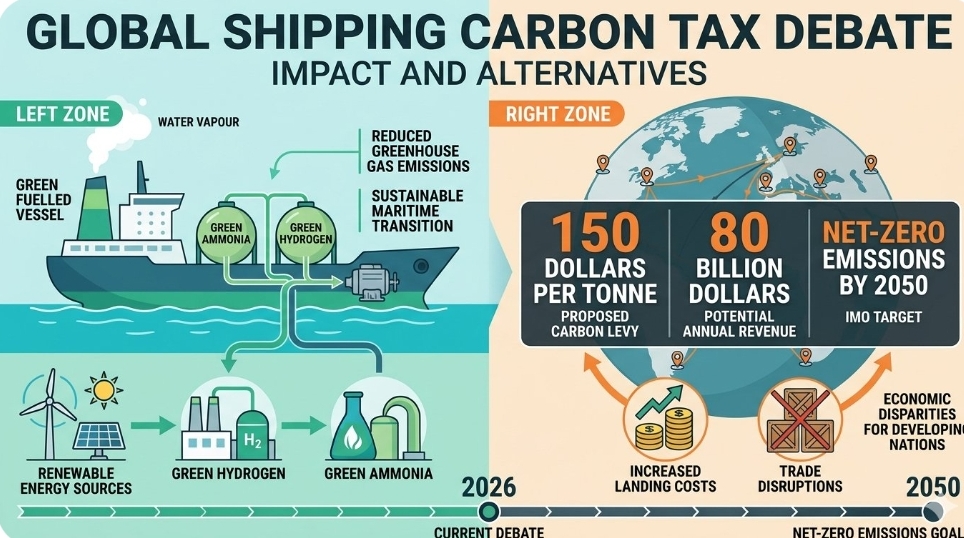
Negotiations at the International Maritime Organisation headquarters in London have reached a critical juncture on November 22, 2026, as member states prepare for a historic vote on a universal carbon levy for the global maritime sector. India has emerged as the definitive swing vote in a deeply divided assembly, leading a powerful coalition of developing nations that strongly opposes a flat global emission tax. The proposed universal levy, heavily championed by the European Union and several climate-vulnerable Pacific island nations, aims to impose a fixed price per tonne of carbon dioxide equivalent on marine fuels to accelerate zero-emission transitions. India's Ministry of Ports, Shipping and Waterways has countered this framework, arguing that an unmitigated global tax would disproportionately penalise developing economies, disrupt international trade corridors, and increase landing costs for essential commodities across the Global South.
The maritime sector currently accounts for approximately three per cent of global greenhouse gas emissions, a figure projected to rise exponentially if left unchecked. While the International Maritime Organisation has set a formal target to achieve net-zero emissions by or around 2050, the mechanisms to fund and enforce this transition remain fiercely contested. The draft resolution currently under review suggests an initial levy of 150 dollars per tonne of carbon, which proponents argue could raise upwards of 80 billion dollars annually. The distribution of these massive revenues has become the primary source of diplomatic friction, with developing states demanding that funds be directly reinvested into domestic port modernisation and green fuel infrastructure rather than a centralised global fund.
The economic impact and regional trade priorities
The financial implications for India’s extensive shipping infrastructure are profound, given that more than 90pc of the nation's trade by volume moves via maritime routes. New Delhi's alternative proposal introduces a differentiated levying system that features an initial grace period for vessels flying flags of developing states, alongside a mandatory mechanism to subsidise the production of green ammonia and green hydrogen within national boundaries. Without these socioeconomic safeguards, Indian trade analysts warn that a sudden shipping tax could spark inflationary pressures on critical imports, including crude oil, fertilisers, and coal, which form the bedrock of regional economic stability.
Furthermore, Indian negotiators have pointed out that the domestic shipping industry is already heavily invested in its own green transition frameworks under the Maritime Amrit Kaal Vision 2047. This existing national programme mandates that major Indian ports source at least 60pc of their electricity from renewable energy loops by 2030, rising to 90pc by 2047. Imposing an additional global tax infrastructure without acknowledging these substantial sovereign capital deployments is viewed by New Delhi as an unfair regulatory duplication that penalises proactive developing economies.
Authoritative institutional and diplomatic statements
The diplomatic rhetoric inside the London plenary has intensified, with representatives from diverse economic blocs outlining their unyielding positions on maritime decarbonisation.
"We cannot accept a regressive tax model that penalises long-distance trade routes and weakens the competitive capabilities of emerging industrial nations," stated TK Ramachandran, Secretary of the Union Ministry of Ports, Shipping and Waterways. "Any global carbon pricing system must explicitly recognise common but differentiated responsibilities, ensuring that collected revenues are directly returned to developing states to build local green bunkering networks."
Conversely, representatives from European maritime authorities argue that a fragmented, multi-tiered taxing system will fail to drive the urgent commercial shifts required by global climate science to regularise the shipping sector.
"The time for transitional exemptions has passed if we are to prevent catastrophic warming," emphasised Arsenio Dominguez, Secretary-General of the International Maritime Organisation. "A unified, predictable global price on maritime carbon is the only mechanism that provides the absolute investment clarity required for shipbuilders to abandon heavy fuel oil completely."
Providing an independent economic assessment of the ongoing dispute, international maritime researchers have highlighted the scale of funding required to transform the sector without collapsing global supply lines.
"The core of this impasse is not about climate ambition, but about economic survival and industrial equity," observed Johannah Christensen, Chief Executive Officer of the Global Maritime Forum. "India’s stance reflects a justifiable concern that without legally guaranteed revenue recycling, a global levy could simply drain capital from the countries that need it most to finance their own green infrastructure transitions."
Adding weight to the concerns of developing markets, maritime logistics specialists warn that the immediate introduction of penalties will cause severe distortions in cargo distributions.
"A flat taxation scheme implemented prematurely will destabilise small-scale fleet operations across Asia," argued Simon Bennett, Deputy Secretary-General of the International Chamber of Shipping. "We must prioritise the availability of zero-carbon fuels at commercial scale before penalising shipowners for utilising the only energy sources currently accessible to them."
Emphasising the voice of small island developing states that are highly vulnerable to both rising tides and increased import costs, regional diplomats urged a balanced structural compromise.
"We face an existential crisis from rising sea levels, but we are also trapped by the exorbitant cost of imported goods," stated Albon Ishoda, the Marshall Islands Ambassador to the International Maritime Organisation. "The final text must compel major industrial fleets to pay for their historical emissions while subsidising the transition for smaller maritime networks."
Editor's Note
India's strategic resistance against a flat international shipping tax is a necessary defence of economic equity in the global climate transition. While the decarbonisation of maritime shipping is non-negotiable, a uniform global levy failing to account for regional baseline disparities is fundamentally flawed. If implemented without robust revenue-sharing mechanisms, such a tax will act as an unintended trade barrier, raising prices for consumer goods in developing countries while wealthier nations easily subsidise their green fleets. The International Maritime Organisation must adopt India’s model of differentiated implementation, using a phased tax approach that rewards early domestic investments in green hydrogen and ammonia, ensuring the path to net-zero shipping does not leave the Global South to carry an unfair financial burden.



Leave a comment