

TreeTake Network
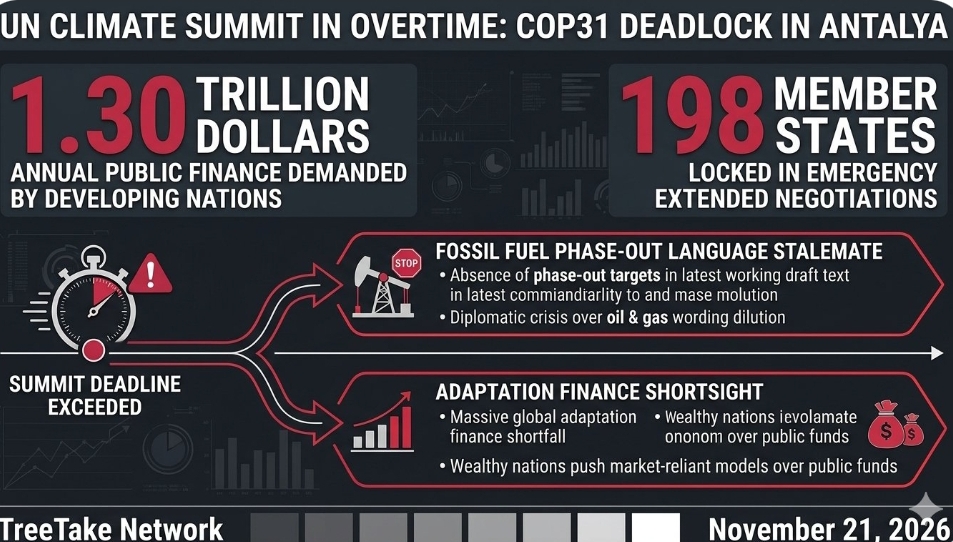
The United Nations Climate Change Conference COP31 in Antalya has officially plunged into emergency weekend negotiations on November 21, 2026, after the high-level implementation teams blew past the final administrative deadline without a global consensus. Delegations from 198 member states remain locked inside closed-door plenary sessions as deep operational rifts persist between the G77 coalition of developing nations and major industrialised economic blocs. The primary deadlocks centre on the stark absence of explicit fossil fuel phase-out targets in the latest working draft text and a massive shortfall in committed global adaptation finance, threatening a total collapse of the high-stakes international climate summit.
Severe Financing Fractures Block Global Mitigation Progress
The financial architecture of the proposed Antalya Pact has emerged as the single most volatile point of contention on the negotiating floor. Developing countries, led by a unified African and Small Island States negotiating bloc, have collectively demanded an annual baseline of 1.30 trillion dollars in public climate financing to build resilience against escalating climate anomalies. Conversely, wealthy industrialised nations have refused to commit to specific public-treasury targets, pushing instead for a heavily market-reliant model that utilises private-sector investment instruments and multilateral development bank leverage mechanisms, a framework that recipient nations argue lacks structural accountability.
"We cannot and will not sign onto an ambiguous text that shifts the historical burden of climate financing away from public accountability and onto volatile global financial markets," stated Dr Driss Yazidi, Lead Negotiator for the G77 Coalition. "The current draft completely dilutes the foundational principle of common but differentiated responsibilities. Developing nations are facing immediate, existential multi-district ecological crises right now, and without a legally binding, public-funded baseline of 1.30 trillion dollars annually, any global implementation framework remains entirely non-functional."
De-Escalation of Fossil Fuel Text Sparks Environmental Outrage
Beyond the structural financing deadlocks, a profound diplomatic crisis has erupted over the specific text governing the transition away from fossil fuels. Civil society observers and progressive state coalitions confirmed that the latest compromise draft systematically removed the terms phase-out and phase-down regarding oil and gas extraction, replacing them with generic phrases emphasising the expansion of low-emission technologies. This language dilution has provoked fierce pushback from high-ambition negotiating blocs, who accuse petro-states and large global energy consumers of actively engineering a historic regression from agreements established at previous summits.
"The latest text is a dangerous step backwards that threatens to undermine years of international climate diplomacy," remarked Dr Inger Andersen, Executive Director of the United Nations Environment Programme. "We cannot realistically keep global warming thresholds within safe parameters through vague promises of low-emission technologies that lack strict timelines. Antalya must deliver a clear, uncompromised, and legally binding operational roadmap for the systematic phase-out of all fossil fuels if we are to prevent irreversible terrestrial and oceanic system tipping points."
Emergency Bureau Meetings Seek Diplomatic Breakthroughs
As the clock ticks deeper into overtime, the COP31 Presidency has initiated a series of restricted, small-group bureau meetings to broker a compromise on the remaining clean energy transport corridors and adaptation targets. Negotiators are frantically working on parallel text revisions that link increased climate adaptation funds to more transparent national emission tracking networks, though observers caution that a comprehensive breakthrough remains highly elusive before the late evening sessions. Administrative wings confirmed that all institutional logistics, security deployments, and translation infrastructure across the Antalya venue have been formally extended through Sunday morning to accommodate the prolonged diplomatic stalemate.
"We are pushing all negotiating parties to move past fixed national positions and find a common, ambitious pathway forward," stated Prof Yalçın ER, Senior Climate Policy Advisor to the COP31 Presidency. "The world is watching, and the widening gaps between industrialised capability and developing-state vulnerability must be bridged immediately. While the structural divisions over the financing language are deeply entrenched, we are exploring unique blended finance mechanisms that could provide the verified accountability recipient nations need to safely sign the final declaration."
Editor's Note
The emergency overtime stalemate at COP31 in Antalya exposes a fundamental systemic defect in the current consensus-driven global climate governance framework. As planetary warming anomalies worsen, the international community continues to allow short-term economic protectionism and fossil-fuel lobbying to systematically dilute the scientific imperatives of the Paris Agreement. The strategic way forward must involve a transition away from broad, non-binding global declarations and toward targeted, multilateral climate clubs and enforceable trade-tariff frameworks that penalise carbon-intensive state economies. Only by attaching real-world economic penalties to environmental inaction can global systems break the recurring cycle of diplomatic deadlocks and drive real-time industrial decarbonisation.



Leave a comment