

TreeTake Network
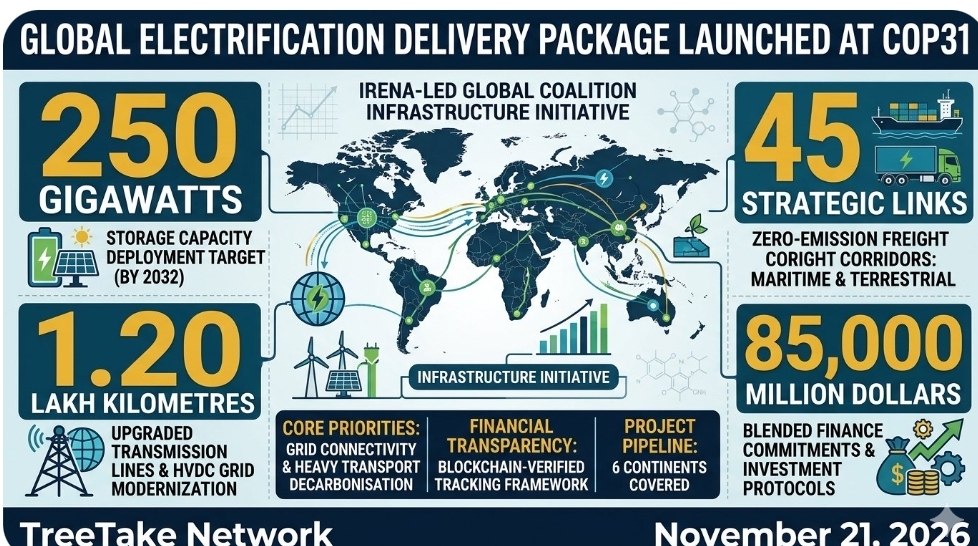
The International Renewable Energy Agency, in alliance with a high-level coalition of multilateral development banks and clean energy state groups, formally launched the Electrification Delivery Package on November 21, 2026. Unveiled during the high-stakes ministerial sessions at the COP31 summit in Antalya, this massive institutional framework aims to coordinate global investments to fast-track clean power generation, expand regional infrastructure storage, and deploy zero-emission freight corridors across six continents. The landmark package represents a vital pivot away from generic green energy pledges, establishing a highly structured pipeline designed to turn financial commitments into immediate, physical decarbonisation assets.
High-Voltage Transmission Infrastructure and Storage Targets
The technological backbone of the newly minted package addresses the critical global deficit in grid connectivity and power-grid storage capacity. Operational frameworks managed under this initiative have established a hard global target to deploy over 250 gigawatts of storage capacity alongside 1.20 lakh kilometres of upgraded high-voltage direct current cross-border transmission lines by 2032. Financial syndicates backing the programme have agreed to utilise structured guarantee mechanisms to lower capital costs for grid modernisation across low-income regions, ensuring that expanding clean energy installations do not trigger regional distribution collapses.
"The greatest bottleneck to global decarbonisation is no longer clean generation capacity, but the chronic underfunding of our transmission grids," stated Francesco La Camera, Director-General of the International Renewable Energy Agency. "The Electrification Delivery Package systematically targets this structural vulnerability. By pooling resources from 14 multilateral institutions, we are establishing a verified investment protocol that will build the high-voltage grids and grid-scale battery networks needed to safely transport solar and wind power across vast transcontinental corridors."
Zero-Emission Freight Corridors and Heavy Transit Links
A major operational priority of the delivery package involves the immediate creation of international zero-emission freight corridors designed to eliminate heavy transport emissions. The initial phase of this deployment has locked in funding for 45 strategic maritime and terrestrial trade links, connecting high-intensity manufacturing hubs directly with major container ports. The framework mandates the parallel installation of megawatt charging grids and liquid hydrogen refuelling infrastructure along major highways across Europe, North America, Asia, and Africa, allowing logistics corporations to rapidly transition away from heavy-duty diesel engines.
"Our maritime and overland heavy freight networks have long been considered hard-to-abate sectors due to the extreme energy density required for long-distance transit," reported Kadri Simson, European Commissioner for Energy. "This package provides a concrete, multi-billion-dollar framework to physically construct clean fueling nodes along our busiest economic arteries. By synchronising the roll-out of high-capacity charging networks across six continents simultaneously, we are providing global logistics firms the absolute operational certainty they need to retire their carbon-heavy fleets."
Financial Syndication and Accountability Protocols
The initial capital mobilisation for the package has successfully pooled 85,000 million dollars in blended finance commitments, combining public development funds with private institutional capital. To ensure absolute transparency and guarantee that these funds are not diverted, the coalition has integrated a real-time blockchain-verified tracking framework that monitors project milestones from initial site acquisition to final grid synchronisation. State representatives realigning their development models under the initiative noted that projects failing to meet strict environmental and local biodiversity protection parameters will see their funding lines automatically frozen by the central compliance wing.
"This is not a traditional climate pledge; it is an active, legally binding infrastructure development contract," stated Dr Ajay Mathur, Director General of the International Solar Alliance. "We have established rigorous technical and social safeguards to guarantee that grid expansions do not infringe on critical terrestrial ecosystems. This package systematically breaks down the bureaucratic barriers that have historically delayed clean energy projects, allowing fast-tracked procurement cycles while maintaining absolute financial and environmental accountability across every single multi-district deployment."
Editor's Note
The launch of the Electrification Delivery Package marks a crucial transition from abstract climate targets to tangible, coordinated infrastructure engineering. By focusing directly on the twin bottlenecks of grid connectivity and heavy transport infrastructure, the international coalition is tackling the structural barriers that have long limited the impact of the clean energy transition. The strategic way forward must now focus on building a specialised domestic workforce within developing nations to manage and maintain these complex, high-voltage networks. Ensuring localised technical self-sufficiency will be vital to making these trans-continental green corridors resilient against future geopolitical supply chain disruptions.



Leave a comment