

TreeTake Network
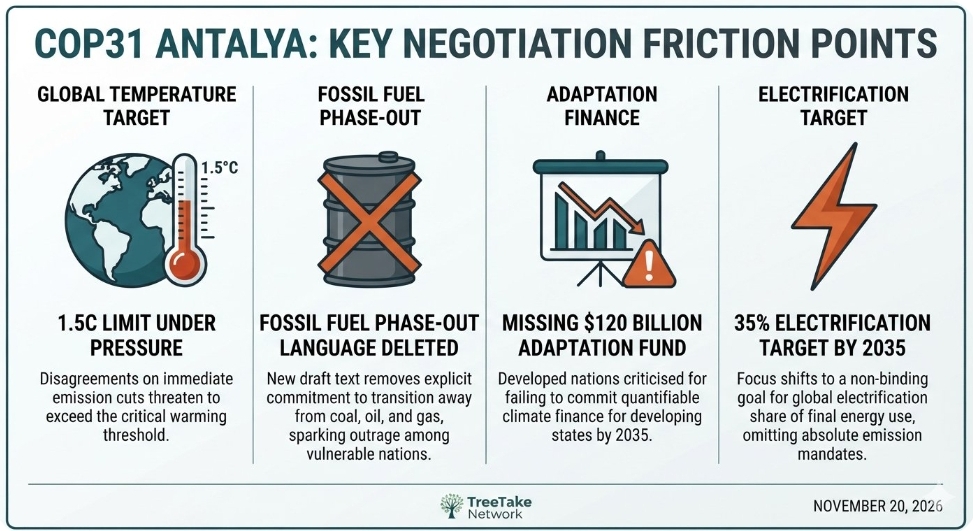
The 31st United Nations Climate Change Conference, COP31, being held in the resort city of Antalya, Türkiye, has descended into intense geopolitical friction during its scheduled final hours on November 20, 2026. Delegates and environmental observers expressed deep outrage following the afternoon release of the second official draft of the key political agreement—known as the cover decision—which completely dropped all explicit commitments to phase out or move away from coal, oil, and gas. The drastic alteration represents a sharp reversal from the initial 18-page text circulated on November 16, 2026, which had explicitly structured accelerated goals for reducing global dependency on fossil fuels. Instead, the newly modernised text focuses heavily on clean energy infrastructure and global electrification. It introduces an ambitious push to raise electricity’s share of global final energy consumption to 35 per cent by 2035, heavily supporting the host nation's proposed 35 by 35 green campaign.
Deepening Standoff Over Adaptation Finance and Target Deletions
Negotiation tracks covering finance, adaptation, and just transitions remain severely stalled as the summit pushes past its diplomatic deadlines. Beyond the omission of fossil fuel language, the revised text completely deleted a previously proposed 120 billion dollar annual adaptation finance target intended for developing nations by 2035. While the document retains a vague, non-binding reaffirmation to triple adaptation funding by 2035, it leaves the definitive methodology for calculating and sourcing that capital entirely unresolved. Wealthy nations face fierce criticism from developing states and civil society organisations for systematically blocking quantifiable funding commitments required to facilitate an equitable economic transition.
The structural text shifts have sparked immense pushback from vulnerable nations and international coalitions. Representatives from small island states and African alliances have openly declared that they will not endorse a final declaration that strips survival mechanisms in favour of administrative workshops. Concurrently, prominent health advocates expressed profound disappointment that the broad political declaration on a healthy transition—spearheaded by Spain and France—retained only six state signatories by late afternoon on November 17, 2026, despite explicitly linking fossil fuel emissions to millions of preventable global deaths annually.
Global Perspectives and Contested Diplomatic Mandates
Frustration spilt into the main plenary halls as world leaders and negotiators traded public barbs over the watering down of historical climate goals. Activists have labelled the current iteration a ghost summit that threatens to entirely unpick the hard-fought global progress achieved at previous UN climate conferences.
"Our message to rich countries is simple: stop blocking," stated Harjeet Singh, a prominent global climate advocate monitoring the final negotiation rounds in Antalya. "Put real money on the table for adaptation, for loss and damage, and for developing countries to move away from fossil fuels. You caused this crisis. The draft text presented erases fossil fuels, deletes the money, and buries the just transition".
The host country defended the structured changes by emphasising that practical actions, such as rapid electrification, naturally imply an economic shift away from carbon-heavy power sources without needing restrictive semantic labels.
"We are not here to discuss decisions at previous COPs," stated Murat Kurum, the COP31 President and Türkiye's Minister of Environment, following a late-night Divan ministerial assembly. He argued that keeping the critical 1.5 degrees Celsius planetary warming threshold within reach remains the ultimate structural goal, even while recognising that different sovereign countries must take varied operational pathways and specific domestic solutions to manage emissions.
Editor's Note: The erasure of explicit fossil fuel targets from the COP31 draft text exposes a severe systemic fragmentation in global climate governance, demonstrating that economic self-interest still supersedes collective environmental survival. By deleting quantifiable adaptation finance figures and swapping out absolute emission reduction mandates for generalised electrification targets, developed economies are effectively offloading the systemic risks of climate overshoot onto the world’s most vulnerable populations. The way forward requires developing blocs to form an unyielding negotiating coalition that rejects compromised texts, forcing a structural deadlock until wealthy historical polluters commit to a legally binding, multi-billion-dollar financial mechanism that ensures an accountable and funded transition away from coal, oil, and gas.



Leave a comment