

TreeTake Network
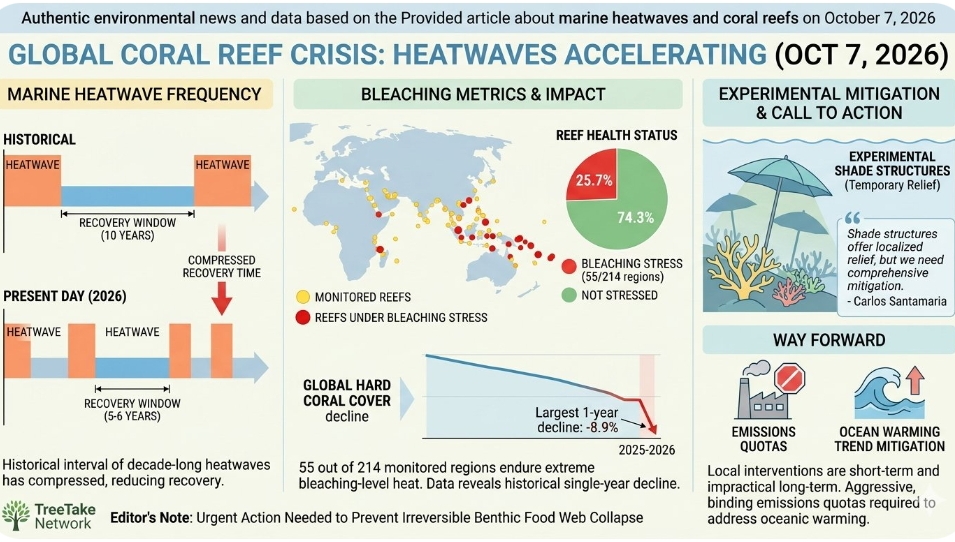
Escalating thermal anomalies across the globe have severely compromised the structural resilience of fragile aquatic ecosystems, leaving baseline habitats vulnerable to unprecedented degradation. The Global Coral Reef Monitoring Network published an extensive field review confirming that a succession of marine heatwaves over the past three decades has destroyed at least 9.5 per cent of the world's corals. This progressive frequency compression has systematically undermined the biological capacity of reef-building corals to rebuild their skeletal matrix between severe warming episodes.
Global heat saturation and benthic degradation metrics
The latest spatial telemetry recorded across international marine sanctuaries points to a catastrophic drop in live coral coverage following consecutive seasonal thermal stresses. Data metrics indicate that increasingly frequent and severe underwater heat threatens global reef structures, with projections showing that seventy to ninety per cent of reef-building corals are expected to die at 1.5 degrees Celsius of warming. Scientific assessments warn that different regional trajectories are emerging as marine heatwaves progressively reduce the time available for reefs to rebuild between disturbances. Marine experts tracking these contrasting global pathways note that while some regional rebounds provide small signs of hope, there are few reasons for complacency as to the increases in stresses over the coming decades.
Short-term interventions and administrative gaps
As baseline conditions continue to worsen, coastal populations living near coral reefs have increased significantly, driving local stressors such as overfishing, pollution, and coastal development that degrade water quality. Local conservation bodies are highlighting the urgent need to act both locally and globally to safeguard what remains of the marine ecosystem. Environmental researchers tracking the crisis emphasize that saving reefs means action on multiple fronts, including cutting fossil fuel use and reducing local stressors so that reefs do not lose their natural resilience. They argue that comprehensive preservation requires absolute mitigation of ocean warming trends rather than relying solely on temporary regional defensive measures.
Editor's Note: The escalating collapse of global coral recovery windows reveals that current maritime protection strategies are severely lagging behind actual environmental breakdown. Moving forward, international bodies must move past localised mitigation projects and enact aggressive, legally binding emissions quotas to address fundamental oceanic warming. The brief analysis suggests that if the current accelerated heatwave cycle becomes permanently institutionalised, the structural collapse of benthic food webs will become entirely irreversible, permanently altering global marine biodiversity.



Leave a comment