

TreeTake Network
The escalating friction between rapid industrial modernisation and environmental stabilisation has taken centre stage this week. As international delegations convene across various environmental summits, a pattern has emerged: physical infrastructure, computational computing networks, and consumer lifecycles are pushing global resources and municipal safety nets past their breaking points. From overheating metropolitan grids to collapsing high-altitude ecosystems, the sheer pace of climate shifts is forcing a fundamental rewrite of public and private environmental accountability guidelines.
Extreme heat anomalies disrupt regional economies
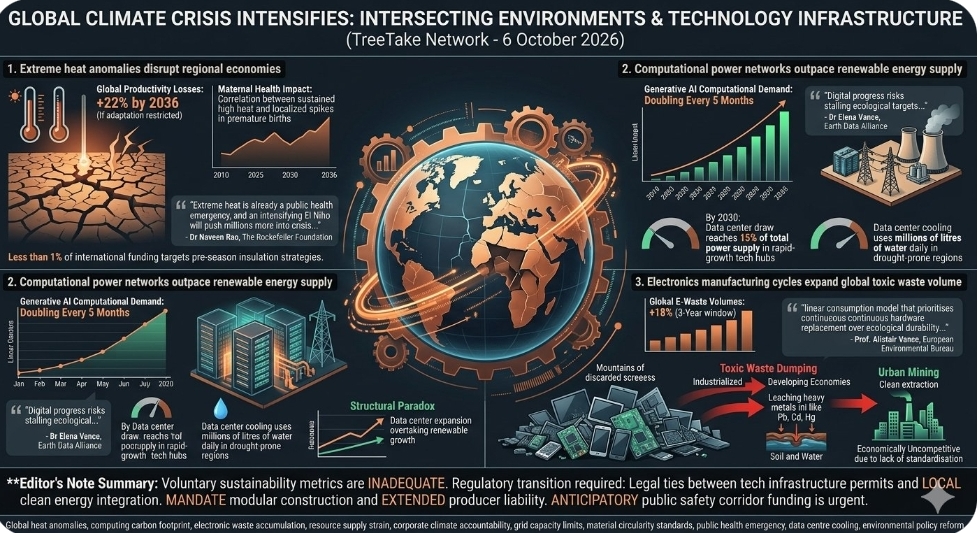
The inaugural Global Heat Forum commenced amidst severe localised weather disturbances, focusing attention on the compounding socio-economic vulnerabilities triggered by an expanding El Niño cycle. Analytical models finalised by financial panels indicate that global productivity losses directly linked to heat stress are on track to climb by 22 per cent over the coming decade if anticipatory adaptation capital remains restricted. Concurrently, public health data have identified a strong correlation between prolonged maternal heat exposure and localised spikes in premature births and neonatal complications within developing economies.
"Extreme heat is already a public health emergency, and an intensifying El Niño will push millions more into crisis, overwhelm local clinics, and erode the financial safety nets communities rely upon," emphasised Dr Naveen Rao, Senior Vice President of Health at The Rockefeller Foundation, during his opening address. Conference delegates strongly criticised international financing channels, pointing out that less than one per cent of global humanitarian funding is currently channelled toward proactive, pre-season insulation strategies.
Computational power networks outpace renewable energy supply
The environmental cost of digital innovation has emerged as a parallel flashpoint at climate talks, with data centre energy draw threatening to derail national carbon-reduction timetables. Power grid registries demonstrate that the computing infrastructure required to sustain next-generation generative intelligence systems is doubling every five months. By 2030, digital storage and processing hubs are projected to absorb up to 15 per cent of total domestic power supplies in rapid-growth technological corridors, forcing municipal grid operators to reactivate coal and gas reserves to prevent blackouts during peak load anomalies.
Beyond electrical capacity, the heavy reliance on liquid-cooling systems for high-density computer architectures is draining millions of litres of water daily from drought-susceptible agricultural water basins. "The computational hunger of modern software infrastructure is expanding faster than our ability to build clean energy grids, creating a structural paradox where digital progress risks stalling ecological targets," observed Dr Elena Vance, Director of Sustainable Infrastructure at the Earth Data Alliance.
Electronics manufacturing cycles expand global toxic waste volume
Compounding these resource strains is a historic peak in globally discarded technology, driven by shortened consumer hardware lifecycles and highly restrictive device maintenance frameworks. Global metrics show an 18 per cent jump in electronic waste volumes over a three-year window, with under 22 per cent processed through certified recycling grids. The remaining electronic volume is routinely routed to informal scrap markets or illegally moved across borders under the guise of second-hand retail, resulting in heavy metals like lead and cadmium leaching into agricultural soils and drinking water tables.
"We are dealing with a linear consumption model that prioritises continuous hardware replacement over ecological durability, shifting the toxic burden onto municipal infrastructure that cannot cope," realised Prof. Alistair Vance, Chair of Sustainable Material Lifecycle Research at the European Environmental Bureau. Panellists noted that while urban mining of gold, copper, and cobalt emits far fewer greenhouse gases than primary resource extraction, the lack of uniform international standardisation keeps recycled commodities economically uncompetitive.
Editor's Note: The integration of these distinct crises demonstrates that voluntary corporate sustainability metrics and reactive municipal governance are entirely inadequate against modern industrial scaling. Whether evaluating data centre energy quotas, product durability rules, or municipal thermal defences, passive oversight must be replaced by strict enforcement. Regulatory systems must legally tie technology infrastructure approval to the real-time installation of equivalent green power sources, mandate modular construction frameworks under extended producer liability laws, and funnel international funds into anticipatory public safety corridors. Material and structural neutrality must be verified at the local level before computing or industrial permits are granted, ensuring technical expansion does not permanently destabilise our ecosystems.



Leave a comment