

ABHISHEK DUBEY
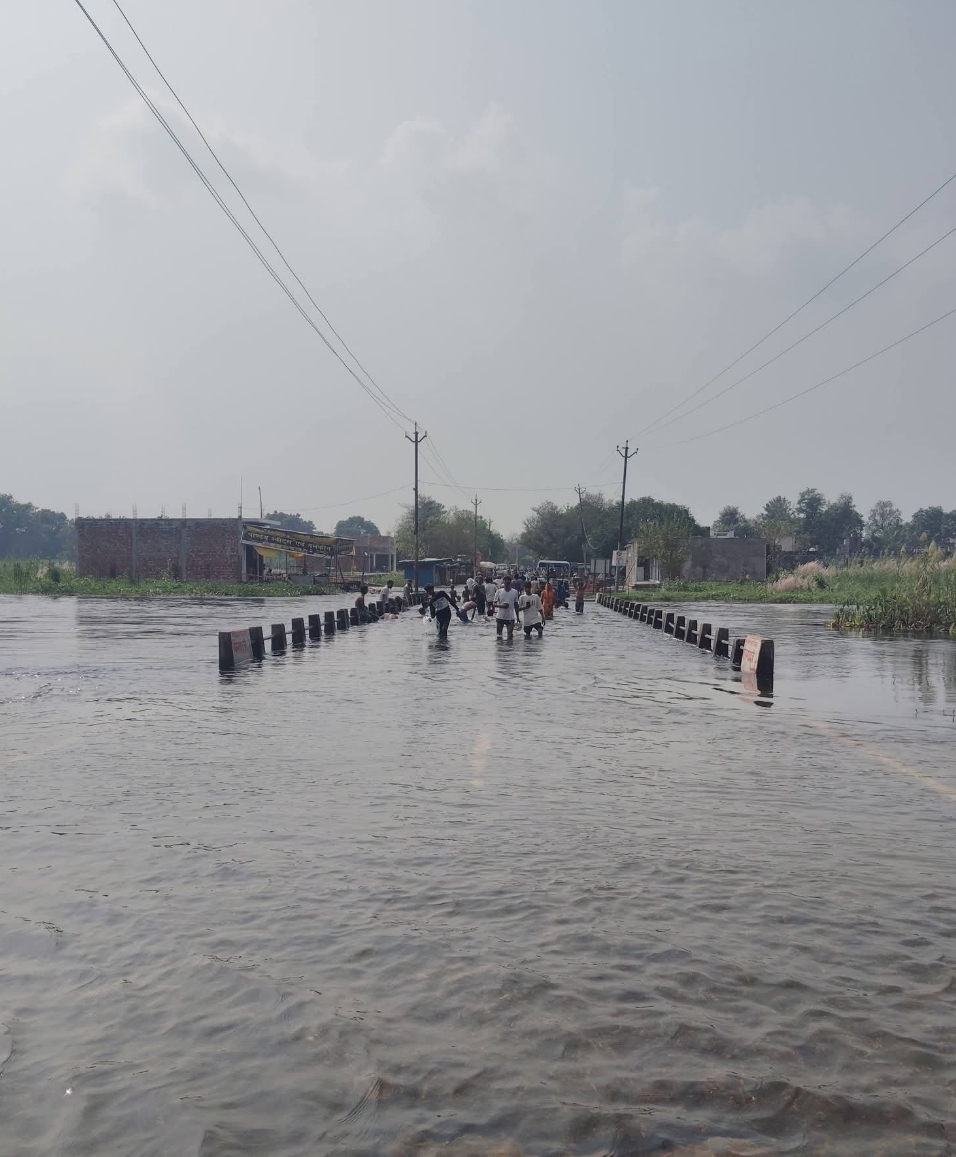
The water level at the Chandwatpur Ghat bridge (also locally referenced as Chandourpur Ghat) over the Tedhi River has remained critically high, flowing two feet above the bridge deck for the past 12 days. Local residents and structural experts point to illegal constructions within the river’s floodplains and surrounding ghat areas as the primary catalyst for the prolonged inundation, which has severely disrupted regional connectivity and compromised public safety.
Despite the escalating crisis, community leaders allege that administrative intervention has been entirely superficial. The Irrigation Department faces sharp criticism for its passive approach, relying solely on issuing paper notifications rather than executing physical demolitions or enforcing strict zoning regulations to clear the natural drainage pathway.
Recent Action and Official Statements
The local administration has stepped in to curb hazardous public movement on the submerged route. Gonda Additional District Magistrate (ADM) Pramod Jha officially directed the Additional Superintendent of Police to block all heavy and motorised vehicles from attempting to cross the bridge. Sadar Sub-Divisional Magistrate (SDM) Jitendra Kumar inspected the site directly, warning that public safety cannot be compromised. Law enforcement personnel have been deployed to monitor the banks, especially after local youths were documented performing highly dangerous stunts by clinging to moving car bumpers in the deep water.
While the Irrigation Department continues to monitor regional water flow levels, local leaders and former Katra Bazar MLA Baijnath Dubey have publicly pushed for a long-term resolution. They acknowledge that structural height correction and complete bridge reconstruction are the only permanent solutions to this recurring blockage.
Impact Assessment: Routes and Affected Villages
The flooding of the Tedhi River has paralysed key regional linkages, impacting approximately 40,000 to 50,000 local residents who rely daily on the Gonda-Katra Bazar road. Because this bridge serves as the singular economic artery connecting Gonda Sadar to the Katra Bazar marketplace, its closure has effectively stranded commuters and cut off direct market access. The situation is further aggravated by structural hazards, including damaged side railings, broken barriers, and deep 10-foot scour pits flanking both sides of the bridge approach.
The highly vulnerable low-lying and coastal villages currently experiencing agricultural waterlogging, fodder shortages, and severe transport disruptions include Dallapur, Naubasta, Garsar, and Durjanpur Ghat. The primary agricultural consequence has been severe, with hundreds of bighas of ready-to-harvest paddy crops currently submerged and rotting. The local administration has put area revenue officers (lekhpals) on high alert across these specific pockets to track ongoing crop damage and coordinate any necessary emergency evacuations.
Key Stakeholder Perspectives
A local resident stated that for nearly two weeks, their main transport route has been entirely submerged under two feet of rushing water. They expressed frustration that the government sits back and watches as illegal structures choke the river, offering nothing but endless administrative delays while daily lives remain completely paralysed.
A hydrology and civil engineering expert explained that when illegal masonry and embankments narrow a river's natural floodplain, its hydraulic capacity drops exponentially. They emphasised that a bridge remaining submerged for 12 days is an explicit structural hazard, and the Irrigation Department's reliance on mere administrative warnings instead of immediate physical clearance represents a systemic failure in disaster mitigation.
Core Highlights
- Critical Submergence: Floodwaters have sustained a height of two feet above the bridge level for almost a fortnight.
- Unregulated Encroachments: Unsanctioned building projects inside the flood zones are actively blocking the river's natural flow.
- Regulatory Inaction: The Irrigation Department has limited its response strictly to issuing bureaucratic notices without enforcing ground-level clearances.



Leave a comment