

TreeTake Network
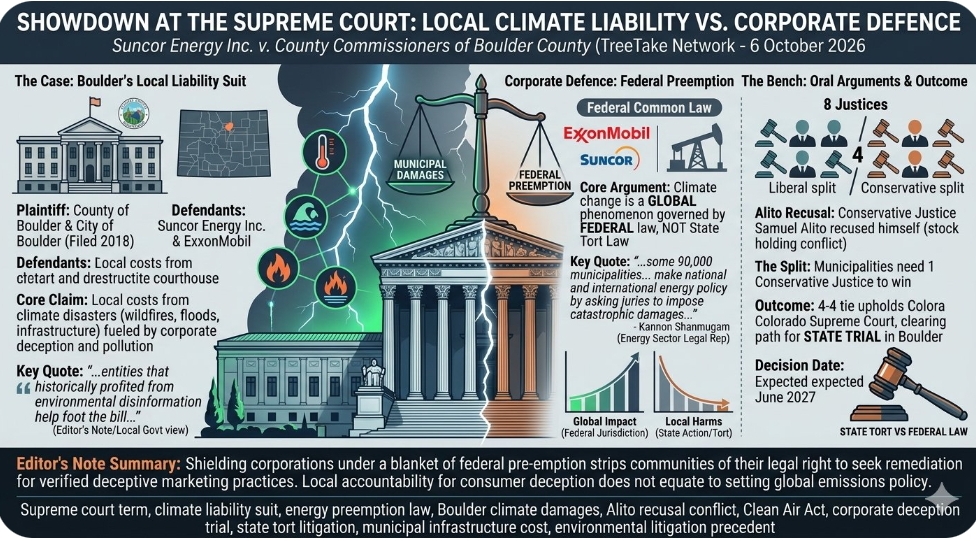
The United States Supreme Court opened its highly anticipated nine-month term yesterday by diving straight into a multi-billion-dollar legal showdown that could determine the future of climate change litigation across America. The eight participating justices spent nearly two hours listening to arguments in Suncor Energy Inc. v. County Commissioners of Boulder County, a case that energy sector representatives are openly hoping will deal a total death blow to state-level climate accountability efforts.
The protracted legal battle stems from a lawsuit filed in 2018, in which the city and county of Boulder, Colorado, sued US-based ExxonMobil and Canada-based Suncor Energy in state court. The municipalities contend that the fossil-fuel giants knowingly deceived the public for decades regarding the destructive environmental consequences of burning oil and gas. Boulder is seeking significant monetary damages to offset skyrocketing taxpayer costs for local climate adaptation, including wildfire management, emergency infrastructure repairs, and flash flood defences.
"If Boulder's claims are allowed to go forward, some 90,000 municipalities across the country will have the ability to make national and international energy policy by asking juries to impose catastrophic damages on selected fossil-fuel producers," argued Kannon Shanmugam, the lead legal representative for the energy corporations. The companies, vigorously backed by a supporting brief from the administration, argue that climate change is a global phenomenon governed strictly by federal common law and the Clean Air Act, meaning individual state courts possess no authority to adjudicate these claims.
The questioning from the bench split along intricate structural lines, yielding mixed signals from both liberal and conservative wings. Significantly, conservative Justice Samuel Alito recused himself from the proceedings due to personal stock holdings in various energy enterprises. This leaves an eight-justice bench, meaning the municipalities only need to convince one conservative member to secure a victory. If the court splits in a four-to-four deadlock, the previous ruling by the Colorado Supreme Court will remain intact, clearing a path for Boulder’s case to finally proceed to a localised state trial.
Editor's Note: The Supreme Court proceedings lay bare a critical constitutional debate over where the financial burden of ecological decay should fall. While the energy sector attempts to frame state tort actions as an unconstitutional overreach into international diplomacy, local governments are facing the immediate, localised check-writing realities of climate disasters. Shielding corporations under a blanket of federal pre-emption strips communities of their legal right to seek remediation for verified deceptive marketing practices. Moving forward, the judiciary must recognise that state-level accountability for consumer deception does not equate to setting global emissions policy. True justice requires allowing local courts to hear these cases, ensuring that entities that historically profited from environmental disinformation help foot the bill for structural survival.



Leave a comment