

TreeTake Network
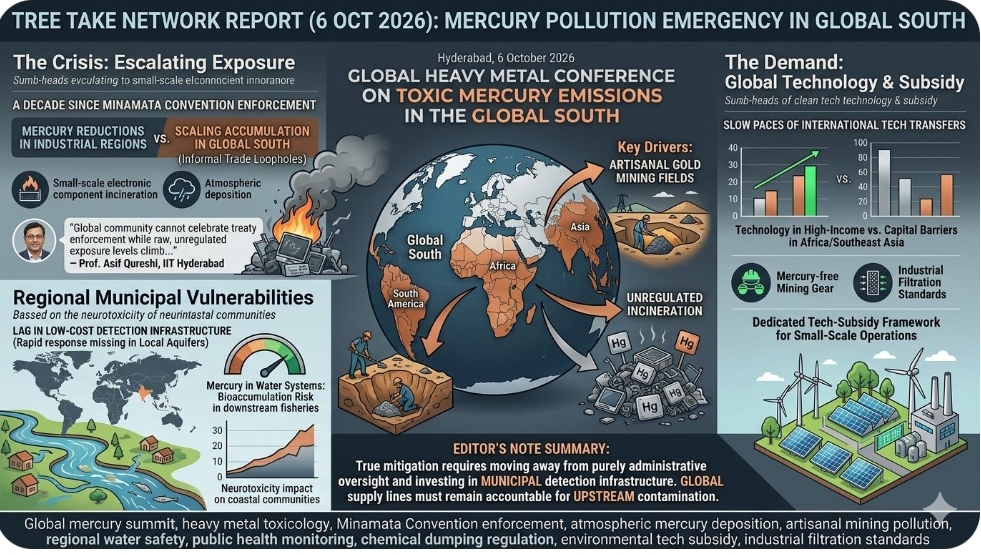
The 17th International Conference on Mercury as a Global Pollutant officially opened today in Hyderabad, bringing together world-class environmental scientists, toxicologists, and policy delegates to map out next-generation elimination metrics. Marking the first time this global assembly has ever convened within the Global South, the five-day summit arrives at a critical milestone as signatory nations celebrate a decade since the enforcement of the Minamata Convention on Mercury.
Scientific papers legalised during the initial plenary tracking panels reveal that despite significant reductions in industrialised regions, mercury accumulation remains an escalating public health crisis across developing trade corridors. Environmental monitoring networks highlighted a severe surge in atmospheric mercury deposition across artisanal gold mining fields and unregulated small-scale electronic component incineration sites. This toxic heavy metal bioaccumulates rapidly within local river systems, posing severe neurological risks to coastal and agricultural communities relying on downstream fisheries.
"The global community cannot celebrate ten years of treaty enforcement while the raw, unregulated exposure levels in the Global South continue to climb through informal trade loopholes," stated Prof. Asif Qureshi, Executive Committee Chair and Civil Engineering Professor at IIT Hyderabad, during his opening address. He emphasised that while traditional industrial tracking exists, regional municipal bodies lack the rapid, low-cost detection infrastructure needed to catch illegal chemical dumping before it reaches localised aquifers.
Delegates at the conference heavily criticised the slow pace of international technology transfers. Although safer, mercury-free mining alternatives and industrial filtering techniques have been standardised in high-income countries, high capital costs have prevented wide-scale deployment across sub-Saharan Africa and Southeast Asia. Representatives from several regional public health ministries urged international finance funds to establish a dedicated tech-subsidy framework to standardise safer extraction gear for small-scale operations.
Editor's Note: The discussions at the mercury summit expose a widening gap between global environmental treaties and ground-level infrastructure realities. Passing international bans does little to safeguard public health if the economic drivers of illegal chemical usage are not directly addressed. Moving forward, environmental agencies must move away from purely administrative oversight and invest directly in municipal detection infrastructure. True heavy-metal mitigation requires establishing international technology transfer pipelines that subsidise mercury-free processing tools for vulnerable workers. Global supply lines must remain accountable for upstream contamination, ensuring that resource extraction does not permanently poison local food and water security.



Leave a comment