

TreeTake Network
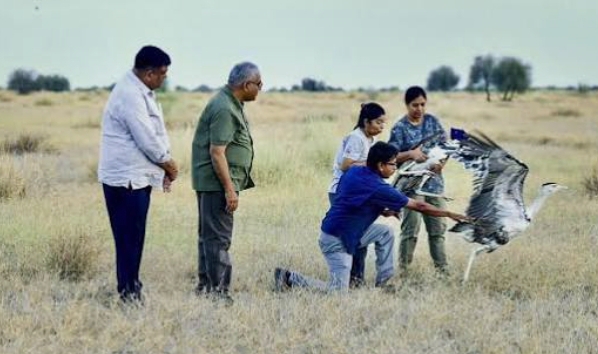
The Ministry of Environment, Forest and Climate Change has successfully released two captive-bred male Great Indian Bustards into the wild at the Desert National Park in Rajasthan. This operation marks the first definitive phase of rewilding for the critically endangered species, which has teetered on the brink of extinction for over a decade. The birds, reared under intensive conservation breeding protocols, are equipped with satellite transmitters to monitor their integration into the remaining wild flocks navigating the Thar Desert.
Data finalised by wildlife biology teams indicate that the wild population of the Great Indian Bustard has collapsed to fewer than 150 individuals globally, with the vast majority concentrated in the grasslands of Rajasthan. The primary driver of this demographic crisis remains habitat fragmentation compounded by high-voltage overhead power transmission lines, which cause fatal collisions due to the bird's limited frontal vision. Furthermore, new ecological metrics reveal a troubling decline in traditional grassland habitats, as agricultural expansion and industrial land allocation alter the semi-arid nesting grounds required for successful seasonal breeding.
"This milestone is the outcome of nearly a decade of unwavering dedication by our scientists, researchers, and ground staff to help the Great Indian Bustard reclaim its native habitat," stated Union Environment Minister Bhupender Yadav during the official release briefing. He emphasised that whilst captive hatching techniques have achieved high success rates, the ultimate survival of the species depends entirely on structural changes to local electricity infrastructure and the mandatory installation of bird diverters across the desert corridor.
Conservationists at the field site also highlighted emerging community challenges in the surrounding buffer zones. Whilst national park boundaries protect core breeding grounds, the birds frequently forage in nearby agricultural fields, increasing their vulnerability to free-ranging feral dogs and pesticide exposure. Regional forest officers urged local panchayats to join community-led surveillance teams to ensure early reporting of injured wildlife and protect fragile nests during the upcoming breeding cycle.
Editor's Note: The rewilding of the Great Indian Bustard represents a massive triumph for captive breeding science, but it also exposes the harsh realities of modern habitat conservation. Releasing birds into a landscape riddled with uninsulated power lines and shrinking grasslands is a high-risk strategy that cannot succeed in isolation. Moving forward, regulatory bodies must mandate the underground cabling of all low- and medium-voltage electricity lines across critical wildlife habitats. True ecological restoration requires strict zoning enforcement that halts industrial encroachment into fragile grasslands, transforming local communities from passive neighbours into active, subsidised guardians of India’s most vulnerable avian treasures.



Leave a comment