

TreeTake Network
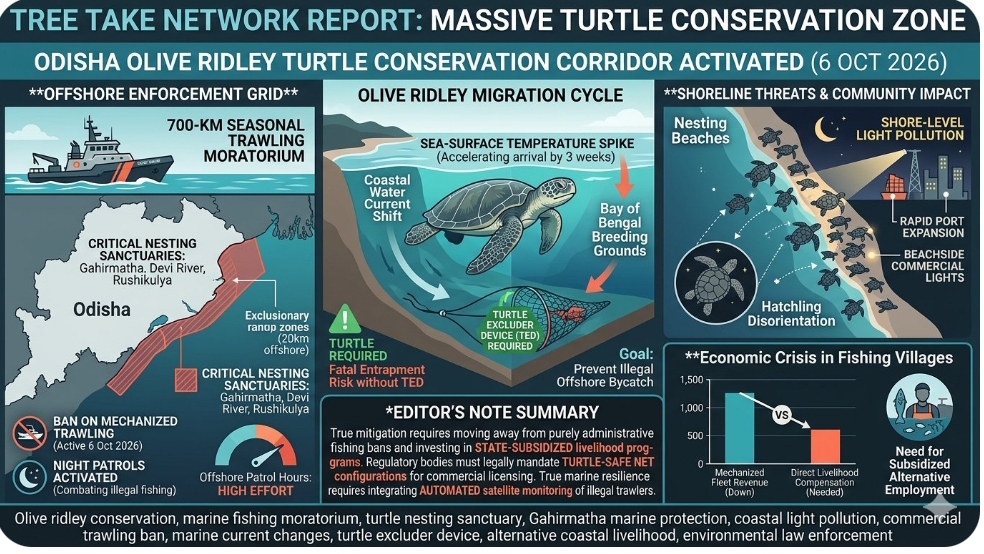
The Odisha Forest Department, in coordination with the Indian Coast Guard and local marine biology institutes, has officially activated a comprehensive seven-hundred-kilometre seasonal fishing moratorium zone to protect incoming olive ridley sea turtles. The sweeping maritime restriction establishes a complete ban on all mechanised trawling operations within twenty kilometres of the state's most critical nesting sanctuaries, including Gahirmatha, the Devi river mouth, and the Rushikulya rookery. The protective enforcement grid commences early this year following structural changes in marine thermal current parameters that have accelerated the turtles' offshore congregation cycles.
Data finalised by marine ecology task forces indicate that seasonal sea-surface temperature spikes have shifted the traditional migratory timelines of these delicate marine reptiles, drawing massive breeding aggregations closer to shallow industrial shipping paths weeks ahead of schedule. The primary driver of nesting mortality remains illegal offshore commercial trawling, where uninsulated nets cause fatal underwater entrapment. Furthermore, new coastal development metrics reveal a troubling escalation in shore-level light pollution, as rapid port expansion and beachside commercial lighting disorient hatchlings, disrupting their natural terrestrial transit toward the open ocean.
"Activating this enforcement perimeter ahead of schedule is a structural necessity to safeguard the millions of nesting sea turtles reliant on our coastal sanctuaries," stated Dr Priyambada Mohanty, Director of the Odisha Marine Conservation Directorate, during the official deployment briefing. She emphasised that whilst traditional maritime patrolling boundaries exist, the absolute survival of the nesting populations requires the mandatory installation of turtle excluder devices across all commercial fishing vessels operating within the Bay of Bengal.
Field conservationists also highlighted emerging community challenges across the adjacent fishing villages. Whilst the seasonal trawling ban successfully isolates the core marine corridors, it simultaneously cuts off the primary source of income for thousands of traditional, non-mechanised local fishers. Regional administrative boards urged the central government to expand direct livelihood compensation distributions, ensuring that vulnerable coastal populations are financially supported throughout the duration of the reproductive cycle.
Editor's Note: The early activation of the Odisha marine conservation corridor represents a vital defensive pivot against climate-shifted migration patterns, but it also exposes a deep structural conflict between ecological preservation and local human survival. Imposing top-down fishing bans without real-time financial counterweights creates severe economic distress, often driving local communities toward non-compliance. Moving forward, maritime regulatory bodies must legally mandate turtle-safe net configurations as a baseline prerequisite for commercial licensing rather than relying on absolute seasonal closures. True marine resilience requires the integration of automated satellite monitoring grids to track illegal trawlers in real time, combined with robust, state-subsidised alternative employment models that transform coastal fishers into active, well-compensated guardians of the coastline.



Leave a comment