

TreeTake Network
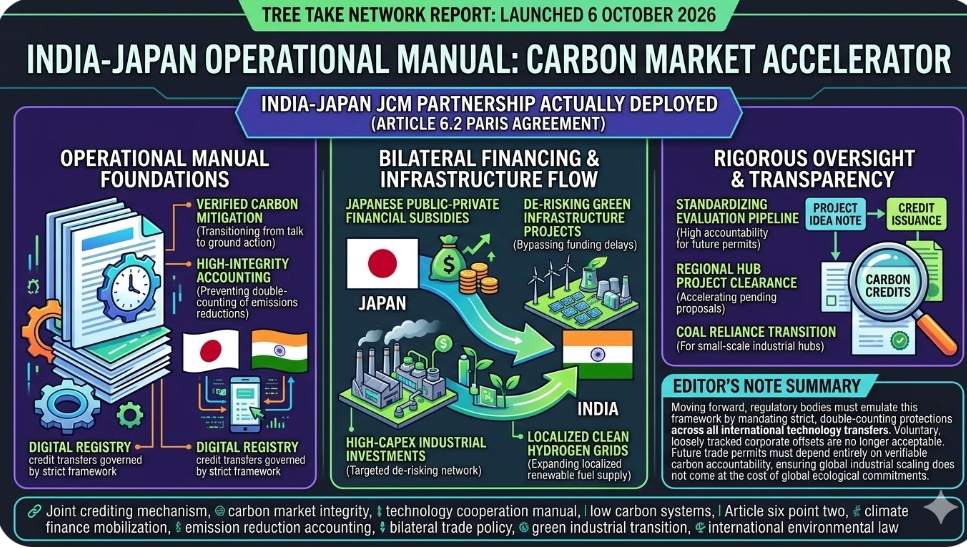
The Ministry of Environment, Forest and Climate Change has formally launched a joint comprehensive operational manual alongside the Embassy of Japan to activate the bilateral Joint Crediting Mechanism. This policy rollout transitions the climate partnership from institutional planning into strict ground-level implementation under Article 6.2 of the Paris Agreement. The new manual establishes a legally binding procedural framework to govern carbon reductions, project verifications, and high-integrity digital registry credit transfers between the two nations.
Bilateral financing framework targets high-capex industrial projects
Data finalised by international trade teams indicates that advanced low-carbon infrastructure investments have historically faced steep economic bottlenecks due to high capital expenses. The newly operationalised framework bypasses traditional funding delays by integrating direct Japanese public-private financial subsidies to significantly de-risk green infrastructure across India. The co-financing network is explicitly channelled into core industrial sectors aligned with domestic low-emission development strategies, focusing heavily on modernising heavy machinery emissions and expanding localised clean hydrogen grids.
"This manual codifies a clear and rigorous operational path that shifts our climate cooperation from abstract talk to verifiable carbon mitigation projects," stated Keiichi Ono, Ambassador of Japan to India, during the launch ceremony. He noted that the implementation of robust, high-integrity accounting systems will effectively execute corresponding adjustments, preventing any double-counting of emissions reductions across international registries.
Rigorous oversight guidelines protect international carbon market integrity
Administrative analysts at the New Delhi briefing highlighted the importance of standardising the evaluation pipeline for future technological permits. By creating a singular, transparent cycle—from the initial project idea note up to the official issuance of carbon credits—the framework ensures high accountability. Regional trade representatives urged both governments to quickly clear pending project proposals to enable small-scale industrial hubs to transition away from coal reliance ahead of peak seasonal power demand.
Editor's Note: The codification of the India-Japan operational manual represents a vital blueprint for bilateral climate action, setting a strict precedent for how international carbon markets must function under Paris Agreement guidelines. Voluntary, loosely tracked corporate offsets are no longer acceptable in an era facing rapid climate disruption. Moving forward, regulatory bodies must emulate this framework by mandating strict, double-counting protections across all international technology transfers. True industrial decarbonisation requires major manufacturing nations to legally tie green technology subsidies straight to real-time emission rollbacks. Future trade permits must depend entirely on verifiable carbon accountability, ensuring global industrial scaling does not come at the cost of global ecological commitments.



Leave a comment