

TreeTake Network
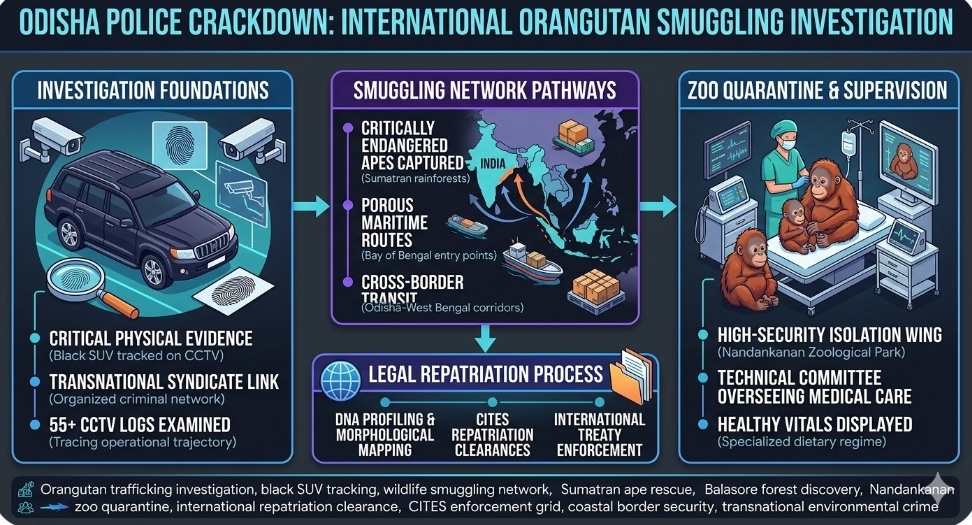
The Special Task Force of the Odisha Police, in coordination with the Wildlife Crime Control Bureau, has intensified its criminal investigation into the five baby orangutans recently found abandoned in a Balasore forest. Forensic teams have finalised initial field assessments confirming that a specific black sports utility vehicle, observed navigating the interior village roads between Odisha and West Bengal, serves as the critical piece of physical evidence linking the abandoned primates to an organised transnational trafficking syndicate. Law enforcement units have examined footage from 55 distinct closed-circuit television cameras installed across the Bhograi block and nearby Digha to trace the vehicle’s exact operational trajectory.
Smuggling network utilised porous maritime and cross-border jungle pathways
Intelligence updates indicate that the critically endangered great apes—three males and two females estimated to be between six months and one year old—were intentionally offloaded to avoid high-security checkpoints. Investigators recovered face masks from a black polythene bag at the forest disposal site in the Bichitrapur area, which forensic analysts suspect were utilised by the couriers to mitigate cross-species disease transmission during transit. Because orangutans are entirely non-native to India and cannot be legally bred or kept locally, investigators are actively examining maritime corridors to determine if the animals were transported through waterways into the eastern coastline.
"If the orangutans were brought from Indonesia, there will definitely be international operatives. The international traffickers must also have agents in local areas, either in West Bengal or Odisha. We have to find them," stated Regional Chief Conservator of Forests Prakash Chand Gogineni during an official briefing on the expanding cross-border network.
State establishes technical committee to supervise high-security zoo quarantine
The rescued primates remain inside a high-security isolation wing at the Nandankanan Zoological Park near Bhubaneswar, where a specialised technical committee has taken control over their medical supervision. Caregivers report that the infants have adapted remarkably well to hand-rearing, showing no hesitation in accepting formula milk offered through feeding bottles. Concurrently, two specialised teams from the Wildlife Crime Control Bureau have arrived from Bhopal and Kolkata to cooperate with state authorities, initiating formal administrative pipelines to trace the exact global origins of the animals and coordinate long-term legal repatriation protocols.
Editor's Note: The discovery of Sumatran great apes abandoned in a coastal Indian forest demonstrates a terrifying escalation in the precision and reach of international wildlife smuggling networks. Treating these incidents as isolated environmental infractions ignores the reality that porous coastal boundaries are actively being exploited by sophisticated criminal enterprises. Moving forward, border enforcement agencies must integrate automated maritime tracking radars with state-wide traffic monitoring networks to disrupt transit loops before cargo can be moved inland. True mitigation requires the judiciary to establish fast-tracked repatriation protocols under treaty rules, removing the bureaucratic logjams that keep seized endangered species stranded in foreign holding facilities while the criminal syndicates escape accountability.



Leave a comment