

TreeTake Network
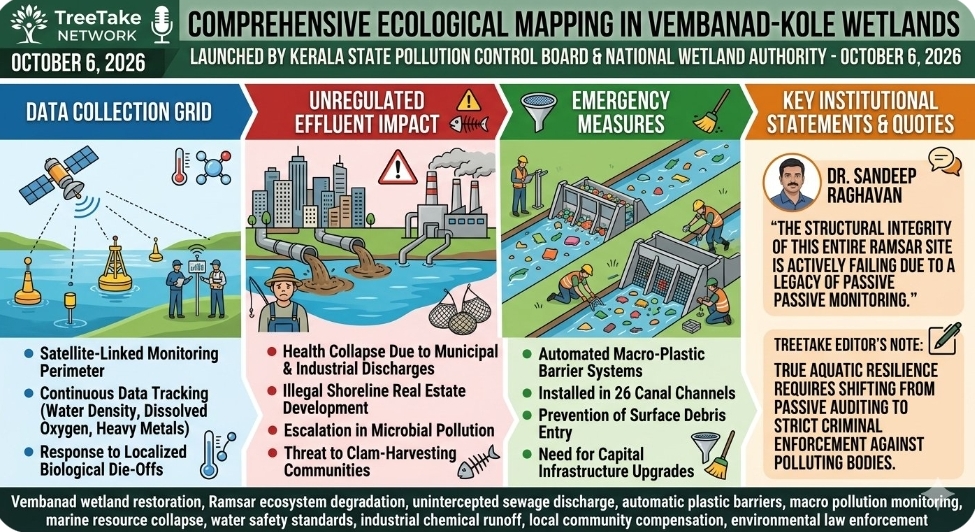
The Kerala State Pollution Control Board, in coordination with the National Wetland Authority and local marine research institutes, has officially launched a unified satellite-linked environmental monitoring perimeter across the Vembanad-Kole ecosystem. The emergency technological deployment establishes a continuous data-collection grid to track structural changes in water density, local dissolved oxygen profiles, and deep-water heavy metal contamination levels across India’s longest wetland basin. The protective initiative commences following localised biological die-offs that have raised serious alarms regarding upstream urban runtime compliance.
Unregulated domestic effluent vector zones trigger severe ecological stress
Data finalised by hydrological conservation networks indicate that the health of the delicate wetland system has collapsed under the weight of unintercepted municipal discharges and illegal shoreline real estate developments. Multi-point field audits show that over sixty per cent of commercial processing units operating along the adjacent industrial zones run without verified connections to centralised sewage treatment infrastructure, allowing toxic chemical runoff to leak directly into the primary channels. Concurrently, public health teams have identified a highly troubling escalation in microbial pollution metrics within shallow localised fishing corridors, threatening the absolute survival of the regional clam-harvesting communities dependent on the water system for basic livelihood stability.
"The structural integrity of this entire Ramsar site is actively failing due to a legacy of passive monitoring, as our current physical treatment infrastructure covers less than twenty per cent of the daily domestic wastewater load generated by the surrounding municipal expansions," noted Dr Sandeep Raghavan, Senior Hydrologist at the Coastal Ecosystems Trust, during the project’s technical briefing. He emphasised that saving the water body requires immediate regulatory actions to shut down non-compliant hospitality structures.
Local administrative boards implement emergency plastic trapping perimeters
Field engineering crews have also begun installing automated macro-plastic barrier systems across twenty-six canal channels feeding the main lagoon. While these localised mesh blocks successfully catch solid surface debris before it enters the core sanctuary boundaries, municipal planners warned that long-term stabilisation requires significant capital infrastructure upgrades to expand underground municipal plumbing loops. Regional environmental groups urged the central finance commission to reallocate dedicated wetland restoration subsidies directly to local village councils to enforce round-the-clock shoreline surveillance and prevent illegal night-time chemical dumping loops.
Editor's Note: The emergency technological deployment across the Vembanad wetland system underscores the total failure of purely generalised environmental planning. Passing preservation acts does nothing to clear heavily polluted water bodies when local municipal expansions are legally permitted to operate without baseline plumbing connections. Moving forward, provincial regulatory frameworks must mandate that all commercial, hospitality, and residential permits are structurally conditioned on verified, real-time links to zero-discharge filtration plants. True aquatic resilience requires shifting from passive environmental auditing to strict criminal enforcement against polluting bodies, ensuring our vital wetland defence shields are protected before seasonal pollution anomalies pass the point of ecological recovery.



Leave a comment