

TreeTake Network
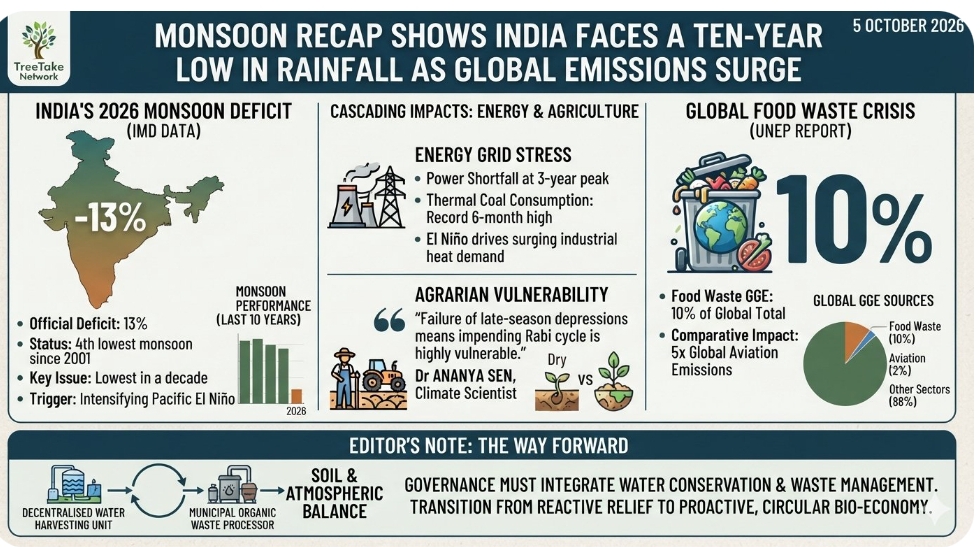
India’s agricultural sector faces an unprecedented structural challenge following the official conclusion of the 2026 southwest monsoon, which has wrapped up with a severe 13 per cent rainfall deficit. Data released by Mr Mrutyunjay Mohapatra, Director General of the India Meteorological Department (IMD), flags this as the fourth-lowest monsoon output since 2001 and the single worst deficit recorded in a decade. The compounding crisis of an intensifying El Niño system in the Pacific Ocean has forced immediate administrative mobilisations across central and southern agrarian belts.
The subcontinental drought footprint has triggered immediate, cascading pressures on the national energy grid. Due to the weak monsoon and surging industrial heat, India’s power shortfall has escalated to a three-year peak. Thermal power plants have been compelled to burn record volumes of coal for six consecutive months to sustain cooling demands, severely complicating India's near-term emissions reduction targets.
"We are witnessing a structural synchronisation of climate anomalies," states senior climate scientist Dr Ananya Sen. "The failure of late-season atmospheric depressions, paired with localised topsoil moisture depletion, means that the impending rabi sowing cycle is highly vulnerable. Without immediate, targeted surface-water channelling, crop yields in critical grain baskets could plunge by double digits."
Concurrently, international ecological frameworks are drawing direct visual correlations between local agricultural management and global atmospheric warming. A landmark global synthesis report published today by Inger Andersen, Executive Director of the United Nations Environment Programme (UNEP), reveals that decomposing food waste is now responsible for a staggering 10 per cent of total global greenhouse gas emissions. UNEP policy analysts note with alarm that this localised organic carbon and methane footprint is roughly five times higher than the total emissions generated by the entire global aviation industry.
Further north, trans-Himalayan transboundary vulnerabilities reached a critical threshold today. Following a sequence of severe flash floods across South Asia, Dr Birendra Piya, Chief Senior Hydrologist at Nepal’s Department of Hydrology and Meteorology, confirmed that emergency high-altitude engineering operations have commenced. Specialised teams are deploying structural siphoning mechanisms to drain four highly volatile glacial lakes before winter freezing sets in, a defensive intervention designed to prevent catastrophic downstream glacial lake outburst floods from decimating riverine communities.
Editor’s Note: The dual realities of a decade-lowest monsoon deficit and skyrocketing organic waste emissions reveal a profound fragmentation in our current ecological governance. India cannot afford to treat water conservation and waste management as separate administrative silos. Moving forward, regional governance must mandate localised decentralised water harvesting alongside rigorous municipal organic waste processing. True climate resilience relies on transitioning from a reactive, crisis-driven relief model to a proactive, circular bio-economy that preserves crucial soil and atmospheric balances before regional ecosystems reach a point of absolute collapse.



Leave a comment