

TreeTake Network
Public health frameworks and environmental safety guidelines face an unprecedented structural reassessment today following a groundbreaking medical-environmental study published by Dr Laura Sadofsky at the Hull York Medical School. Data compiled through ultra-precise spectroscopic analysis of surgical tissue samples reveals that microplastic particles have breached deep biological barriers, manifesting at significantly higher concentrations within live human lung tissue than ever previously recorded. The compounding crisis of indoor air degradation has forced immediate administrative and scientific mobilisations globally.
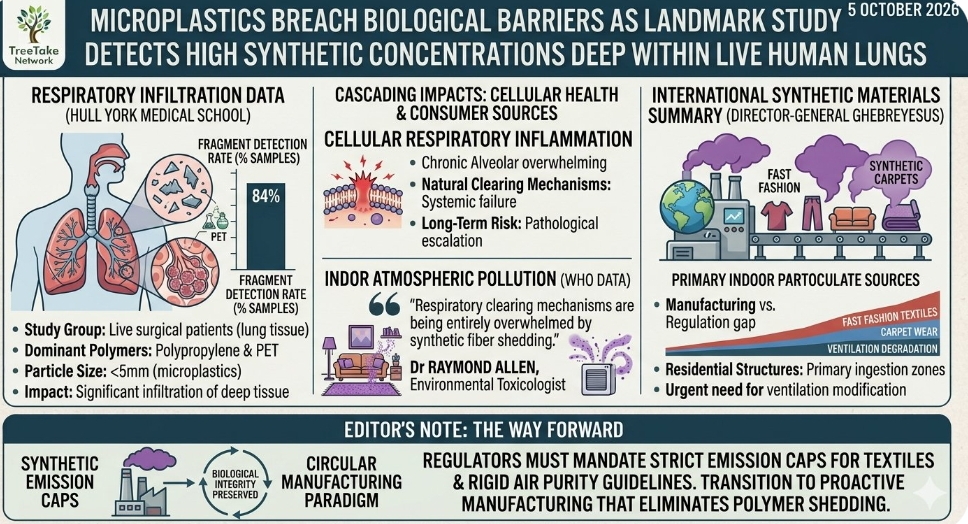
The cellular footprint of this synthetic infiltration stretches across all anatomical sections of the respiratory system. According to the laboratory findings, over 84 per cent of individual lung samples analysed contained polymer fragments measuring less than five millimetres, with polypropylene and polyethene terephthalate being the dominant chemical compounds identified. This represents the single most alarming physical confirmation of chronic airborne plastic inhalation within active domestic and industrial environments.
"We are no longer discussing microplastic contamination as a distant marine anomaly," states senior environmental toxicologist Dr Raymond Allen. "The structural presence of these jagged synthetic fragments within the deepest alveolar regions implies that our natural respiratory clearing mechanisms are being entirely overwhelmed by synthetic fiber shedding. Without immediate, targeted modifications to global manufacturing and ventilation standards, the long-term cellular inflammation could trigger an escalation in chronic respiratory pathologies."
Concurrently, international consumer safety frameworks are drawing direct material correlations between modern textile manufacturing and indoor atmospheric pollution. A comprehensive synthetic materials summary published today by Professor Tedros Adhanom Ghebreyesus, Director-General of the World Health Organisation (WHO), confirms that synthetic clothing degradation and carpet wear are the primary drivers of this localised particulate cloud. WHO analysts note with grave concern that fast-fashion industrial practices have completely outpaced existing indoor air quality regulations, turning modern residential structures into primary ingestion zones.
Further north, municipal healthcare boards reached a critical administrative threshold today. Following a sequence of urgent multi-sector assemblies in urban centres, regional environment ministries commenced immediate defensive interventions. Authorised teams are deploying experimental high-efficiency particulate air filtration arrays and microfibre-trapping industrial washing protocols across public infrastructure, a targeted structural operation designed to shield vulnerable clinical environments before atmospheric synthetic density escalates further during the winter heating cycle.
Editor’s Note: The physical identification of deep-tissue microplastic accumulation reveals a profound fragmentation between industrial production and human biological safety. Modern environmental governance cannot afford to isolate material manufacturing from public health monitoring. Moving forward, national regulatory bodies must mandate strict synthetic particle emission caps for commercial textiles alongside rigid municipal indoor air purity guidelines. True environmental resilience relies on transitioning from a reactive, treatment-oriented healthcare model to a proactive, circular manufacturing paradigm that eliminates toxic polymer shedding before consumer products reach a stage of absolute biological infiltration.



Leave a comment