

TreeTake Network
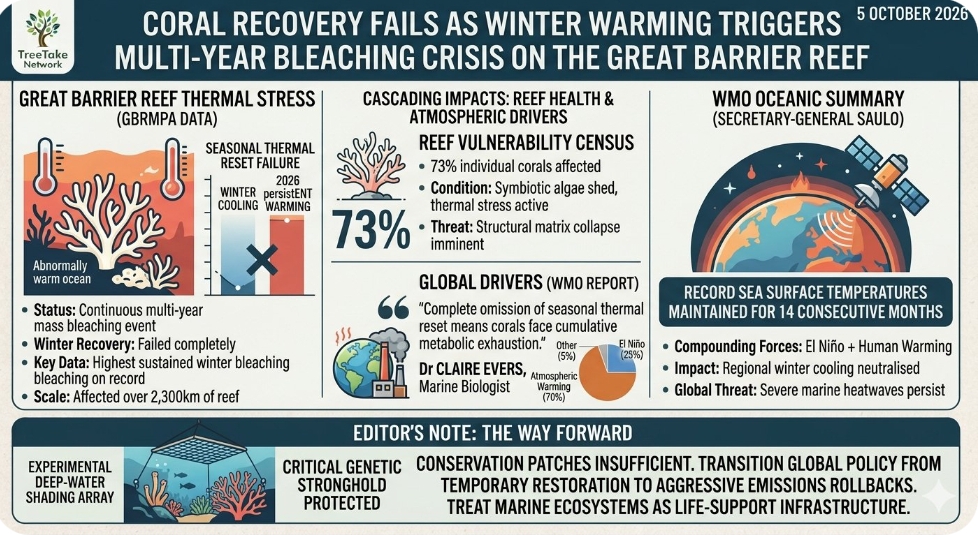
Marine ecosystems across the Southern Hemisphere have entered uncharted ecological territory today following an official joint statement by Dr Roger Beeden, Chief Scientist at the Great Barrier Reef Marine Park Authority. Data compiled through extensive aerial and underwater surveys reveals that the traditional winter cooling cycle has completely failed to lower marine temperatures across the Coral Sea. This thermal persistence has effectively locked the planet's premier coral ecosystem into an unprecedented, continuous multi-year mass bleaching event.
The ecological footprint of this marine heatwave stretches across thousands of kilometres of fragile reef configurations. According to marine census reports, over 73 per cent of individual coral structures surveyed across the northern and central management sectors are actively shedding their symbiotic algae due to prolonged thermal stress. This represents the single most severe sustained winter bleaching event recorded since formal baseline observations began in the mid-twentieth century.
"We are no longer looking at episodic bleaching anomalies," states senior marine biologist Dr Claire Evers. "The complete omission of a seasonal thermal reset means that structural corals are being subjected to cumulative metabolic exhaustion without any window for physiological repair. If these oceanic temperatures remain stable over the next sixty days, we will witness widespread structural collapse across entire reef matrices."
Concurrently, international atmospheric agencies are drawing direct physical correlations between escalating marine temperatures and broader hemispheric climate patterns. A global oceanic summary published today by Professor Celeste Saulo, Secretary-General of the World Meteorological Organisation (WMO), confirms that global sea surface temperatures have maintained record-breaking thresholds for an uninterrupted fourteen-month window. WMO analysts note with grave concern that the compounding forces of a powerful Pacific El Niño and human-driven atmospheric warming have completely neutralised the cooling capacity of regional winter currents.
Further south, coastal community frameworks reached an administrative tipping point today. Following a sequence of urgent multi-agency assemblies in Queensland, regional maritime protection networks commenced immediate interventions. Authorised teams are deploying experimental deep-water shading arrays and localised macroalgae harvesting mechanisms across high-value sanctuary pockets, a defensive intervention designed to shield critical genetic strongholds before summer solar radiation intensifies.
Editor’s Note: The structural failure of the Great Barrier Reef's winter recovery serves as a stark warning for marine governance models globally, including our own vulnerable coastal and riverine ecosystems in India. Planetary boundaries cannot be managed through localised restoration alone whilst upstream carbon investments continue to surge. Moving forward, global environmental policy must transition from temporary conservation patches to aggressive, legally binding emissions rollbacks. True marine resilience relies on treating oceanic ecosystems not as static tourism assets, but as critical global life-support infrastructure that requires comprehensive thermal stabilisation before regional biodiversity undergoes absolute extinction.



Leave a comment