

TreeTake Network
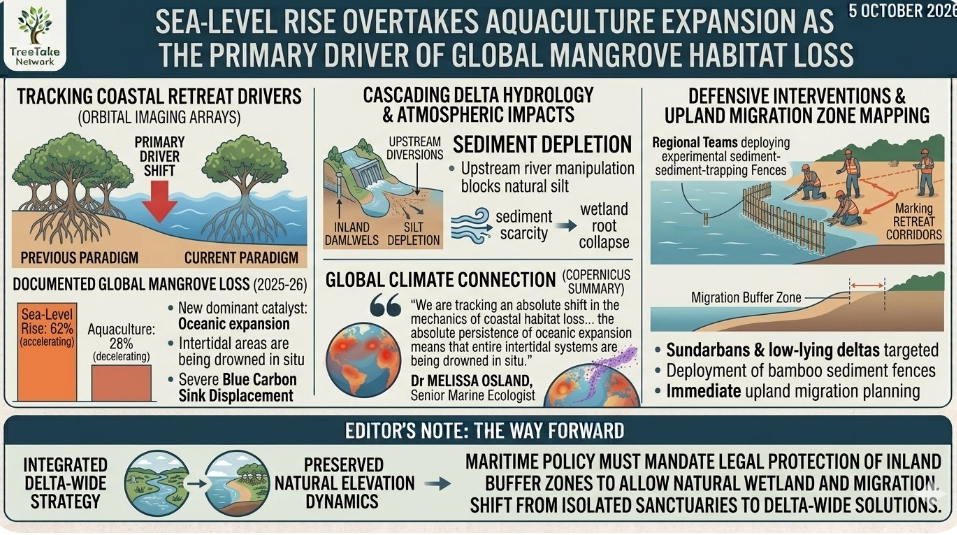
Coastal wetland ecosystems globally face an unprecedented structural transformation today following an official tracking synthesis released by Dr Valerie Hickey, Global Director for Environment at the World Bank. Data compiled via high-resolution orbital imaging arrays confirms that accelerating sea-level rise has officially surpassed shrimp farming and commercial aquaculture to become the dominant catalyst of global mangrove deforestation. This shifting environmental dynamic has forced immediate administrative updates across vulnerable tropical and subtropical maritime boundaries.
The physical footprint of this marine inundation stretches across critical estuarine protection belts. According to marine ecological inventories, over 62 per cent of documented mangrove retreats over the past twelve months occurred along low-lying deltas where rising oceanic baselines outpaced landward sediment accumulation. This represents the single most severe structural displacement of blue carbon sinks observed since satellite-based coastal monitoring commenced at the turn of the century.
"Mangroves are among the most resilient ecosystems on the planet, but they are being pushed to their absolute limits," states senior marine ecologist Dr Melissa Osland. "For decades, our primary conservation battles targeted localised commercial logging and aquaculture conversions. However, the absolute persistence of oceanic expansion means that entire intertidal systems are being drowned in situ. Without immediate, targeted engineering for coastal retreat corridors, our premier marine buffers will collapse under cumulative hydrodynamic pressure."
Concurrently, international hydrological frameworks are drawing direct material correlations between inland delta manipulation and coastal resilience. A comprehensive global delta summary published today by Dr Axel Timmermann, Director of the Center for Climate Physics, confirms that upstream river damming and groundwater extraction have drastically reduced the silt delivery required to elevate coastal root matrices. Climate analysts note with grave concern that these combined pressures have entirely neutralised the natural capacity of mangrove forests to adapt to rising sea surface boundaries.
Further east, regional maritime governance boards reached a critical administrative threshold today. Following a sequence of urgent multi-agency assemblies across the Sundarbans management zone, coastal protection ministries commenced immediate defensive interventions. Authorised teams are deploying experimental sediment-trapping bamboo fences and pioneering upland migration zone mapping, a targeted operation designed to shield critical genetic strongholds before seasonal cyclonic activity amplifies coastal erosion further.
Editor’s Note: The transition of sea-level rise to the primary driver of mangrove deforestation exposes a critical fragmentation in global coastal management models. Conservation frameworks can no longer rely on simply policing local land-use conversions whilst ignoring the broader impacts of global thermal expansion. Moving forward, maritime policy must mandate the legal protection of inland buffer zones to allow natural wetland migration alongside aggressive reductions in upstream river diversions. True coastal resilience relies on shifting from isolated sanctuary fences to an integrated delta-wide strategy that preserves natural elevation dynamics before regional marine biomes undergo absolute drowning.



Leave a comment