

TreeTake Network
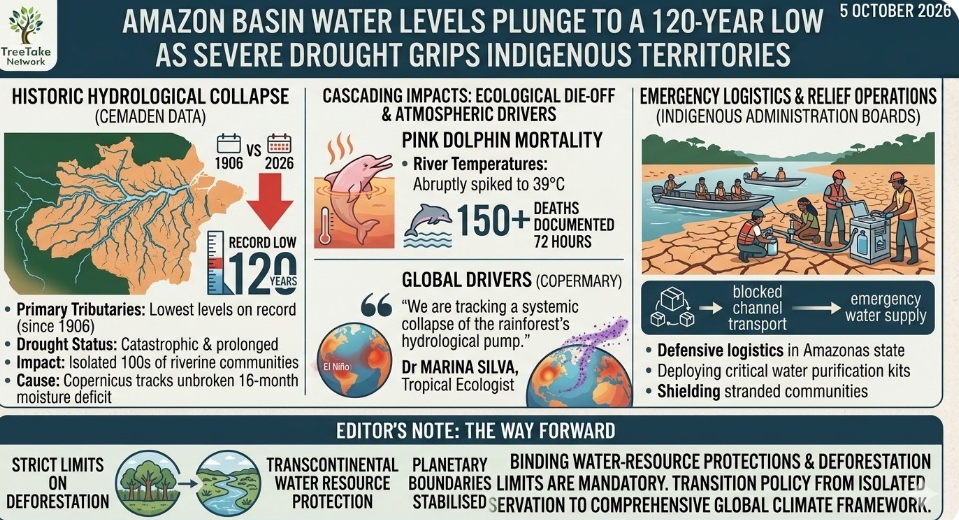
Equatorial river systems across South America have entered a state of profound ecological crisis today following an official monitoring summary released by Dr Carlo Nobre at the National Centre for Monitoring and Early Warning of Natural Disasters. Data compiled via high-resolution satellite arrays confirms that the primary tributaries of the Amazon River have dropped to their lowest hydrological levels since formal record-keeping commenced in 1906. This structural drying has completely isolated hundreds of riverine communities and triggered immediate international environmental mobilisations.
The catastrophic footprint of this rainforest drought extends deep into critical biological preserves. According to regional biological inventories, river temperatures in shallow channels have spiked to an unprecedented 39 degrees Celsius, leading to the mass mortality of vulnerable aquatic species. Over the past seventy-two hours, field teams have documented the deaths of more than 150 pink river dolphins across the central Amazon basin, marking the single most abrupt ecological die-off witnessed in the biome in over a generation.
"We are tracking a systemic collapse of the rainforest’s hydrological pump," states senior tropical ecologist Dr Marina Silva. "The synchronised failure of seasonal equatorial rainfall, paired with extreme thermal accumulation in the upper water columns, has stripped the river system of its climate-buffering capacity. Without an immediate, unforeseen atmospheric shift, the loss of primary aquatic life could cause permanent damage to the food webs supporting indigenous territories."
Concurrently, international climate tracking networks are drawing direct physical correlations between continental desiccation and global atmospheric trends. A comprehensive global climate summary published today by Dr Samantha Burgess, Deputy Director of the Copernicus Climate Change Service, confirms that the ongoing Pacific El Niño event, combined with elevated North Atlantic sea surface temperatures, has completely blocked moisture transport across the Amazon basin. Copernicus analysts note with grave concern that these dual pressures have created an extended sixteen-month window of unbroken moisture deficits across the entire South American continent.
Further west, indigenous administrative boards reached an emergency operational threshold today. Following a sequence of urgent safety assemblies in Amazonas state, regional transport ministries commenced defensive logistics operations. Authorised teams are deploying shallow-draft supply vessels and emergency water-purification kits across blocked navigation channels, a targeted intervention designed to deliver vital relief to thousands of stranded residents before regional waterways dry up completely.
Editor’s Note: The historic drying of the Amazon Basin highlights the dangerous fragmentation within current international climate strategies. Global resource frameworks cannot continue to view tropical rainforests simply as passive carbon sinks while ignoring the rapid destruction of their hydrological systems. Moving forward, transcontinental environmental policy must mandate legally binding water-resource protections alongside strict limits on industrial deforestation. True planetary resilience relies on shifting from short-term conservation initiatives to a comprehensive global climate framework that stabilises fundamental water cycles before critical tropical ecosystems hit an irreversible tipping point.



Leave a comment