

TreeTake Network
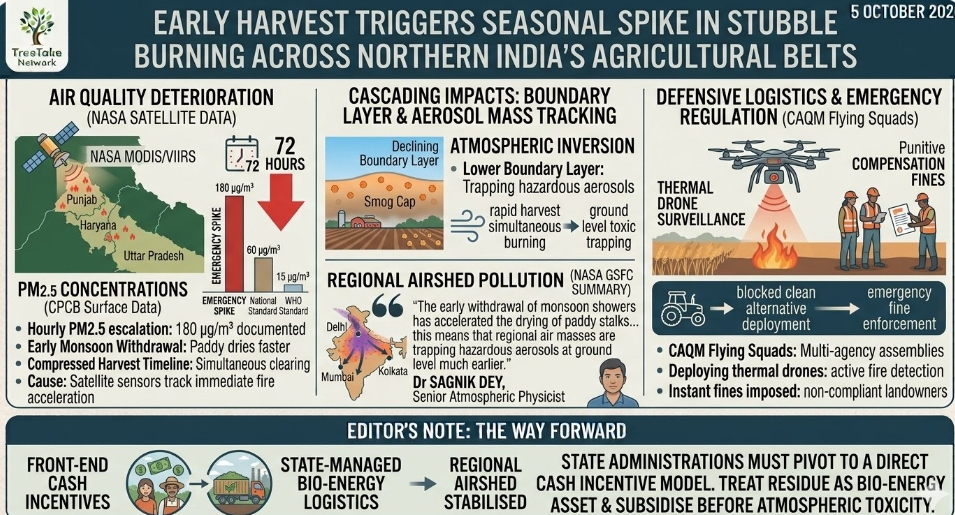
Atmospheric monitoring networks across the Indo-Gangetic Plain have registered an immediate deterioration in air quality today following an official satellite data compilation released by Dr Pawan Gupta, Senior Scientist at the Universities Space Research Association at NASA's Marshall Space Flight Centre. High-resolution orbital sensors have tracked the first major seasonal acceleration in agricultural fire counts across Punjab, Haryana, and western Uttar Pradesh. This early post-monsoon harvest residue clearing has forced immediate administrative mobilisations across regional environmental enforcement directorates.
The toxic atmospheric footprint of this seasonal clearing cycle is expanding rapidly across regional airsheds. According to surface monitoring stations managed by the Central Pollution Control Board (CPCB), hourly concentrations of fine particulate matter (PM2.5) have spiked to an alarming 180 microgrammes per cubic metre in rural clusters surrounding Amritsar and Karnal. This represents an abrupt threefold escalation above the national ambient air quality safety threshold within a rolling seventy-two-hour window.
"We are tracking a highly compressed harvesting timeline this year," states senior atmospheric physicist Dr Sagnik Dey. "The early withdrawal of monsoon showers has accelerated the drying of paddy stalks, prompting cultivators to deploy mechanical harvesters simultaneously. This simultaneous residue burning, paired with declining winter boundary layer heights, means that regional air masses are trapping hazardous aerosols at ground level much earlier than standard seasonal projections suggest."
Concurrently, regional agricultural frameworks are highlighting the material constraints preventing widespread adoption of alternative crop residue technologies. A field assessment summary published today by Dr Himanshu Pathak, Director General of the Indian Council of Agricultural Research (ICAR), confirms that despite state-subsidised distribution of in-situ management machinery like the Happy Seeder, high operational fuel costs remain a primary deterrent for marginal cultivators. ICAR analysts note with grave concern that the economic penalties for seasonal non-compliance are entirely failing to offset the immediate financial advantages of rapid open-field burning.
Further east, the Commission for Air Quality Management (CAQM) reached an emergency regulatory threshold today. Following a sequence of urgent multi-agency assemblies in New Delhi, enforcement ministries commenced immediate punitive interventions. Authorised flying squads are deploying thermal drone surveillance arrays and imposing instant environmental compensation fines on non-compliant landowners, a targeted structural operation designed to suppress active fire clusters before downwind meteorological vectors transport the particulate plume into urban metropolitan centres.
Editor’s Note: The early surge in northern India’s stubble burning highlights a profound fragmentation between structural agricultural policies and atmospheric health guidelines. Regulatory bodies cannot expect resource-constrained cultivators to single-handedly bear the financial burden of green transitions whilst mechanical alternatives remain economically unviable. Moving forward, state administrations must pivot to a direct, front-end cash incentive model for residue preservation alongside state-managed machinery logistics pools. True airshed resilience relies on treating agricultural waste not as a disposable seasonal hazard, but as a valuable industrial asset for bio-energy production that must be systematically subsidised before the regional atmosphere drops into absolute toxicity.



Leave a comment