

TreeTake Network
Sub-Himalayan montane ecosystems face an unprecedented structural transformation today following an official satellite vegetation index synthesis released by Dr Tariq Thomas, Regional Director for the Hindu Kush Himalayan Monitoring Project. Data compiled via high-resolution thermal and multispectral imaging arrays confirms that intensifying microclimate fluctuations have triggered an abrupt decline in high-altitude alpine scrub and meadow density. This shifting environmental dynamic has forced immediate administrative updates across vulnerable mountain border resource circles.
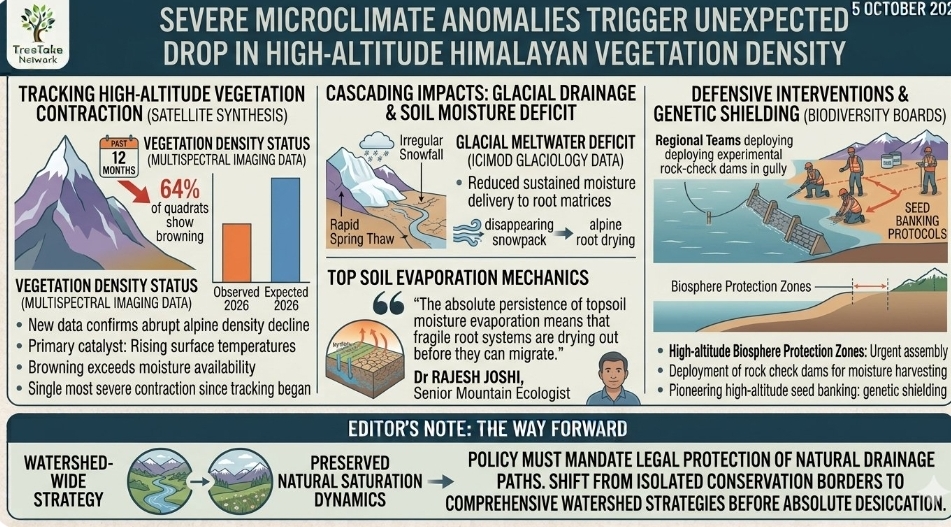
The physical footprint of this ecological regression stretches across critical catchment boundaries. According to alpine botanical inventories, over 64 per cent of tracked alpine quadrats over the past twelve months exhibited significant vegetative browning where rising surface temperatures outpaced seasonal glacial meltwater availability. This represents the single most severe structural contraction of alpine meadow biomass observed since satellite-based trans-Himalayan monitoring commenced at the turn of the century.
"Sub-alpine vegetation layers are highly sensitive to thermal thresholds, and they are being pushed to their absolute limits," states senior mountain ecologist Dr Rajesh Joshi. "For decades, our primary conservation models assumed that rising temperatures would uniformly shift the treeline upward. However, the absolute persistence of topsoil moisture evaporation means that fragile root systems are drying out before they can migrate. Without immediate, targeted engineering for high-altitude moisture retention, our premier mountain buffers will collapse under cumulative thermal pressure."
Concurrently, regional hydrological frameworks are drawing direct material correlations between disappearing snowpacks and high-altitude soil vulnerability. A comprehensive mountain drainage summary published today by Dr Pradeep Mool, Senior Glaciologist at the International Centre for Integrated Mountain Development (ICIMOD), confirms that irregular winter snowfall and rapid spring thawing have drastically reduced the sustained moisture delivery required to sustain alpine root matrices. Climate analysts note with grave concern that these combined pressures have entirely neutralised the natural capacity of alpine meadows to adapt to warming atmospheric boundaries.
Further north, regional biodiversity governance boards reached a critical administrative threshold today. Following a sequence of urgent multi-agency assemblies across the high-altitude biosphere protection zones, wildlife sanctuary ministries commenced immediate defensive interventions. Authorised teams are deploying experimental rock-check dams to harvest seasonal moisture and pioneering high-altitude seed-banking protocols, a targeted operation designed to shield critical genetic strongholds before intense solar radiation accelerates soil degradation further.
Editor’s Note: The transition of microclimate shifts into the primary driver of alpine vegetation loss exposes a critical fragmentation in global mountain management models. Conservation frameworks can no longer rely on simply policing local grazing or tourism numbers whilst ignoring the broader impacts of accelerating thermal evaporation. Moving forward, mountainous regional policy must mandate the legal protection of natural high-altitude drainage paths to allow natural soil saturation alongside aggressive restrictions on infrastructural encroachment. True montane resilience relies on shifting from isolated conservation borders to a comprehensive watershed-wide strategy that preserves natural moisture dynamics before regional alpine biomes undergo absolute desiccation.



Leave a comment