

TreeTake Network
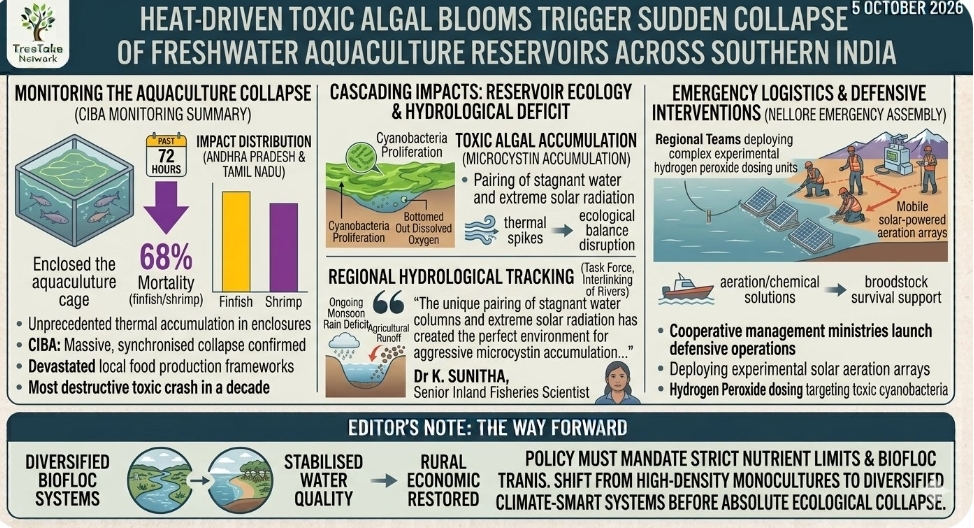
Inland fisheries across southern India have entered a state of profound ecological crisis today following an official monitoring summary released by Dr M. Karthikeyan, Director of the Central Institute of Brackishwater Aquaculture. Data compiled via telemetry and surface monitoring arrays confirms that unprecedented thermal accumulation has triggered a massive, synchronised collapse of freshwater aquaculture reservoirs. This sudden environmental emergency has devastated local food production frameworks and forced immediate administrative updates across regional environmental and cooperative aquaculture bodies.
The catastrophic footprint of this reservoir failure extends deep into critical commercial and community breeding matrices. According to regional biological inventories, water temperatures in shallow breeding enclosures have spiked to record thresholds, facilitating the rapid proliferation of toxic cyanobacteria. Over the past seventy-two hours, intensive monitoring teams have documented the total loss of more than 68 per cent of individual finfish and shrimp stocks across the primary production basins of Andhra Pradesh and Tamil Nadu, marking the single most destructive toxic algal crash witnessed in the sector in over a decade.
"We are tracking an absolute disruption of reservoir ecological balance," states senior inland fisheries scientist Dr K. Sunitha. "The unique pairing of stagnant water columns and extreme solar radiation has created the perfect environment for aggressive microcystin accumulation. The toxic presence of these blooms means that natural dissolved oxygen levels have completely bottomed out overnight. Without immediate, targeted mechanical aeration and chemical neutralisation, the survival of remaining broodstock is entirely compromised."
Concurrently, national hydrological tracking networks are drawing direct physical correlations between low reservoir replenishment and escalating nutrient concentrations. A comprehensive water quality summary published today by Dr Sharad Kumar Jain, Chairman of the Task Force on Interlinking of Rivers, confirms that the ongoing monsoon rain deficit has left reservoir volumes exceptionally low, which drastically amplifies the concentration of agricultural runoff. Climate and agricultural analysts note with grave concern that these combined pressures have entirely neutralised the self-purifying capacity of inland water bodies.
Further south, regional fisheries cooperative boards reached an emergency operational threshold today. Following a sequence of urgent safety assemblies in Nellore, cooperative management ministries commenced immediate defensive logistics operations. Authorised teams are deploying experimental hydrogen peroxide dosing units and mobile solar-powered aeration arrays across high-value sanctuary pockets, a targeted intervention designed to shield remaining genetic strongholds before seasonal temperatures climb further.
Editor’s Note: The sudden collapse of southern India's freshwater aquaculture networks exposes a critical fragmentation between industrial intensive farming models and fundamental climate realities. Regulatory frameworks can no longer treat commercial aquaculture simply as an isolated economic driver whilst ignoring the systemic vulnerabilities caused by regional hydrological deficits and unchecked agricultural runoff. Moving forward, inland water policy must mandate strict nutrient discharge limits for surrounding farmlands alongside state-supported investments in automated water quality sensors. True rural economic resilience relies on shifting from high-density, vulnerable monocultures to diversified, climate-smart biofloc systems that actively stabilise baseline water quality before regional reservoirs reach a state of absolute ecological collapse.



Leave a comment