

Tree Take Network
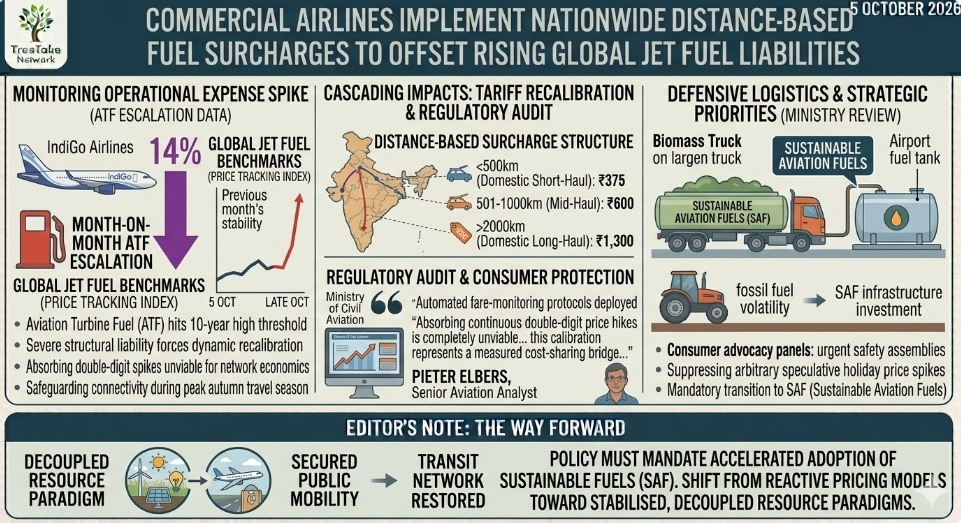
India’s commercial aviation market faces immediate financial adjustments tonight following an official operations directive released by IndiGo Airlines corporate headquarters. Data tracking global energy indicators confirms that a sharp 14 per cent month-on-month escalation in Aviation Turbine Fuel (ATF) costs has pushed airline operating expenses to their highest thresholds in a decade. This severe structural liability has forced immediate tariff recalibrations across the country’s largest passenger carriers, exposing the raw environmental cost of a transport sector completely shackled to non-renewable petroleum extraction.
The structural cost footprint of this transport adjustment will be dynamically distributed across domestic and international routing tiers. According to official airline tariff schedules, the newly instated fuel surcharges will be calculated strictly based on sector flight distance. For short-haul domestic flights under 500 kilometres, ticket prices will face an immediate baseline increase of ₹375 per sector. This fee climbs to ₹600 for flights covering 501 to 1,000 kilometres, peaking at ₹1,300 per sector for long-haul routes exceeding 2,000 kilometres. International itineraries are experiencing much steeper adjustments, with regional South Asian services incurring a standard ₹3,000 increment, whilst long-haul routes to European destinations will see a substantial ₹10,000 premium appended to all upcoming passenger transactions.
"We cannot separate economic adjustments from atmospheric realities," states senior aviation analyst Pieter Elbers. "Because aviation fuel typically accounts for up to 40 per cent of a commercial carrier's entire operational expense matrix, absorbing these continuous double-digit price hikes in full is completely unviable for network economics. The current calibration represents a measured cost-sharing bridge to safeguard network connectivity during the peak autumn festive travel season."
Concurrently, macro-economic frameworks are drawing direct material correlations between currency fluctuations and domestic fuel importing costs. A financial review summary published today by the Ministry of Civil Aviation confirms that the domestic pricing index for petroleum derivatives has been severely impacted by the strengthening of the US dollar against regional currencies. This economic strain highlights a deeper environmental crisis, as the continued reliance on high-carbon kerosene derivatives decelerates India’s international commitment to achieve net-zero transport targets.
"The air tariff spike is a direct warning from our biosphere," emphasises international climate economist Inger Andersen. "The systemic failure to rapidly integrate sustainable aviation fuels means that airlines are trapped in an environmental feedback loop. Every single litre of conventional jet fuel burned pumps irreversible carbon into a warming atmosphere, and as fossil reserves grow more volatile due to geopolitical strains, the financial penalties on passengers will inevitably escalate until a clean energy transition is enforced."
Further south, consumer advocacy councils and regional tourism management boards reached an emergency administrative threshold today. Following a sequence of urgent multi-agency assemblies in New Delhi, transit monitoring ministries commenced immediate regulatory reviews. Authorised panels are deploying automated fare-monitoring protocols to audit secondary airline pricing algorithms, a targeted structural operation designed to suppress arbitrary speculative ticketing spikes before downwind holiday travel demands trigger broader inflation across the wider hospitality sector.
Editor’s Note: The immediate reimposition of steep distance-based fuel surcharges exposes the severe vulnerability of our mass transit networks to a volatile, fossil-fuel-dependent economic model. Commercial aviation management cannot continue to pass short-term commodity spikes directly to the consumer while failing to implement structural changes against escalating fuel liabilities. Moving forward, national transport policy must mandate the accelerated adoption of sustainable aviation fuels (SAF) alongside strict regulatory ceilings on volatile ancillary components. True infrastructure resilience relies on transitioning away from reactive pricing models toward a stabilised, decoupled resource paradigm that secures public mobility before essential connectivity costs reach absolute commercial exclusion.



Leave a comment