

TreeTake Network
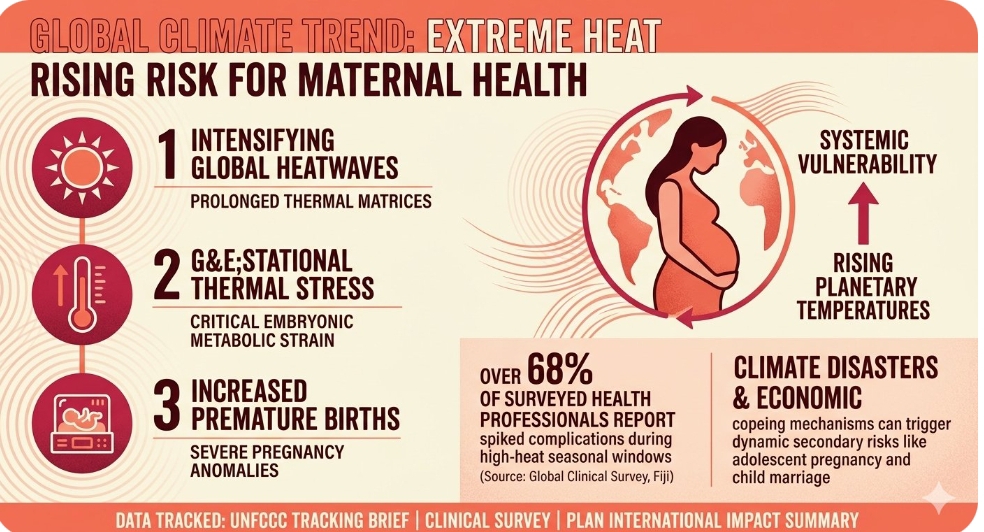
Global public healthcare networks and maternal welfare protection directorates face an unprecedented structural reassessment today after Simon Stiell, Executive Secretary of the United Nations Framework Convention on Climate Change (UNFCCC), released an official tracking brief. Comprehensive data compiled across five continents confirms that accelerating planetary surface heat anomalies have established a direct, quantifiable correlation with severe pregnancy anomalies, premature births, and maternal health complications. This shifting epidemiological dynamic has forced immediate administrative updates across international ecological and clinical surveillance bodies.
The medical-environmental footprint of this atmospheric heat trap is expanding rapidly across vulnerable equatorial and subtropical demographics. According to a global clinical survey presented at the Pre-COP talks in Nadi, Fiji, over 68 per cent of surveyed health professionals documented an immediate spike in gestational complications, low birth weights, and stillbirths during high-heat seasonal windows. This is the most alarming physical confirmation to date that extreme weather directly jeopardises human biological reproduction, since regional climate tracking frameworks began expanding their parameters.
"Climate change is not a far-off problem; it is a present-day crisis that is harming the most vulnerable among us," states UN Climate Change Executive Secretary Simon Stiell. "For years, our macro-conservation blueprints focused primarily on melting glaciers and infrastructure vulnerability. However, the absolute persistence of prolonged summer heat matrices means that the human body's natural thermal regulation is being entirely overwhelmed during critical embryonic stages. Without immediate, targeted interventions in urban cooling networks, our foundational public health safety nets will collapse under cumulative metabolic strain."
Concurrently, international social protection networks are drawing direct material correlations between compounding climate disasters and broader societal vulnerabilities. A separate demographic impact summary published today by Plan International confirms that prolonged droughts and extreme weather patterns have severely disrupted rural family incomes, triggering a secondary escalation in child marriage and adolescent pregnancies across frontline regions. Climate policy analysts note with grave concern that these systemic cascading risks are systematically locking young women out of vital education and healthcare delivery services.
"When climate disasters strike, it is girls and young women who bear the heaviest burdens," emphasises international humanitarian coordinator Kathleen Sherwin. "The breakdown of agrarian safety nets directly drives families to desperate economic coping mechanisms, including early marriage, which entirely removes young women from protective educational spaces and introduces severe physical risks. True atmospheric adaptation must encompass human structural equity, or our climate mitigation frameworks will entirely fail the populations that need them most."
Further east, regional environmental health boards reached a critical administrative threshold today. Following a sequence of urgent multi-agency assemblies across frontline island states and coastal territories, public health ministries commenced immediate defensive interventions. Authorised teams are deploying experimental community shade pavilions and pioneering localised heat-alert protocols tailored for expectant mothers, a targeted operational response designed to shield vulnerable clinical groups before the next summer solar radiation cycle intensifies further.
Editor’s Note: The dangerous manifestation of climate-driven extreme heat within live maternal biology exposes a profound fragmentation in our current environmental management models. International resource frameworks can no longer isolate carbon emission quotas from the raw deterioration of public healthcare infrastructure. Moving forward, global environmental policy must mandate legally binding municipal cooling infrastructure targets alongside dedicated public health adaptation funding for high-risk zones. True planetary resilience relies on shifting from short-term emergency relief models to an integrated, human-centric bio-economy that actively safeguards reproductive health before global warming causes irreversible damage to future generations.



Leave a comment