

TreeTake Network
Agricultural monitoring networks across central and eastern Uttar Pradesh face immediate structural revisions tonight following an operational crop status report released by Dr Alok Kumar Sikka, Head of the Indian Council of Agricultural Research (ICAR) Research Complex for Eastern Region. Direct field feedback confirms that abnormally high post-monsoon topsoil temperatures, paired with erratic residual moisture levels from late-season atmospheric depressions, have forced a compulsory delay in the initial sowing schedules for key winter cash crops. This unexpected agronomic shift has forced immediate updates across regional farming cooperatives and district-level irrigation planning boards.
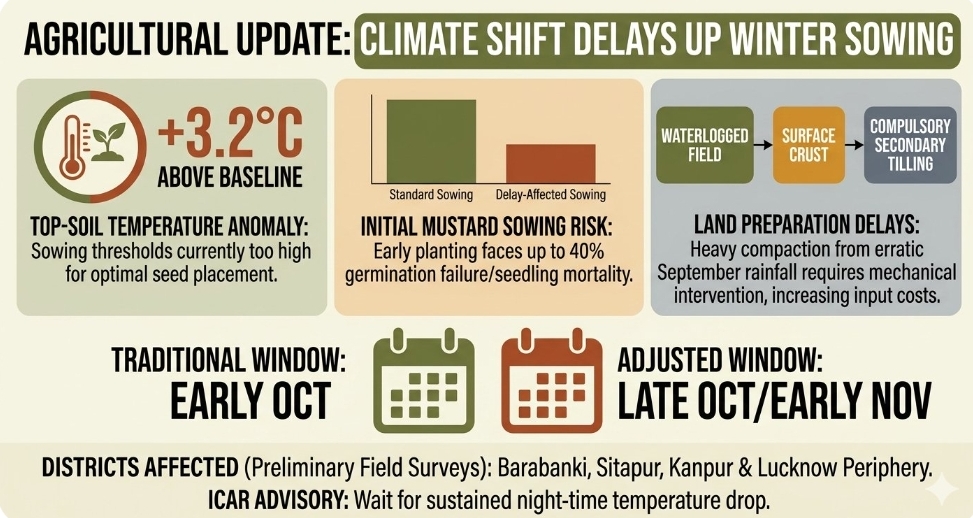
The physical footprint of this seasonal sowing disruption is expanding across major production belts, including Barabanki, Sitapur, and the surrounding Lucknow periphery. According to regional agroecological field surveys, ambient soil temperatures at a depth of five centimetres are hovering at an unseasonal 3.2 degrees Celsius above the historic baseline required for optimal germination. Agronomists note with grave concern that under these elevated thermal thresholds, early-sown mustard seeds face up to a 40 per cent mortality rate due to seedling scorching, whilst potato tubers are experiencing premature rotting within the saturated, uncooled soil beds.
"We are tracking a clear misalignment between traditional crop calendars and localized atmospheric conditions," states senior agrometeorologist Dr Manoj Prasad. "The persistence of high diurnal temperatures well into early October means that the standard sowing windows must be pushed back by at least fourteen days to prevent widespread germination failure. Cultivators who rush the planting process without waiting for a sustained drop in night-time temperatures risk total seed loss and severe financial ruin."
Concurrently, regional ground resource frameworks are drawing direct material correlations between soil compaction and delayed mechanised tilling. A comprehensive field infrastructure summary published today by Dr Vinod Kumar Singh, Director of the Indian Institute of Farming Systems Research, confirms that heavy, erratic downpours during the final week of September left fields temporarily waterlogged, which has now turned into a hardened surface crust under the current intense solar radiation. Agricultural engineers note that this crust requires secondary tractor operations to loosen the earth, a necessary intervention that is driving up diesel consumption and operational costs for smallholders.
Further west, district agricultural development boards reached a critical administrative threshold today. Following a sequence of urgent multi-agency assemblies in Kanpur, regional supply ministries commenced immediate defensive interventions. Authorised teams are accelerating the distribution of heat-tolerant seed varieties and deploying mobile extension vans to provide real-time soil moisture mapping to rural panchayats, a targeted operation designed to shield vulnerable farming communities before full-scale winter sowing commences late in the month.
Editor’s Note: The forced delay in Uttar Pradesh’s winter sowing windows exposes a profound fragmentation within our current agrarian assistance models. Administrative bodies cannot continue to issue generic, date-driven crop advisories that fail to account for rapidly shifting microclimate baselines. Moving forward, regional agricultural policy must mandate the establishment of village-level automated weather stations alongside state-subsidised crop insurance frameworks that cover climate-driven sowing delays. True rural economic resilience relies on shifting from fixed historical timelines to an agile, data-driven precision farming paradigm that actively safeguards initial crop investments before vital agrarian cycles drop into absolute seasonal failure.



Leave a comment