

TreeTake Network
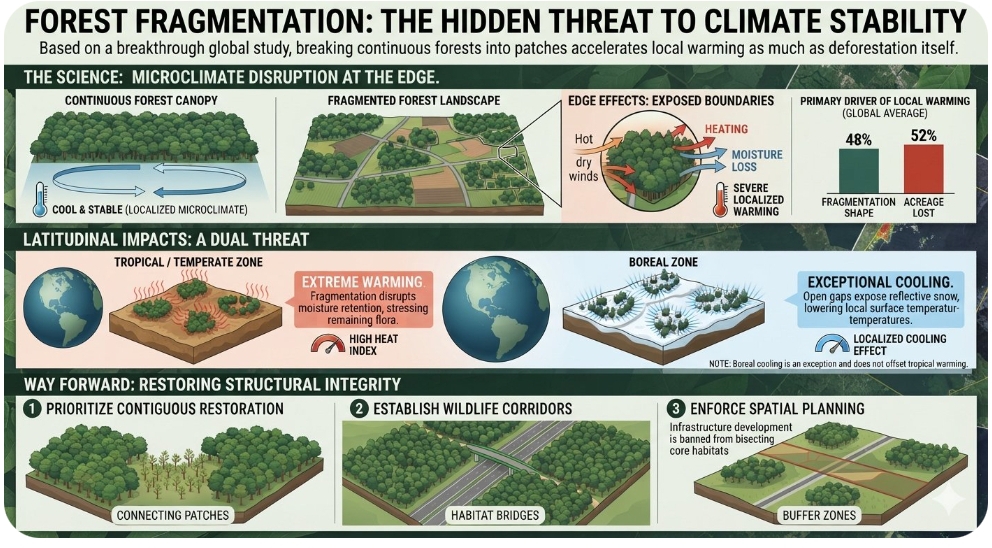
An international breakthrough study tracking global canopy patterns has revealed that breaking continuous woodlands into isolated patches accelerates land surface warming at a rate matching actual deforestation. By analysing over two decades of high-resolution satellite data across various latitudes, researchers have proved that the structural degradation of a forest alters its microclimate independently of the absolute volume of trees felled, fundamentally threatening local ecosystems. The extensive research indicates that the shapes and borders of fragmented green spaces dictate how effectively moisture is retained and heat is dispersed. In nearly half of the world’s examined forests, the sheer fragmentation of the landscape influenced local temperature spikes far more severely than the total acreage of canopy lost. Ecologists warn that edge effects leave exposed boundaries vulnerable to drying winds, which strip moisture away and create severe localised heat islands.
Dr Eleanor Vance, a senior climate scientist specialising in canopy ecosystems, expressed deep concern over the findings. She noted that conservation models have spent decades focused almost exclusively on raw acreage rather than landscape geometry. In her reaction, she stated that treating forests as numerical data points on a spreadsheet has blinded policy to spatial reality, and that a fractured forest is a feverish forest, rendering traditional carbon metrics dangerously incomplete. Adding to this perspective, Marcus Thorne, a veteran biodiversity strategist, warned that policy failure is imminent without a change in approach. He observed that governments are currently celebrating fragmented tree-planting drives along highways and housing estates while ignoring the massive thermal leaks occurring at the frayed edges of our remaining ancient jungles.
The thermal consequences vary drastically by latitude, according to the data. While tropical and temperate zones experience severe warming from fragmented borders, high-altitude boreal forests in northern regions show a contrasting localised cooling because open gaps expose reflective snow. Regional forestry advocates emphasise that this northern exception offers no comfort to equatorial zones. They warn that tropical fragmentation triggers a destructive feedback loop, stressing remaining flora and accelerating biodiversity collapse.
Editor's Note: To counter this accelerating thermal threat, environmental planners must urgently transition from basic tree-planting targets to contiguous landscape restoration. This requires prioritising the establishment of dense wildlife corridors and buffer zones that stitch fragmented woodlands back into unified ecosystems. Governments must enforce strict spatial planning laws that halt infrastructure bisection of untouched habitats, ensuring that future conservation funds are directed toward maintaining structural integrity rather than merely boosting sapling counts.



Leave a comment