

TreeTake Network
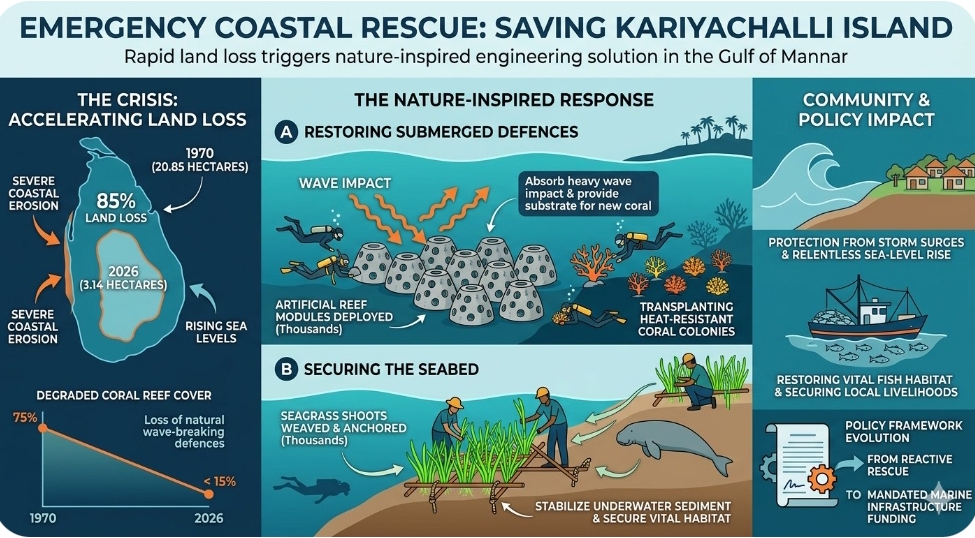
A fragile marine ecosystem off the southern coast of India is facing total submersion as severe coastal erosion and rising sea levels threaten to erase Kariyachalli Island from the map. Government data indicates that the unique ecological shield, located within a chain of twenty-one islands in the Gulf of Mannar, has suffered a catastrophic reduction in landmass. Over the past half-century, the island has shrunk drastically from 20.85 hectares to a mere 3.14 hectares, prompting a race against time by conservationists to deploy nature-inspired engineering solutions before the territory vanishes entirely.
The rapid degradation of nearby coral reefs and surrounding marine vegetation has stripped the island of its natural wave-breaking defences. Historical records demonstrate that these complex marine ecosystems are vital for coastal survival, famously softening the deadly impact of the devastating 2004 Indian Ocean tsunami for the mainland population. However, rising ocean temperatures, extensive pollution, and past coral mining have decimated the local barriers, causing the immediate reef area surrounding Kariyachalli to contract by more than sixty per cent in recent decades.
Supriya Sahu, a senior environmental official overseeing the emergency state conservation deployment, emphasised the high stakes of the operation. She warned that failing to provide immediate ecological resilience leaves local fishing communities entirely at the mercy of intensifying storm surges, cyclonic tempests, and relentless sea-level rise. In her briefing, she remarked that the disappearing landmass serves as a stark warning system for the mainland, and that allowing Kariyachalli to submerge would dismantle the first line of defence protecting thousands of coastal livelihoods.
To halt the erosion, specialised marine teams are working alongside local communities to implement a multi-layered restoration project. Divers are anchoring thousands of multi-tonne artificial reef modules to the ocean floor to absorb heavy wave impact whilst simultaneously transplanting native, heat-resistant coral colonies. On the shallower banks, workers are weaving thousands of bright green seagrass shoots onto organic wooden frames to stabilise underwater sediment and secure a vital habitat for endangered dugongs and native fish species.
Editor's Note: To prevent the permanent loss of low-lying islands, marine conservation policy must evolve beyond reactive, localised rescue missions. Authorities should establish regional climate-resilient nurseries dedicated to cultivating heat-tolerant coral strains capable of surviving ongoing marine heatwaves. Furthermore, coastal development frameworks must mandate long-term funding for community-led seagrass and mangrove propagation, treating marine botanical restoration not as an optional conservation project, but as essential national infrastructure for disaster risk reduction.



Leave a comment