

TreeTake Network
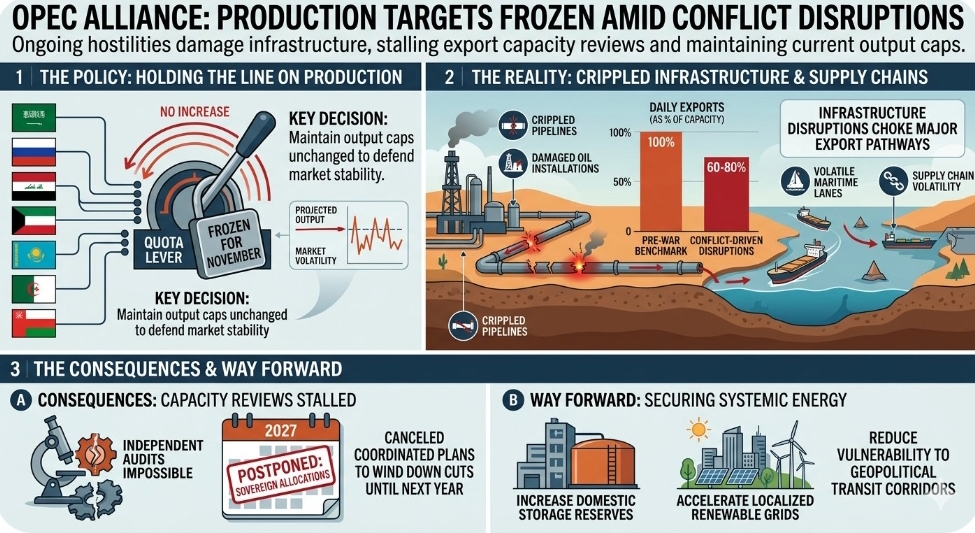
The seven core nations driving the OPEC alliance have agreed to freeze their collective oil production quotas for November in an emergency effort to maintain energy market stability. Meeting virtually to assess the macroeconomic fallout of ongoing geopolitical hostilities, ministers from Saudi Arabia, Russia, Iraq, Kuwait, Kazakhstan, Algeria, and Oman confirmed they will maintain output caps unchanged. The defensive policy manoeuvre comes as persistent regional conflicts continue to inflict heavy damage on vital supply lines, keeping actual crude output from major Gulf installations millions of barrels below designated capacities.
While headline paper limits remain unchanged, the overarching story across global energy corridors is one of severe infrastructural constraint. Extreme volatility and structural disruptions have choked maritime shipping lanes, reducing regional oil exports to roughly sixty to eighty per cent of traditional operating thresholds. Data verified during the ministerial review shows that the core group produced approximately twenty-five million barrels per day. Despite minor monthly fluctuations, this volume languishes a staggering five million barrels below the pre-war benchmarks established prior to the outbreak of major hostilities.
Prince Abdulaziz bin Salman, the veteran Saudi energy minister steering the cartel’s market-balancing strategy, strongly defended the aggressive enforcement of baseline compliance. He declared that volatile market fluctuations demand absolute operational discipline rather than speculative expansion. In his address to the committee, he stated that the principal mandate of the alliance is to protect international energy pathways from collapsing, adding that the group will not compromise long-term market predictability whilst critical infrastructure remains under active threat.
The widespread industrial damage has forced a complete postponement of the group's highly anticipated long-term production reviews. Independent auditing bodies had been commissioned to recalculate maximum output potentials to form the basis for 2027 sovereign allocations. However, energy analysts report that unstable extraction parameters and crippled logistics have made accurate capacity assessments impossible. Industry strategists emphasise that until secure transit routes are guaranteed, any coordinated plans to wind down historical production cuts will remain completely shelved until next year.
Editor's Note: To insulate the global economy from cascading fuel supply shocks, international energy policies must look beyond the immediate pricing metrics controlled by state syndicates. Consuming nations must accelerate systemic investments in diversified domestic storage and localised renewable grids to reduce vulnerability to overseas transit corridors. True energy security will not be achieved by tracking the paper quotas of external cartels, but by aggressively dismantling the broader industrial dependence on fossil fuel infrastructure prone to geopolitical vulnerability.



Leave a comment