

TreeTake Network
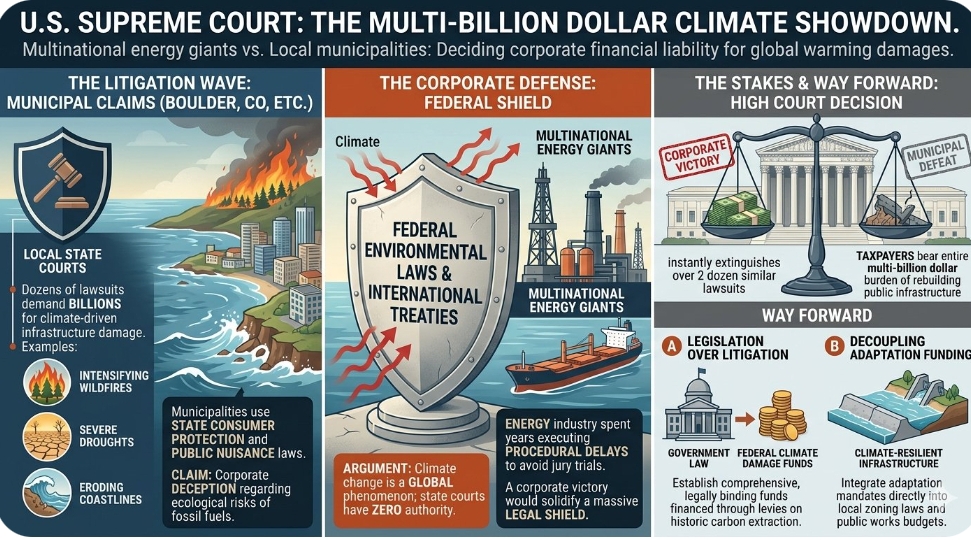
The Supreme Court of the United States has commenced its highly anticipated judicial term by jumping into a momentous legal battle that could redefine corporate financial liability for global warming. The justices are reviewing a high-stakes petition from a coalition of multinational energy giants seeking to permanently derail a wave of climate change litigation brought by local municipalities. The case stands as a critical constitutional showdown, determining whether local communities can use state consumer protection and public nuisance laws to force fossil fuel companies to pay for infrastructure damage caused by rising temperatures.
The underlying legal conflict centres on dozens of lawsuits filed by local governments, including the city of Boulder, Colorado, which demand billions of dollars in compensation for climate-driven damages like intensifying wildfires, severe droughts, and eroding coastlines. The energy companies argue that climate change is an inherently global phenomenon regulated strictly by federal environmental laws and international treaties, meaning local state courts have zero authority to oversee such sweeping claims. Conversely, the municipalities maintain that their lawsuits do not seek to regulate global emissions, but rather seek damages for corporate deception regarding the known ecological risks of fossil fuels.
The aggressive pushback by the oil industry has drawn sharp reactions from legal experts and corporate accountability advocates alike. Alyssa Johl, a senior legal counsel specialising in climate accountability frameworks, strongly criticised the corporate attempt to escape local jurisdiction. She noted that the energy industry has spent years executing procedural delays to avoid facing a jury on the merits of their historical climate knowledge. In her reaction, she stated that filing a petition before the highest court is a desperate bid to shut down the courthouse doors for communities facing real, localised economic ruin.
The Supreme Court's ultimate ruling will have massive implications for corporate risk assessments and global climate finance. If the justices rule in favour of the energy conglomerates, it could instantly extinguish over two dozen similar lawsuits pending across various states, cutting off an essential avenue of climate adaptation funding for local communities. Legal strategists emphasise that a corporate victory would solidify a massive legal shield for polluters, forcing ordinary taxpayers to bear the entire multi-billion-dollar burden of rebuilding public infrastructure shattered by extreme weather events.
Editor's Note: To ensure vulnerable communities are not left defenceless against escalating climate damages, legislative bodies must move beyond the uncertainties of state-level litigation. Federal lawmakers should establish comprehensive, legally binding climate damage funds financed directly through progressive levies on historic carbon extraction. Furthermore, municipal planners must immediately decouple adaptation funding from speculative legal payouts, integrating aggressive climate-resilient infrastructure mandates directly into local zoning laws and public works budgets to build immediate, localised systemic protection.



Leave a comment