

TreeTake Network
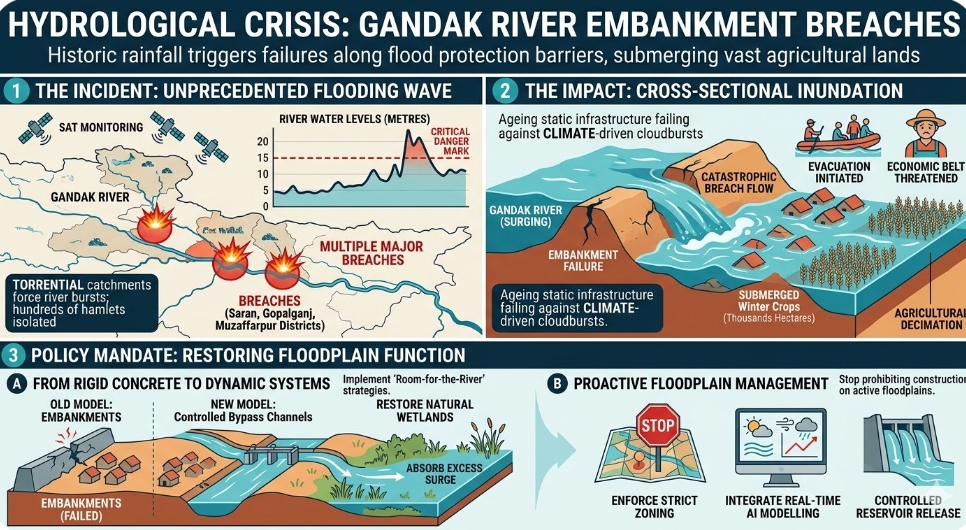
A severe hydrological crisis has unfolded across northern India after historic, unseasonal monsoon downpours forced the Gandak River to burst its banks, submerging vast tracts of agricultural land. Automated satellite monitoring networks tracking the river basin confirmed that surging water levels have caused multiple major structural failures along critical flood protection barriers. The sudden breaches have sent torrents of water cascading into dozens of low-lying rural settlements across the Saran, Gopalganj, and Muzaffarpur districts, forcing disaster management authorities to execute emergency evacuations for hundreds of thousands of marooned citizens.
The scale of the inundation has caught local communities off guard, as intense rainfall in the upper catchment areas sent unprecedented volumes of water rushing through regional barrages. Agricultural experts warn that the flooding has completely decimated standing winter crops across thousands of hectares, threatening the economic stability of the regional farming belt. Emergency services are utilising fleets of rescue boats to reach isolated hamlets, whilst engineering teams attempt to deploy heavy machinery and sandbags to plug the widening gaps in the earthen embankments before the main river channel shifts further.
Dr Rajeev Narayan, a veteran hydrologist specialising in Himalayan river systems, expressed deep concern over the recurring vulnerability of the region’s flood-control infrastructure. He observed that relying on ageing, static embankments is proving fatal as climate change intensifies unpredictable cloudburst events. In his assessment, he stated that the engineering paradigms of the past century are fundamentally mismatched with modern atmospheric realities, adding that structural barriers without dynamic retention basins act merely as temporary dams that amplify the violence of water when they inevitably fail.
Local administrative officials emphasise that immediate relief operations are focused purely on saving lives and preventing the spread of waterborne diseases in waterlogged zones. However, community leaders note that seasonal displacements are becoming an annual catastrophe, draining local resources and leaving populations in a state of permanent economic insecurity. Environmental planners stress that the physical alteration of natural floodplains to accommodate infrastructure expansion has severely restricted the river's capacity to disperse energy safely, transforming standard seasonal rises into devastating floods.
Editor's Note: To mitigate the compounding threat of riverine flooding, water resource departments must shift from an obsession with rigid concrete embankments toward room-for-the-river management strategies. This transition requires the deliberate creation of controlled bypass channels and the restoration of natural low-lying wetlands that can safely absorb excess surge volumes during extreme rainfall events. Governments must enforce strict regulations prohibiting permanent construction on active floodplains, whilst integrating real-time AI predictive modelling into reservoir management to orchestrate controlled releases rather than reactive emergency discharges.



Leave a comment