

TreeTake Network
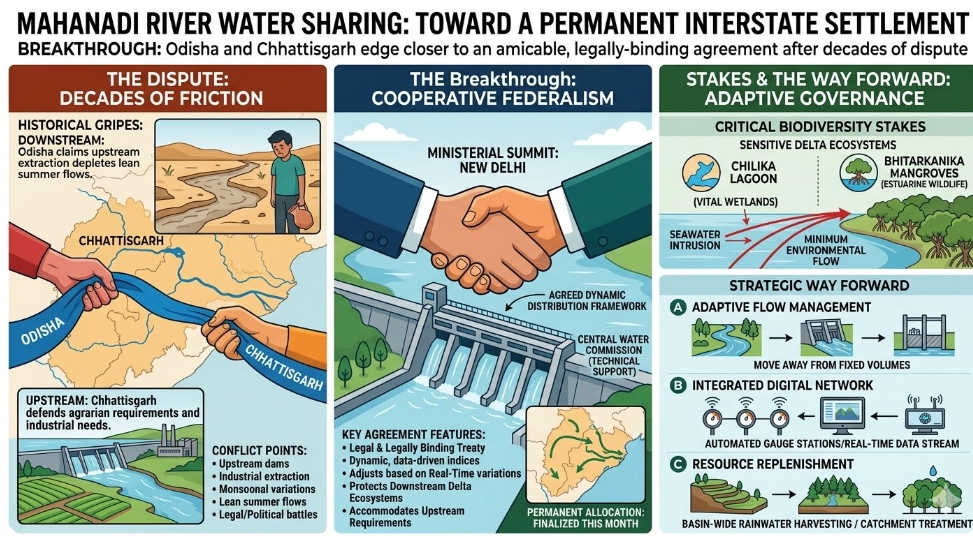
A decisive breakthrough in India’s long-standing resource diplomacy has emerged following a high-level ministerial summit in New Delhi regarding the sharing of the Mahanadi River. The Chief Ministers of Odisha and Chhattisgarh have formally confirmed that the dispute-resolution process has entered its final phases, signalling an end to decades of socio-political friction. Supported by comprehensive technical evaluations from the Central Water Commission, state negotiators announced that they are on track to finalise an amicable, legally binding framework within the month to permanently govern the river's ecological and industrial flow.
The conflict has historically centred on the construction of upstream barrages and industrial extraction pits, which downstream communities argue drastically depletes water availability during lean summer months. The impending agreement seeks to implement a dynamic, data-driven distribution index that adjusts sharing ratios based on real-time monsoon variations rather than rigid, historical baselines. Legal and technical advisors from both states are currently reviewing the cross-border flow metrics to ensure the final treaty guarantees adequate water volumes to protect downstream delta ecosystems whilst accommodating upstream agrarian requirements.
Dinesh Kumar Sharma, a veteran water governance strategist who has monitored the tribunal proceedings, welcomed the shift toward cooperative federalism. He noted that judicial battles over natural resources rarely yield ecological balance because they treat river basins as political boundaries rather than unified living systems. In his reaction, he stated that moving the conversation away from adversarial courtrooms and into collaborative technical chambers is a massive victory for resource security, adding that a river cannot be managed by legal decrees but must be shared through ecological science.
The resolution comes at a critical juncture for regional biodiversity, as the Mahanadi River basin feeds some of the subcontinent’s most vital wetlands, including the Chilika lagoon and the mangrove networks of Bhitarkanika. Conservationists emphasise that maintaining a healthy minimum environmental flow is essential to stop seawater intrusion and protect vulnerable estuarine wildlife. Agrarian bodies across both states have expressed cautious optimism, stressing that a transparent, predictable allocation schedule will allow farmers to plan crop cycles effectively without the constant fear of sudden, cross-border supply cuts.
Editor's Note: To ensure this interstate framework survives future climate shocks, water distribution treaties must move away from fixed volumetric allocations and embrace adaptive flow management. The newly formed authority should establish an integrated, cross-border digital network featuring automated gauge stations that stream real-time discharge data transparently to both states. Furthermore, both regional governments must mandate extensive catchment-area treatment programs and basin-wide rainwater harvesting initiatives to optimise water tables naturally, ensuring that cooperation is built on resource replenishment rather than merely dividing a dwindling supply.


Leave a comment