

TreeTake Network
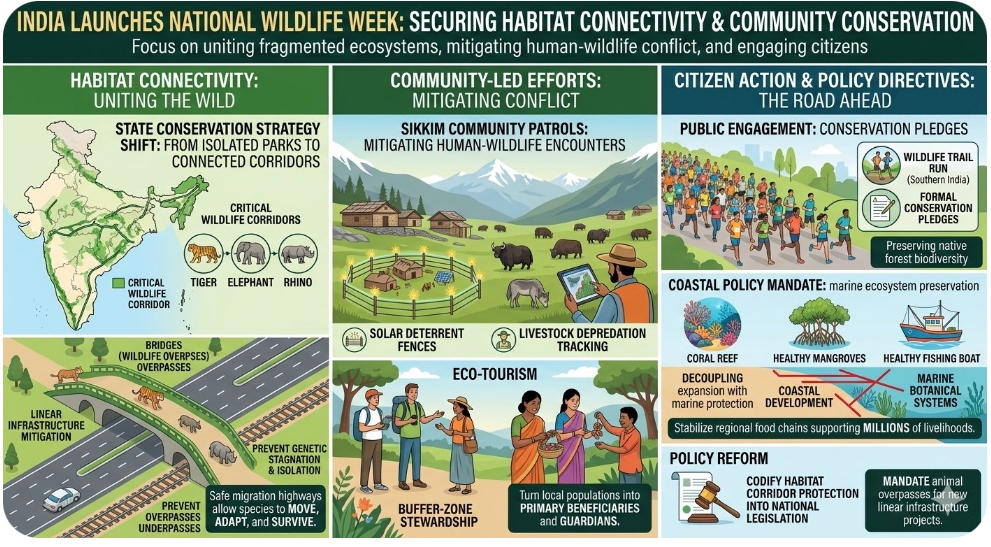
India has officially commenced its annual National Wildlife Week celebrations across its most critical ecological hotspots, rolling out a series of aggressive campaigns designed to secure fragmented wildlife habitats. Moving under the nationwide directive of connecting habitats and ensuring thriving wildlife, environmental departments have activated extensive local networks to address the country’s most pressing ecological strains. The coordinated launch marks a significant shift in state conservation strategy, moving away from isolated forest protection models to focus heavily on stabilizing the fragile boundaries where human settlements meet wilderness zones.
In the northern mountainous regions, the Forest and Environment Department of Sikkim has initiated community-led patrol systems across its high-altitude sanctuaries to mitigate escalating human-wildlife encounters. Conservation officers are working directly with indigenous communities to install solar-powered deterrent fences and track wildlife migration corridors to reduce livestock depredation by apex predators. Concurrently, across urban centres in southern India, massive public engagement campaigns have taken off, including flagship wildlife trail runs that brought together thousands of citizens to take formal conservation pledges aimed at preserving native biodiversity.
Dr Arham Vardhan, a veteran field biologist specialising in landscape ecology, strongly endorsed the unified national focus on contiguous forest pathways. He pointed out that isolating wildlife inside artificially drawn park boundaries creates genetic stagnation and amplifies conflict with nearby agrarian villages. In his reaction, he stated that a sanctuary without a safe, connected corridor is merely an open-air zoo destined for ecological decay, adding that true wildlife protection requires protecting the migration highways that allow species to move, adapt, and survive.
The nationwide drive is operating alongside strict new policy guidelines presented at the concluding day of the national Earth Again Conference in Bhubaneswar. Global climate strategists and state planners at the summit issued a sharp directive emphasising that India’s rapid infrastructure expansion must be aggressively coupled with localised marine and coral reef protection. The delegation warned that ignoring near-shore marine botanical systems during coastal development drives will completely destabilise the regional food chains that support millions of domestic fishing livelihoods.
Editor's Note: To transform Wildlife Week from a symbolic annual event into a permanent conservation triumph, India must codify habitat corridor protection into national infrastructure legislation. Linear infrastructure projects, such as highways and railways cutting through eco-sensitive zones, must legally mandate the construction of overpasses and underpasses designed specifically for animal migration. Furthermore, municipal budgets must allocate dedicated funds to support community-led eco-tourism and buffer-zone stewardship, turning local populations into the primary financial beneficiaries and guardians of thriving, continuous ecosystems.



Leave a comment