

TreeTake Network
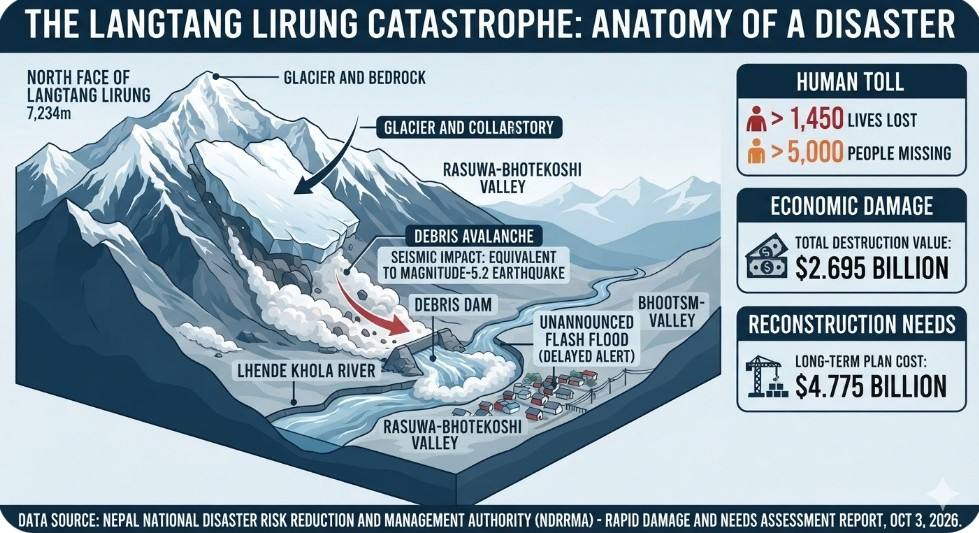
A catastrophic bedrock collapse on the north face of Langtang Lirung generated a localised shockwave equivalent to a magnitude-5.2 earthquake, triggering the sudden and unannounced flash flood that devastated the Rasuwa-Bhotekoshi corridor. The harrowing details were officially published today in a comprehensive Rapid Damage and Needs Assessment (RDNA) report released by Nepal’s National Disaster Risk Reduction and Management Authority (NDRRMA), operating under the Ministry of Home Affairs. The highly anticipated scientific audit formally accounts for the failure of downstream early warning systems, whilst placing the total financial destruction at a staggering 2.695 billion dollars.
The investigation reveals that a massive, unstable slab of glacial ice and underlying alpine bedrock sheared cleanly off the mountain face. The kinetic impact of millions of tonnes of debris hitting the valley floor sent shockwaves through the region, immediately followed by a massive secondary avalanche that temporarily dammed the Lhende Khola River. When this unstable wall of ice and rock abruptly ruptured, it sent an unannounced wall of water, mud, and boulders downstream, completely bypassing traditional early warning metrics and giving communities no time to mobilise. The disaster has claimed more than 1,450 lives, with over 5,000 individuals still officially registered as missing.
Government officials emphasise that treating this purely as a localised weather event ignores the systemic climate risks reshaping high-altitude geography. Speaking at the publication launch, Anil Pokhrel, Chief Executive Officer of the NDRRMA, stated: "The sheer kinetic force of this collapse, registering as a localised seismic event, underscores a terrifying reality. Our existing downstream early warning frameworks are simply not designed to anticipate structural mountain failures of this magnitude, meaning we must shift our focus to real-time satellite monitoring of high-altitude glacial stability."
The economic toll detailed in the report is equally unprecedented. Repairing shattered infrastructure, restoring paralysed hydropower units, and rebuilding thousands of homes will require a long-term mobilisation blueprint costing the nation an estimated 4.775 billion dollars. In response to these findings, the Nepalese government announced an emergency multi-year initiative to begin actively draining four volatile glacial lakes deemed most at risk of similar failures.
Highlighting the regional urgency, a senior planning official from the National Planning Commission remarked: "The reconstruction blueprint requires international solidarity. This is not merely an infrastructural recovery project; it is a fundamental reconfiguration of mountain settlement safety in the era of rapid cryosphere degradation."
Editor's note: This report synthesises the official findings from the RDNA publication released on 3 October 2026 by Nepal’s National Disaster Risk Reduction and Management Authority (NDRRMA) in coordination with the National Planning Commission.



Leave a comment