

TreeTake Network
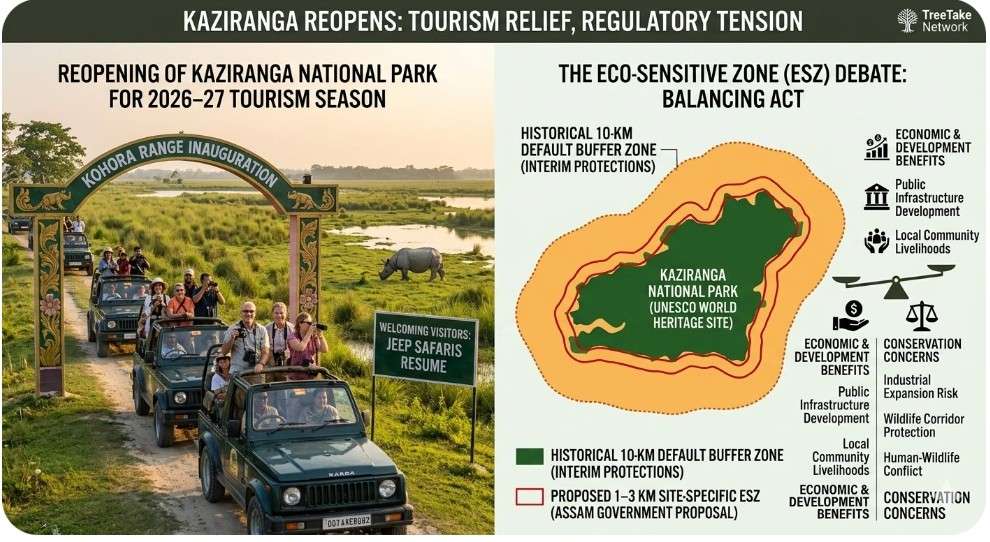
The globally renowned Kaziranga National Park and Tiger Reserve officially reopened its gates today, 3 October 2026, marking the commencement of the 2026–27 ecotourism season following its annual monsoon closure. The ceremonial reopening, held at the Kohora Range, saw jeep safaris immediately resume operations for domestic and international wildlife enthusiasts. However, the commercial milestone arrives amid a growing administrative debate surrounding a proposal by the Assam government to modify the park’s peripheral protections by establishing a site-specific Eco-Sensitive Zone (ESZ) with a reduced 1–3 kilometre buffer.
The transition to the new ecotourism calendar commenced with official administrative actions. Jeep safari services resumed across both the Central Range at Kohora and the Western Range at Bagori, whilst elephant safaris remain temporarily suspended as forest personnel complete logistical arrangements. The seasonal reopening is expected to provide critical economic relief to regional hospitality workers, safari operators, and local guides whose livelihoods depend on the landscape. However, the day's events were partially impacted by a wildlife encounter at the Bhaichamari Forest Camp under the Bagori Forest Range, where a forest worker, identified as Pradip Barua, sustained injuries following an attack by a rhinoceros whilst on active duty.
The structural focal point for environmental analysts remains the state government's ongoing push to redefine the park's protective perimeters. The interim safety buffer around the UNESCO World Heritage Site has historically stood at a default 10-kilometre limit. The Assam government has actively proposed replacing this uniform boundary with a site-specific ESZ stretching between 1 and 3 kilometres, arguing that the expansive interim limit severely hampers necessary public infrastructure development and affects local communities residing in peripheral areas.
State officials present at the park's opening highlighted the economic expectations for the region. At the formal inaugural ceremony at the Kohora Range, Assam Environment and Forest Minister Jayanta Mallabaruah stated that he formally marked the reopening of Kaziranga National Park for the 2026–27 tourism season, welcoming visitors and wildlife enthusiasts from across the country and abroad. The Minister further expressed hope that tourist arrivals would surpass last season's figures.
Conversely, the proposed regulatory shrinkage has drawn scrutiny from conservationists and legal practitioners who focus on regional wildlife corridors. The ongoing discourse highlights fears that shortening the buffer zone could inadvertently permit industrial expansion, alter critical transit paths used by migratory wildlife outside formal park boundaries, and increase human-animal conflict instances in the fringe sectors. Government representatives have countered these concerns by clarifying that the proposed adjustments strictly align with judicial frameworks allowing site-specific specifications, and that the core boundaries of the park itself will remain completely unchanged.
Editor's note: This report incorporates official field briefings from the Assam Forest Department, statements recorded at the ecotourism inaugural event on 3 October 2026, and legal filings regarding the Kaziranga Eco-Sensitive Zone regulatory framework.



Leave a comment