

TreeTake Network
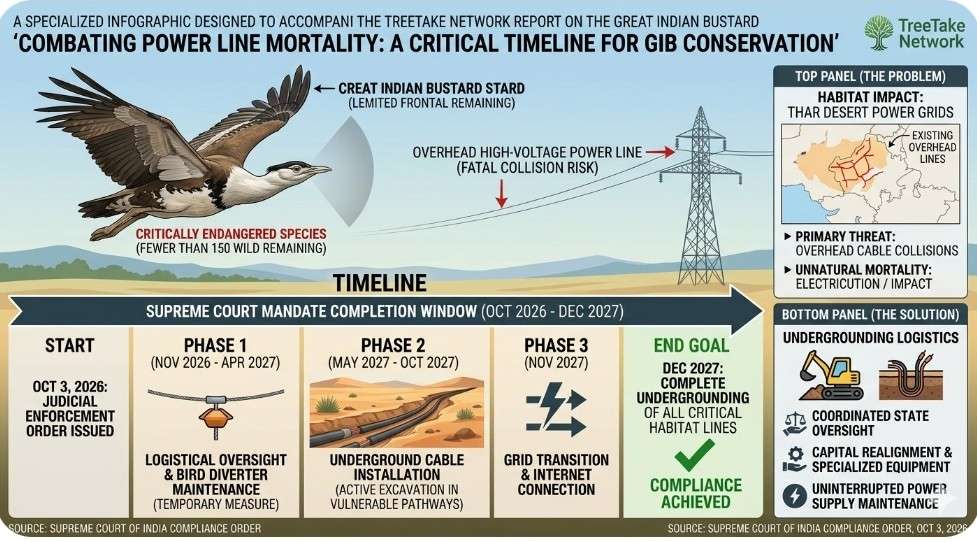
The Supreme Court of India today issued a strict regulatory directive enforcing a definitive compliance timeline that orders all high-voltage power lines running through the peripheral habitats of the critically endangered Great Indian Bustard (GIB) to be buried underground by December 2027. The judicial mandate represents a significant intervention to halt the rapid population decline of the species, which faces imminent extinction primarily due to fatal collisions with overhead power cables in its last remaining strongholds across Rajasthan and Gujarat.
The enforcement order targets a major source of unnatural mortality for the heavy-flying birds. Due to their poor frontal vision and immense body weight, Great Indian Bustards are biologically incapable of spotting overhead cables in time to maneuver away, leading to instantaneous electrocution or fatal impact injuries upon collision. Conservation biologists have long identified these low-visibility power grids—built rapidly to evacuate power from massive solar and wind energy fields in the Thar Desert—as the single greatest threat to the species' immediate survival. Fewer than 150 individuals are estimated to remain in the wild.
The judicial intervention directly addresses the historical friction between green energy expansion and wildlife preservation. While power companies and state transmission corporations previously argued that undergrounding high-voltage lines is technically challenging and financially prohibitive over vast desert terrains, the bench clarified that wildlife survival timelines cannot be left open-ended. The court stated that the technical transition must be systematically executed and completed within the next fourteen months, putting an end to consecutive implementation delays.
The structural implementation of the undergrounding project will require coordinated logistical oversight across multiple state departments. Central and state authorities are required to supervise the transition, ensuring that ongoing power supply to local grids remains uninterrupted whilst cable installation proceeds along vulnerable migratory pathways. To prevent further ecological damage during the transitional phase, the court directed that bird diverters must be maintained and properly managed on all existing overhead lines until the underground infrastructure becomes fully operational.
Environmental practitioners and conservation groups have welcomed the definitive deadline, noting that a firm timeline provides the legal leverage necessary to hold state agencies accountable. However, power infrastructure developers have expressed logistical concerns regarding the short window, pointing out that purchasing specialized underground cables and excavating rocky desert terrain within the mandated period will require unprecedented speed and significant capital realignment.
Editor's note: This report outlines the judicial compliance order issued on 3 October 2026 by the Supreme Court of India regarding habitat protection infrastructure for the Great Indian Bustard.



Leave a comment