

TreeTake Network
A sharp contraction in India’s foreign exchange reserves has exposed the severe economic vulnerabilities tied to fossil fuel dependency. The official data, published in the Reserve Bank of India’s weekly statistical supplement, shows the nation's total currency chest falling to 747.56 billion dollars. Environmental economists point out that this massive fiscal drain is a direct consequence of the country's reliance on imported crude oil, which has spiked in cost due to recent maritime environmental and security crises along international shipping corridors.
The Ecological Resource Crisis
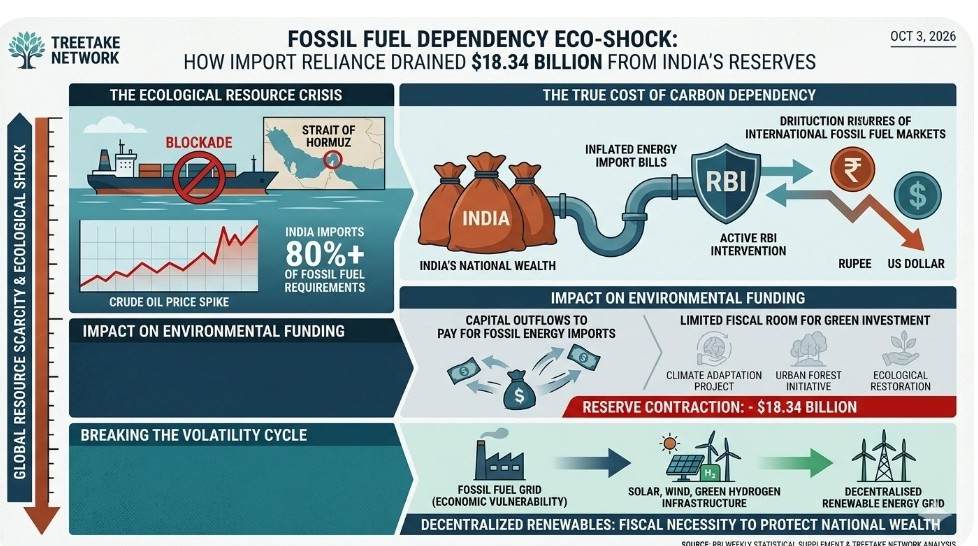
The financial shock highlights the direct connection between ecological resource vulnerability and macroeconomic stability. Following recent projectile attacks and blockades on commercial oil tankers in the Strait of Hormuz, global energy markets suffered immediate supply disruptions, causing crude prices to surge. Because India must import more than 80 per cent of its fossil fuel requirements to sustain its domestic energy grid, the country was forced to deploy vastly larger sums of foreign currency simply to cover its inflated energy bills and prevent a volatile collapse of the Indian Rupee.
The True Cost of Carbon Dependency
Climate policy analysts emphasise that treating foreign exchange fluctuations purely as a banking issue overlooks the underlying resource crisis. The high cost of carbon-intensive fuels acts as a continuous drain on national wealth during international supply disruptions. Conservation advocates argue that if a fraction of the capital used to stabilise currency markets against oil shocks were redirected toward accelerating domestic solar, wind, and green hydrogen infrastructure, the country could insulate its economy from external resource scarcity.
Impact on Environmental Funding
The structural strain on the nation's wealth pool also affects long-term environmental funding capacity. Large-scale capital outflows to pay for fossil energy imports limit the fiscal room available for state governments to invest in climate adaptation projects, urban forest initiatives, and ecological restoration. Financial experts note that whilst a reserve of 747.56 billion dollars remains a strong defence against immediate market panics, sustained dependency on fragile global fossil fuel networks presents a long-term risk to both economic and environmental security.
Breaking the Volatility Cycle
Sustainability practitioners have urged a faster transition toward decentralised renewable energy grids to break this cycle of economic vulnerability. Moving away from volatile foreign oil markets is no longer just a conservation goal, but a fiscal necessity to protect national wealth. Until the transition to a low-carbon economy is achieved, India's broader financial reserves will remain exposed to the ecological and geopolitical instabilities inherent in the global fossil fuel supply chain.
Editor's note: This report analyses the ecological and resource implications of the weekly statistical data the Reserve Bank of India released on 3 October 2026.


.jpg?resize=780%2C450&ssl=1)



Leave a comment