

TreeTake Network
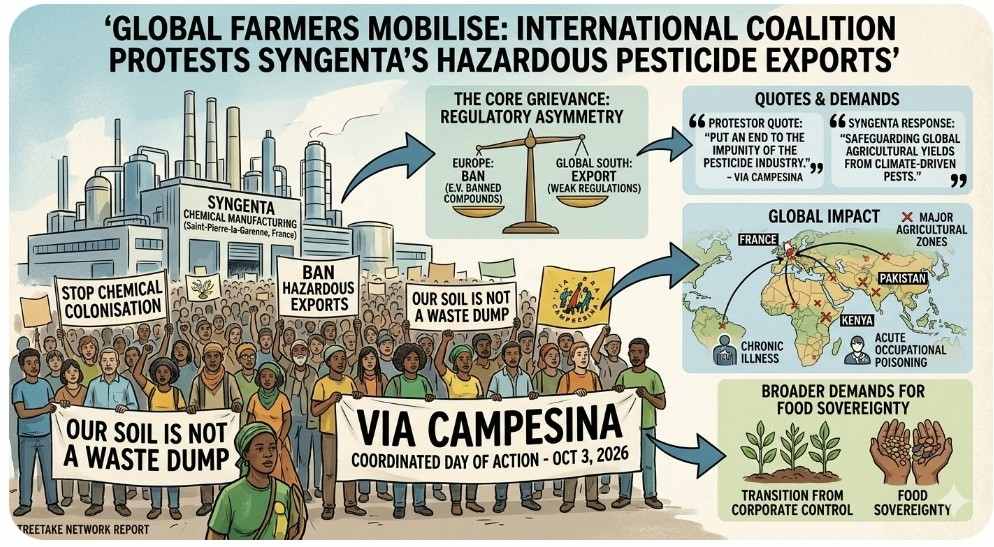
Thousands of agricultural workers, trade unions, and health advocates gathered globally today, 3 October 2026, to stage coordinated demonstrations against the agrochemical multinational Syngenta. The massive international mobilisation, coordinated by global rural movements including Via Campesina, targets the production and export of highly hazardous chemical pesticides to developing countries. The focal point of the movement materialised outside Syngenta's major chemical manufacturing facility in Saint-Pierre-la-Garenne, France, where protestors demanded an immediate halt to what they term chemical colonisation.
The Core Grievances of the Mobilisation
The demonstrators, comprising farmers, cancer patients, and residents from affected agrarian zones, are demanding corporate accountability for long-term soil and water contamination. A key issue raised by organisers is the regulatory asymmetry that permits European agrochemical giants to manufacture toxic pesticides within Europe and export them to Global South nations, even when those specific chemical compounds are legally banned from use inside European fields. Activists argue that this system exploits weaker environmental regulations abroad, resulting in high rates of chronic illnesses and acute occupational poisoning among small-scale farmers who lack protective equipment.
Highlighting the shared determination of the international movement, an official campaign statement issued by Via Campesina declared: "On October 3, 2026, we will be present in France and in all the other territories that wish to join our fight, to put an end to the impunity of the pesticide industry. To end chemical insecurity, the expression of collective anger is essential."
Corporate Response and Scientific Counter-Arguments
Syngenta published an official response addressing the protests, defending its technological innovations as necessary components of modern agriculture. The corporation challenged a newly updated 2026 scientific paper circulating among advocacy groups regarding annual pesticide poisoning data, stating that the methodology relies on unvalidated metrics and massive statistical extrapolations from unrepresentative localised groups.
Defending its operations and calling for collaborative dialogue, Syngenta stated in an official media briefing: "We recognise that there are organisations fundamentally opposed to modern agricultural technologies. While we recognise the right of people to express diverse opinions and respect the dedication and conviction of demonstrators, the depth of their concern may at times influence their interpretation of a complex issue and make it challenging to consider all aspects of the evidence with complete objectivity."
Broader Demands for Food Sovereignty
The demonstrations have expanded to include systemic demands for global food sovereignty and a transition away from corporate-controlled seed and chemical dependencies. Coordinated local actions were reported across agricultural hubs in Switzerland, Kenya, and Pakistan. Legal advocates participating in the marches noted that the global movement aims to build pressure for stricter international trade laws, effectively closing existing loopholes that allow the transboundary transfer of ecologically damaging substances under the guise of agricultural assistance.
Editor's note: This report incorporates corporate briefings issued by Syngenta on 2 October 2026 and field updates from the international coalition organising the 3 October global day of action.


.jpg?resize=780%2C450&ssl=1)



Leave a comment