

TreeTake Network
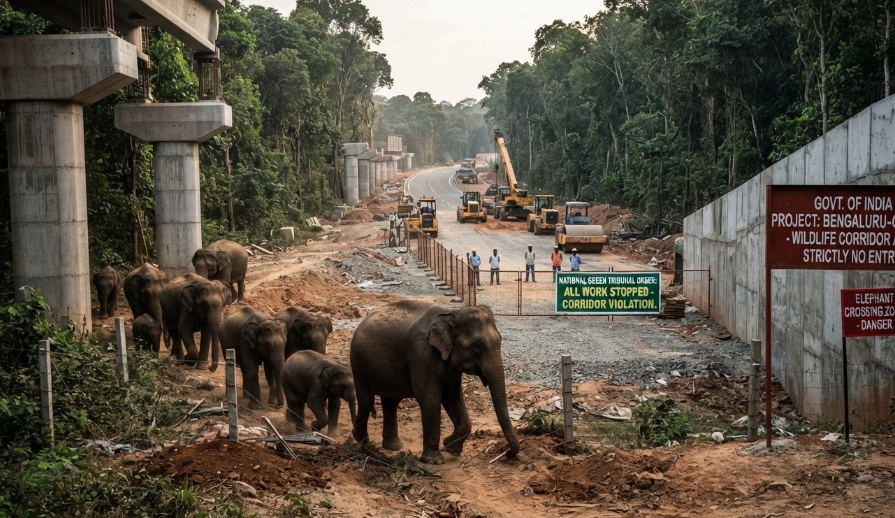
For generations, the Asian elephant (Elephas maximus) has remained an integral part of India’s rich natural and cultural heritage, inspiring communities with its strength, intelligence, and deep social being. However, the modern reality facing India’s national heritage animal is increasingly grim. A highly aggressive expansion of linear infrastructure—ranging from multi-lane highways and railway lines to cutting-edge mining projects—is structurally severing the ancient migratory paths these animals have traversed for centuries.
The DNA Baseline: A Reality Check
The scientific foundation of this crisis was officially laid out on October 14, 2025, when the Wildlife Institute of India (WII) and the Ministry of Environment, Forest and Climate Change released the report titled Status of Elephants in India: DNA-based Synchronous All-India Population Estimation of Elephants (SAIEE 2021-25). Moving away from subjective visual counts, this scientific baseline confirmed the presence of 22,446 wild Asian elephants nationwide, establishing a rigorous genetic library via 21,056 dung samples. While the Southern Landscape remains the chief stronghold, holding 53% of the total population, the true takeaway of this genetic framework is that it isolates how intensely fragmented the populations have become. By tracing unique genetic profiles, the census proves that shrinking habitats are trapping individual herds in ecological islands.
The Graver Situation Within the Survey Period (2021–2025)
The multi-year timeline of the study itself exposes a much graver reality on the ground. During the four years it took to gather and validate this complex data, the landscape experienced rapid deterioration. The underlying data indicates an 18% to 25% drop when contrasted against past counting methods—a discrepancy that researchers attribute to a combination of historical overcounting and active habitat loss during the study period. More critically, the survey period documented an accelerating trend of land-use changes that completely wiped out historic pathways before the final report could even be published.
Why the Data Has Ignited a Fresh Crisis Today
While the census data was made public a year ago, it has taken on explosive relevance today due to a landmark Supreme Court directive passed in August 2026. The apex court ruled that individual States cannot block traditional elephant corridors, formally establishing a nationwide "right of passage" for elephant herds and demanding absolute inter-state coordination. This historic ruling has suddenly turned the 2025 census data into a powerful legal weapon. Environmental lawyers and field groups are actively using the WII's DNA-validated corridor maps in courtrooms right now to demand the immediate demolition of illegal fences, corporate resorts, and commercial barriers that directly violate the Supreme Court's new decree.
The Choke Point: Corridors Under Siege From Government Projects
The primary battleground for the survival of the species lies within its migratory corridors. Official data validates over 150 critical elephant corridors across India, but nearly 20% of these corridors are now in a state of active decline or are structurally impaired due to human encroachment and aggressive state development. When these narrow lifelines are blocked, the result is an explosion of human-elephant conflict. Major structural pain points driven by state and central projects include:
- The East-Central Mining Crisis (Odisha & West Bengal): West Bengal alone holds the highest number of corridors (26), representing over 17% of the national total. Large-scale government-allocated coal mining blocks and thermal power grid lines have sliced through these regions, creating heavily fragmented forest patches interspaced with paddy fields. Without continuous forest cover, elephants frequently cross into agricultural land, leading to rampant crop-raiding, accidental electrocutions via low-hanging public power lines, and tragic loss of human life.
- State Highway and Rail Expansion Fatalities: Unmitigated public works projects, including multi-lane highway widenings and railway track doubling across the Siliguri corridor in the Northeast and specific public transit segments in Tamil Nadu and Uttarakhand, have turned ancient paths into death traps. Speeding state trains routinely strike and kill migrating herds because government departments continuously delay the implementation of underground eco-ducts and overpasses.
- Captive Management Debates: The crisis extends to captive populations where commercial exploitation, particularly within unmonitored eco-tourism safaris, creates severe psychological and physical stress, disrupting the natural social being inherent to the species.
Systemic Friction: Budgetary Standoffs and Injunctions
The core bottleneck in resolving this crisis is the severe institutional conflict within the central government itself. The Ministry of Environment, Forest and Climate Change has prioritised a list of over 100 sensitive stretches that require immediate mitigation infrastructure. However, intense budgetary friction has erupted with the Ministry of Railways over the staggering costs associated with constructing elevated tracks and subterranean eco-bridges. The Ministry of Railways routinely pushes back against funding these multi-crore ecological structures entirely from its development capital, arguing that the financial burden should be shared or heavily subsidised by environmental funds.
Because of this bureaucratic deadlock, critical infrastructure projects have stalled or become targets of intense litigation. Major national projects are currently facing severe legal injunctions and standoffs due to their projected impact on wildlife:
- The Hubli-Ankola Railway Project: This massive 168-kilometre proposed rail line in the Western Ghats is locked in an intense legal battle. Conservationists have successfully secured stays against its construction, demonstrating that the project would tear directly through lush, contiguous forests, a primary tiger reserve, and vital elephant migration paths, necessitating the destruction of thousands of old-growth trees.
- The Bengaluru-Chennai Railway Track Doubling: This high-priority transit project is facing fierce legal resistance and structural halts over a highly sensitive 32-corridor bottleneck zone in Southern India. Tracks passing through these areas act as permanent barriers, forcing herds into agricultural lands and coffee estates, prompting recent emergency courts to demand immediate project suspensions until adequate underpass models are cleared.
Engineering Coexistence: Foolproof Blueprints for Wildlife Eco-ducts
To dismantle these blockages, the National Green Tribunal (NGT) and the Supreme Court have begun enforcing specific, non-negotiable engineering blueprints developed by the Wildlife Institute of India. Studies show that elephants suffer from severe claustrophobia and will completely reject passage structures that do not offer a clear, panoramic line of sight. Consequently, the minimum dimensions for any functionally successful elephant underpass are now strictly standardised.
Every structural eco-duct must feature a clear clearance height ranging from 6 to 8 metres (ideally matching the 7-metre maximum standard for full adult herds with calves) and a minimum width of 10 to 12 metres. Crucially, the length of the structure dictates its architectural scale; as a highway or railway system widens to multiple lanes, the "Openness Index" (calculated as width multiplied by height, divided by length) drops. To offset this, a four-lane divided highway requires underpass widths to expand up to 30 metres across to maintain the illusion of open space. The blueprints also mandate structural funnelling—using a 500-metre diagonal web of reinforced fencing on both approach sides—coupled with extensive habitat enrichment to naturally guide herds away from tarmac and tracks into the structural openings.
Judicial Enforcement: The National Green Tribunal’s Iron Fist
The legal landscape has transformed due to the proactive stances taken by the National Green Tribunal. The green panel has aggressively internalised the 2025 census data to issue crushing financial penalties against both public and private developers who attempt to bypass structural wildlife safeguards. The NGT has established clear legal precedents ruling that any highway expansion failing to construct WII-compliant eco-ducts inside validated corridors will face immediate project suspension and severe environmental compensation fines. The tribunal has repeatedly targeted regional infrastructure divisions, warning that state-sponsored delays in implementing eco-sensitive zoning regulations will be treated as direct legal violations of the environment, enforcing strict financial accountability on local authorities to protect these ancient paths.
Perspectives from the Field
- Official Viewpoint (Wildlife Institute of India): Speaking on the condition of anonymity, a senior field researcher involved with the SAIEE report stated, "The DNA-based census made public in late 2025 must not be treated as a mere numbers game; it is an alarm bell. With the Supreme Court's August 2026 directive on the right of passage, our spatial maps have transitioned from academic data into legally binding boundaries. This means state governments can no longer clear their own major roads through these pathways without facing severe legal consequences."
- Conservation Advocacy (Ex-Project Elephant Official): Speaking on the condition of anonymity, a former top administrator with Project Elephant noted, "We spent the entire 2021–2025 survey period watching critical corridors fragment in real-time under heavy corporate and public infrastructure development. Now that the apex court has mandated a uniform national corridor strategy, we finally have the legal teeth to freeze state-sponsored infrastructure projects like the Hubli-Ankola line that are actively slicing through these ancient pathways."
- Welfare and Policy Outlook: Speaking on the condition of anonymity, a regional wildlife warden overseeing captive welfare laws added, "The commodification of these animals for eco-tourism reached a breaking point during the years of this study. While local communities deserve livelihoods, the domestic elephant is not a prop. Without strict, unyielding enforcement of veterinary regulations and the elimination of commercial safaris that force animals onto concrete, we are violating the very cultural heritage we claim to protect."
The Way Forward
The findings from TreeTake's assessment make it clear that passive conservation is no longer an option. Securing India’s ecological future requires an aggressive strategy: legally designating all remaining elephant corridors as eco-sensitive zones, constructing functional eco-bridges over existing highways, and imposing strict legal mandates to reroute future infrastructure projects around established elephant habitats.



Leave a comment