

The degradation of river ecosystems has emerged as one of the definitive environmental crises of the twenty-first century. As nations grapple with rapid urbanisation and industrial expansion, the lifelines of human civilisation—our rivers—are bearing the brunt of unchecked pollution. On World Rivers Day, the stark contrast between international river restoration successes and India's expensive, yet largely ineffective, clean-up initiatives comes into sharp focus. Despite the allocation of thousands of crores of rupees over decades under various national schemes, India’s primary river systems remain critically polluted, presenting a sobering case study in infrastructural mismanagement and systemic policy failure.
TreeTake Network
Reports from our network correspondents across major riparian zones in India reveal a distressing pattern. From the foam-choked stretches of the Yamuna in Delhi to the heavy metal-laden waters of the Ganga near Kanpur, localised monitoring shows that faecal coliform levels and biochemical oxygen demand (BOD) regularly exceed permissible human safety limits by hundreds of times. Field samples collected across our regional monitoring grid confirm that natural self-purification capacities in Indian rivers have dropped to near-zero. Ground teams note that heavy urban stretches of the Sabarmati, Yamuna, and Mula-Mutha rivers have completely ceased to function as living aquatic environments, transforming instead into open, stagnant channels for industrial and domestic waste. In contrast, data coming in from international environmental agencies shows a steady, decades-long trajectory of recovery for rivers that were once declared biologically dead.
A Tale of Two Currents: The Implementation and Data Divide
The financial scale of India's river cleaning programmes is staggering. The flagship Namami Gange Programme, launched with an initial outlay of ₹20,000 crore, has seen continuous funding injections alongside the broader National River Conservation Plan. Yet, the scale of the crisis is precisely documented in the latest comprehensive water quality inventories. Out of 603 rivers monitored across the country, the Central Pollution Control Board (CPCB) classified 311 stretches across 279 rivers as "critically polluted". While a BOD level above 3 milligrams per litre (mg/L) renders water unfit for bathing, monitoring stations along the Yamuna at Delhi and the Ghaggar in Punjab regularly log BOD spikes exceeding 30 to 50 mg/L.
The Infrastructure Chasm: Building Without Connecting
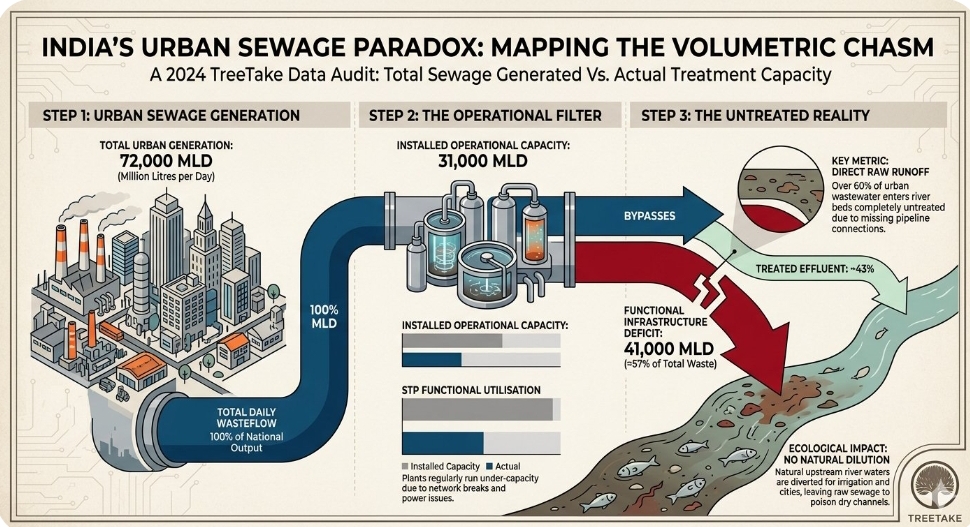
The core of the failure lies in a fundamental structural chasm between sewage generation and functional infrastructure. Indian cities produce approximately 72,000 million litres per day (MLD) of municipal sewage. However, the combined operational capacity of all installed treatment facilities sits at just over 31,000 MLD. In reality, due to operational inefficiencies, over 60% of the urban wastewater enters natural river beds completely untreated every single day.
"We are trapped in a cycle of pouring money into concrete infrastructure without fixing the underlying governance," states Dr. Sunita Narain, Director General of the Centre for Science and Environment (CSE). "You cannot clean a river by simply building treatment plants if the sewage network does not connect households to those plants, leaving the waste to flow directly into the river anyway."
The International Blueprint: Source Protection and Legal Teeth
This structural deficit stands in sharp contrast to international standards, where the blueprint for success relies on strict, centralised legal accountability and holistic watershed management rather than piecemeal engineering projects.
Consider the restoration of the River Thames in the United Kingdom. In the mid-nineteenth century, the river was so profoundly polluted it caused the "Great Stink" of London and was declared biologically dead by the 1950s. The UK turned the tide through rigorous statutory enforcement, massive investments in centralised, legally compliant sewage systems, and the creation of the National Rivers Authority. Today, the Thames hosts over 125 species of fish.
Similarly, the restoration of the Rhine in Europe, which spans multiple nations, succeeded through international legal treaties like the Rhine Action Programme, which launched clear, binding targets to reduce chemical discharges by 50%. The target was met ahead of schedule because industrial polluters faced crippling financial penalties and immediate shutdowns for non-compliance.
In the United States, under the strict mandate of the Clean Water Act, municipal authorities are legally required to maintain National Pollutant Discharge Elimination System permits. This framework treats any unauthorised discharge of a pollutant from a point source into a river as an immediate, heavily penalised statutory violation, allowing over 70% of evaluated American waterways to support healthy ecosystems.
Regulatory Gaps: The Retrospective Failure of Enforcement
In India, heavy industrial compliance remains a secondary concern, frequently compromised by local corruption and weak enforcement capabilities. A striking example is the toxic contamination of the Ganga basin by leather tanneries in Uttar Pradesh and chemical units in West Bengal. Sampling studies reveal heavy metal concentrations—including chromium, cadmium, and lead—at levels up to 200 times higher than World Health Organisation safety limits in downstream sediments.
"The fundamental difference is that international models focus on preventing pollution from entering the source. In India, our approach is retrospective," emphasises Prof. Vinod Tare, founding coordinator of the Centre for Ganga River Basin Management and Studies (cGanga) at IIT Kanpur. "We allow untreated waste to mix with the river and then attempt to clean it. Until we enforce a strict policy of 'zero liquid discharge' for industries and completely separate our storm-water drains from sewage lines, public money will continue to yield no measurable ecological return."
The Destruction of Ecological Flows: Drying Out the Lifelines
Further compounding this is the physical manipulation of the waterways themselves. "We are witnessing a total systemic decoupling between urban growth and environmental governance," states Dr. Himanshu Thakkar, Coordinator of the South Asia Network on Dams, Rivers and People (SANDRP). "The state installs treatment systems based on engineering assumptions rather than ecological flows. When a river is dammed and diverted upstream for agriculture and cities, it loses its natural dilution capacity. Pouring under-treated sewage into a dry river bed guarantees ecological death, no matter how much money is poured into the project."
The mathematical reality is undeniable. While the European Union’s Water Framework Directive has successfully brought over 40% of its surface waters to "good ecological status" through rigid, data-driven basin management, India's regulatory boards function as descriptive agencies that merely record the death of rivers rather than enforcement bodies that prevent it.
"The institutional machinery has failed to penalise polluters effectively," explains Madhav Gadgil, renowned ecologist and founder of the Centre for Ecological Sciences at the Indian Institute of Science. "Without empowering local community panchayats and riparian populations to legally prosecute municipal bodies and corporate entities that poison their water, top-down funding will remain entirely futile."
Editor's Note
The empirical evidence indicates that India's river crisis cannot be spending-engineered out of existence. The persistent degradation of our water tables is a direct byproduct of a regulatory framework that treats environmental compliance as a negotiable option rather than an unyielding law. Until the country establishes a legally binding, independent river basin authority with the power to penalise municipal commissioners and corporate executives criminally, public funds will simply continue to flow down a heavily contaminated drain.



Leave a comment