

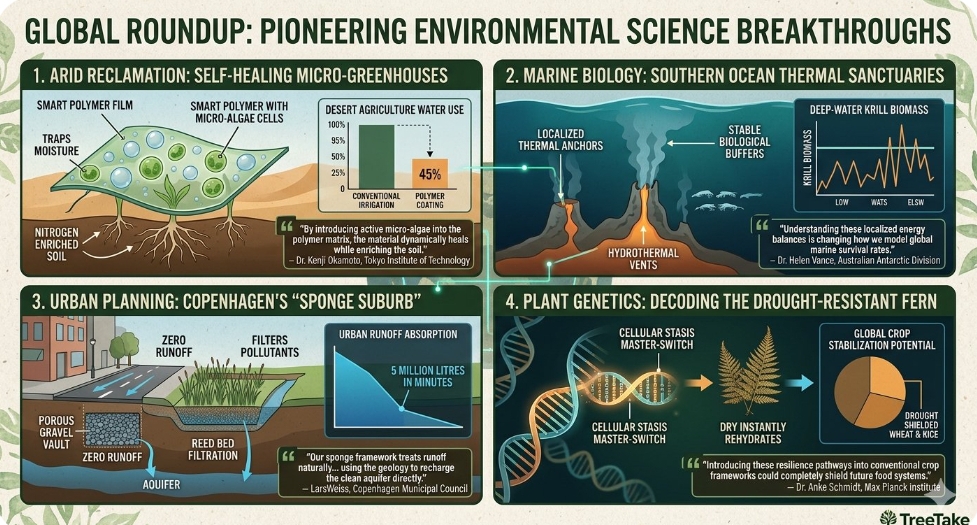
As traditional conservation strategies reach their structural limits, the focus of global environmental engineering is rapidly shifting towards laboratory innovation and systemic urban adaptation. This month’s global roundup tracks four critical breakthroughs across material science, marine biology, civil planning, and plant genetics. From the deep trenches of the Southern Ocean to the pioneering urban design grids of Scandinavia, these data-driven developments highlight how international scientific institutions are constructing new defence mechanisms against rapid ecological shifts.
TreeTake Network
Dispatches from our international monitoring points indicate a profound shift in the research landscape. While traditional ecological field updates continue to document habitat loss, laboratory networks are increasingly reporting practical interventions driven by genetic sequencing and structural bio-engineering. This shift underscores a broader global realisation: surviving the Anthropocene requires moving past reactive policy measures and moving directly into the deliberate creation of climate-resilient systems.
1. Arid Reclamation: The Rise of Self-Healing Greenhouses
In a significant leap for dryland agricultural security, material scientists at the Tokyo Institute of Technology have engineered a biodegradable polymer coating designed specifically for automated greenhouse farming in hyper-arid zones. The material uses embedded micro-algae cells to trap moisture while naturally synthesising ambient nitrogen to feed the underlying topsoil. Laboratory testing profiles indicate that these smart greenhouse sheets can reduce agricultural water usage metrics by up to 45% while simultaneously boosting early crop yield retention rates by nearly a third.
The breakthrough fundamentally shifts how crop microclimates are maintained in vulnerable zones. "We have moved away from conventional passive plastic barriers that degrade rapidly under harsh ultraviolet radiation," explains Dr. Kenji Okamoto, lead researcher of the biomaterials division at the Tokyo Institute of Technology. "By introducing active micro-algae components directly into the synthetic matrix, the polymer dynamically heals its own structural fissures while enriching the micro-environment. This represents a functional blueprint for self-sustaining food security in regions facing acute desertification."
2. Marine Ecology: Thermal Anchors Found in the Southern Ocean
A joint deep-sea exploration project spearheaded by the Australian Antarctic Division has successfully mapped a network of previously undocumented hydrothermal vents in the deep Southern Ocean. These vents are producing highly localised underwater thermal sanctuaries. Marine telemetry arrays and automated submersible checks show that despite surrounding fluctuations in polar current temperatures, these unique geothermal zones maintain stable, nutrient-dense microclimates.
The discovery carries profound implications for marine food web survival. "These subterranean structures function as vital biological buffers," notes Dr. Helen Vance, a senior marine biologist participating in the southern polar survey. "As the broader oceanic column undergoes rapid thermal transitions, these zones act as microclimate anchors, allowing critical populations of deep-water krill and sensitive benthic organisms to seek refuge. Understanding these localised energy balances is changing how we model global marine survival rates."
3. Infrastructure Design: Copenhagen’s Zero-Runoff "Sponge Suburb"
In the arena of urban climate adaptation, municipal planners in Copenhagen have officially certified the completion of Scandinavia's first fully integrated, zero-runoff suburban district. The entire neighbourhood structure is built upon massive subterranean porous gravel vaults and localised bio-swales. Field data confirmed that during a recent severe cloudburst event, the infrastructure successfully absorbed and processed 5 million litres of flash storm-water within minutes, completely eliminating surface flooding.
The urban water cycle is managed through natural biological filtration systems. "Conventional civil engineering relies entirely on concrete drainage pipes designed to channel dirty water away as quickly as possible, which inevitably overwhelms municipal river networks," states Lars Weiss, Director of Sustainable Development at the Copenhagen Municipal Planning Council. "Our sponge framework retains, treats, and filters urban runoff naturally through reed beds, using the geology of the suburb to recharge the underlying clean drinking water aquifer directly on-site."
4. Agricultural Genetics: Ancient Fern Decoded for Drought Defiance
Botanists at the Max Planck Institute have completed the comprehensive genetic sequencing of a resilient, ancient jungle fern species capable of surviving absolute cellular dehydration for months. By completely mapping the plant's genome, laboratory teams have isolated the specific transcription factors responsible for initiating a state of cellular stasis during prolonged dry spells.
The genetic discovery holds massive potential for stabilising global staple crops. "The evolutionary mechanisms we have mapped in this fern act as a biological master-switch," explains Dr Anke Schmidt, Head of the Plant Genomics Group at the Max Planck Institute. "When moisture levels drop to zero, the plant completely halts cellular degradation, protecting its core DNA architecture until water returns. Introducing these specific resilience pathways into conventional crop frameworks like wheat and rice could completely shield future food systems from catastrophic climate disruptions."
Editor's Note
This global roundup demonstrates that the next phase of environmental protection will be won or lost in the spaces of empirical innovation. While global political summits remain bogged down by geopolitical debates, independent scientific bodies are quietly building practical toolkits for survival. The success of these international projects confirms that effective environmental stewardship requires combining rigid enforcement with next-generation scientific technology.



Leave a comment