

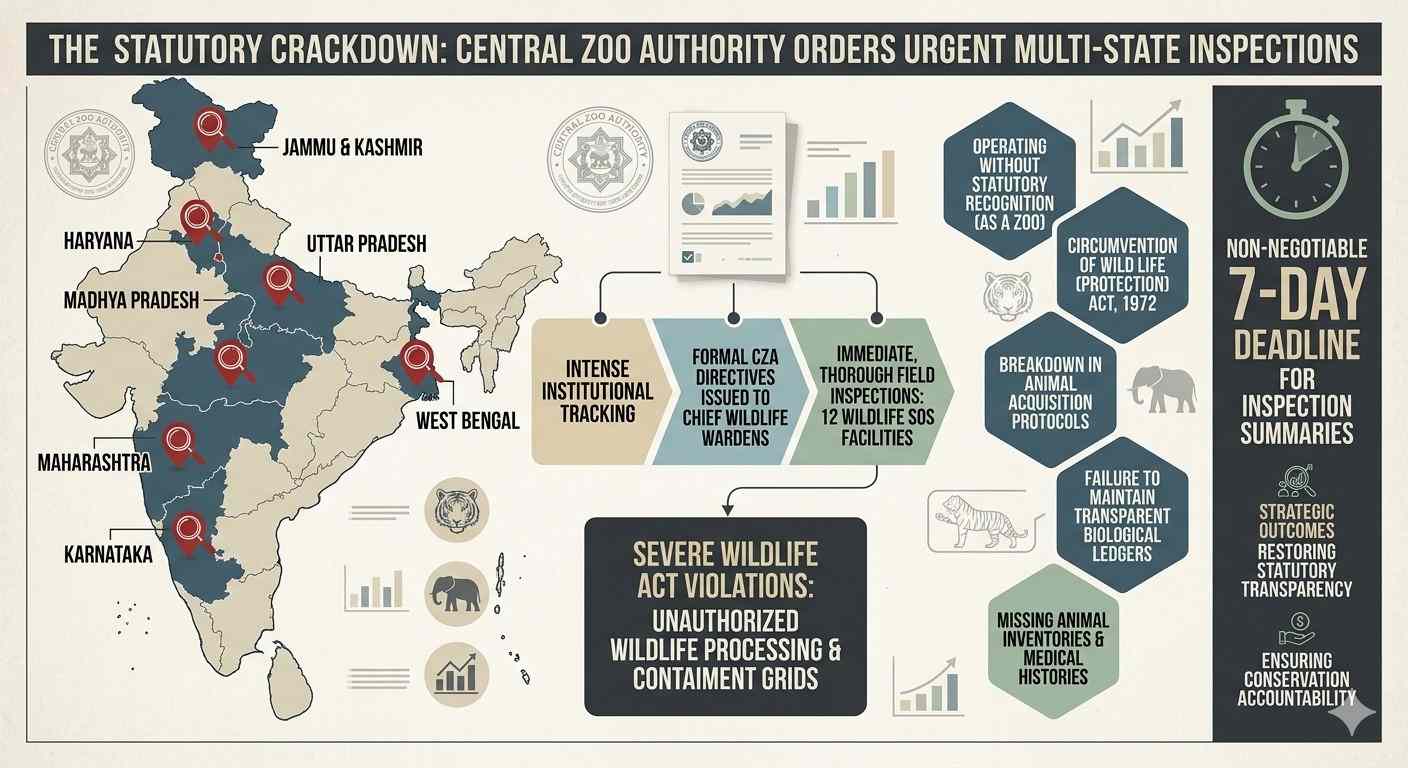
The enforcement parameters governing subcontinental ex-situ wildlife conservation have faced an intensive administrative shake-up. The Central Zoo Authority, a statutory oversight body operating under the Union Ministry of Environment, Forest and Climate Change, has formally issued a blistering directive compelling urgent field probes across six states and a Union Territory. The sweeping federal action targets twelve facilities managed by a prominent, capital-based non-governmental organisation following tracking parameters that flag extensive, unauthorised wildlife containment grids functioning completely outside central legal clearances. TreeTake delivers an authentic, fact-verified report on this institutional crackdown, detailing the strict seven-day reporting mandates imposed on state conservation secretariats and the structural pathways needed to restore statutory transparency.
TreeTake Network
A major regulatory intervention has been launched across the country's wildlife rescue and holding infrastructure. The Central Zoo Authority has formally issued an unyielding multi-state directive compelling Chief Wildlife Wardens to execute immediate, thorough field inspections of twelve distinct facilities managed by a prominent, capital-based wildlife protection non-governmental organisation. The aggressive statutory sweep follows detailed institutional tracking reports that flag extensive, unauthorised wildlife processing setups operating completely outside the legal frameworks cleared by central conservation bureaus.
The Structural Violations and the Seven-Day Mandate
The technical enforcement logs tracking wildlife facility compliance underwent an immediate escalation as the Central Zoo Authority issued formal directives to the conservation secretariats of Haryana, Madhya Pradesh, Uttar Pradesh, West Bengal, Maharashtra, Karnataka, and Jammu and Kashmir. The statutory body has set a strict, non-negotiable seven-day deadline for all regional field units to submit comprehensive, data-verified inspection summaries directly to the central ministry. The rapid mobilisation aims to audit the operational records of twelve designated installations operating under the administrative control of Wildlife SOS.
The core of the legal conflict turns on the severe, systematic circumvention of the Wild Life (Protection) Act, 1972. According to primary official communications, investigators have flagged that multiple high-capacity rescue hubs have been functioning as full-scale zoological displays without possessing the mandatory, statutory recognition from the Central Zoo Authority. Field monitoring units track a deeply disturbing pattern where wild animals, rescued from conflict zones or confiscated from illegal loops, are routinely transferred into long-term captive custody frameworks, completely bypassing the mandatory prior clearances legally required under central conservation codes.
Unauthorised Holdings and Inventory Discrepancies
The administrative friction is heavily aggravated by a structural failure to maintain transparent biological ledgers. Under existing environmental policy frameworks, every recognised animal housing facility is statutorily required to submit detailed, multi-season animal inventories to central monitoring registries within precise, fixed timelines. The central audit has exposed a complete breakdown in these reporting protocols, showing that the targeted facilities have systematically failed to account for the tracking numbers, medical histories, and transfer paths of the protected fauna under their management.
This institutional insulation has faced firm resistance from conservation planners who point out that allowing private or non-governmental entities to collect and hold apex carnivores without central tracking effectively creates an unmonitored, parallel captive system. Senior wildlife administrators close to the investigation clarify that by operating large animal holding enclosures without formal, data-verified zoo recognition, these setups completely separate themselves from the unified oversight required to prevent structural exploitation. The state-directed inspections are engineered to audit every single cage footprint, verify the legal procurement papers for every animal registry, and intercept any unnotified transfers before the utilities can retroactively alter their digital inventory matrices.
Strategic Pathways to Conservation Accountability
Dismantling the systemic oversight gaps gridlocking subcontinental ex-situ conservation requires a total transformation of regulatory tracking and institutional governance. The primary outcome of this ongoing multi-state crackdown is the realisation that private animal welfare narratives cannot substitute for the strict, unyielding application of statutory environmental laws.
First, the Ministry of Environment, Forest and Climate Change must legally mandate the integration of a centralised, blockchain-backed National Wildlife Inventory System, forcing all rescue centres and public facilities to log every animal arrival via unalterable digital weighing and biometric registries within twenty-four hours of capture. Second, the judiciary must establish strict statutory bans that prevent the allocation of public compensation or rescue grants to any facility operating without full, multi-layered zoo recognition from central bureaus. Finally, the central government must introduce automated satellite and CCTV telemetry loops linked directly to an independent National Conservation Dashboard, ensuring that no protected fauna can be retained in long-term captivity without continuous, transparent data tracking, thereby engineering absolute accountability into the foundational tier of subcontinental wildlife preservation.



Leave a comment