

TreeTake Network
A severe landslide triggered by continuous heavy rainfall has caused extensive destruction in western Sikkim's Gyalshing district. The geological collapse, which occurred under the Yuksom-Tashiding constituency, sent a massive torrent of mud, large boulders, and structural debris rushing down the upper slopes of the Singlitam hillock. The mudslide entirely buried sections of the lower rural settlement, washing away critical public assets and leaving multiple residential units severely compromised. The environmental catastrophe has brought regional transit to a complete halt, cutting off vital road connections to surrounding tourist corridors and adding deep urgency to subcontinental debates on climate adaptation.
Hillside Instability and Structural Loss Metrics
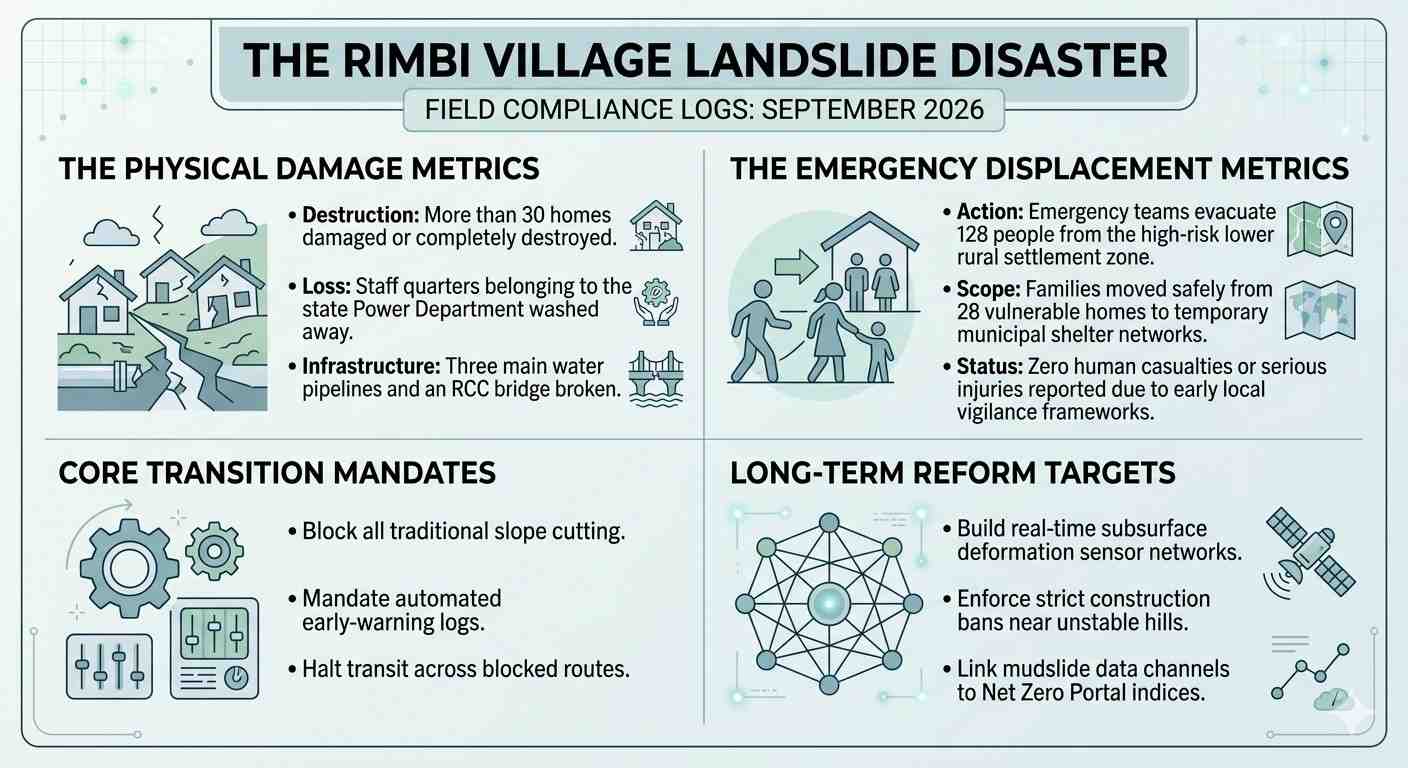
The extreme weather event escalated rapidly following a spell of incessant downpours that saturated the fragile Himalayan topsoil layers over consecutive days. The primary slope failure occurred late at night, moving down through the residential perimeters while most families were asleep. Official field updates from the Sikkim State Disaster Management Authority confirm that more than thirty residential homes have been extensively damaged or completely destroyed by the sudden influx of slurry.
The physical force of the mudflow completely washed away several government staff quarters belonging to the state Power Department. Debris accumulation along local streams also destroyed three vital regional water supply pipelines and washed away a reinforced cement concrete bridge, cutting off clean drinking options for downstream clusters. In response to the immediate threat of further slope failure, emergency response teams swiftly evacuated one hundred and twenty-eight people from twenty-eight high-risk homes, moving them to temporary state shelters. Due to timely early shifts and local vigilance, no loss of life or serious human injuries have been reported so far.
The Threat of Erratic Precipitation Shifts
The landslide has completely gridlocked regional transport infrastructure along the western border. The massive volume of stones and mud has entirely blocked the main highway connecting the Rimbi–Yuksam and Rimbi–Khecheopalri road networks, leaving multiple border communities isolated from the nearest town centres. Local administrative offices have issued urgent travel advisories compelling commuters to completely avoid the vulnerable corridors until extensive mechanical clearance teams can stabilise the rockfaces.
Sikkim Chief Minister Prem Singh Tamang termed the field situation serious and issued an immediate administrative directive to district collectors and emergency teams. Chief Minister Tamang stated that local authorities have been directed to remain on high alert, closely monitor the shifting slopes, and take all necessary measures to ensure public safety. He appealed to all residents to remain highly vigilant, strictly follow official updates, and move away from active landslide zones and swollen river streams during periods of continuous rainfall. Local conservation planners note that the recurring mudslides indicate a long-term change in subcontinental weather patterns, where brief, highly intense downpours place an impossible burden on steep slope ecosystems that have been weakened by infrastructure development.
Strategic Paths to Mountain Transport Security
Dismantling the systemic vulnerabilities gridlocking Himalayan conservation demands a total transformation of mountain engineering and regional risk mapping. First, the Ministry of Road Transport and Highways must legally ban all traditional heavy hillside cutting practices along fragile border paths, mandating the use of advanced geological telemetry to track subsurface deformation parameters before any expansion works are approved. Second, regional development bodies must implement automated, sensor-based early warning networks across unstable hillocks to transmit real-time slope movement updates directly to village panchayats, giving families hours to move out of harm's way. Finally, the state must establish strict statutory restrictions that prevent the construction of heavy commercial structures or government accommodations within designated high-risk landslide zones, ensuring that infrastructure investments are anchored in transparent geological science rather than compromised spatial planning.



Leave a comment