

TreeTake Network
In a historic push toward global ecocentric governance, Panamanian President José Raúl Mulino delivered a definitive address before the United Nations General Assembly. Standing before world leaders, Mulino formally announced that Panama will spearhead an international legislative movement to secure a non-binding global treaty establishing that natural ecosystems possess inherent legal rights. The diplomatic initiative aims to shift international environmental policy away from traditional resource management models toward an unyielding legal framework where the natural world is recognised as a subject of rights capable of being defended within statutory judiciaries.
The Diplomatic Architecture and the UN Pathway
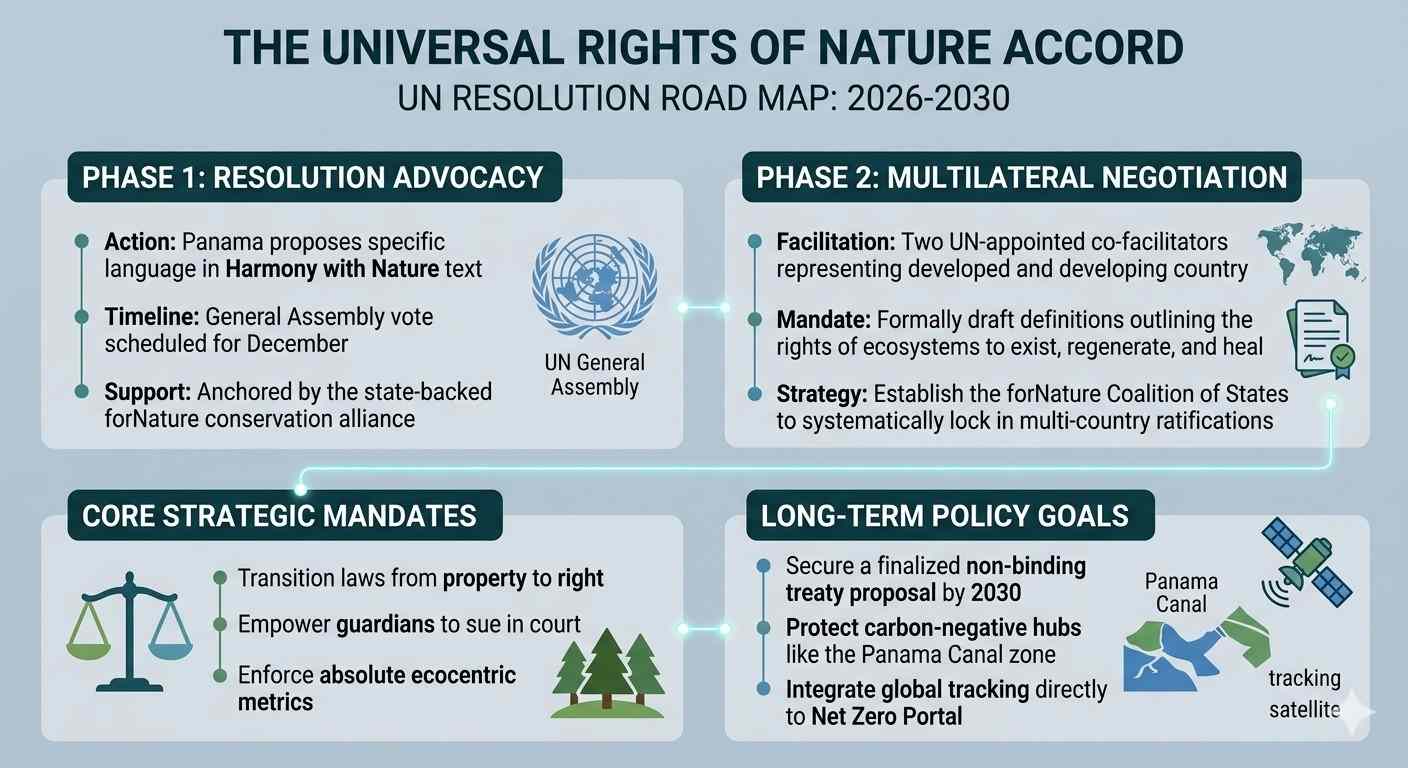
The Panamanian state delegation is actively coordinating within the longstanding United Nations Harmony with Nature programme. The primary legislative objective involves introducing specific, foundational language into the upcoming triennial Harmony with Nature resolution, which is scheduled for an intergovernmental vote. If successfully passed by the General Assembly, the resolution will formally authorise the opening of structured multilateral negotiations to draft a non-binding declaration that explicitly defines and articulates what constitutes the legal rights of nature.
The designated road map sets a strategic completion target for 2030. Under the established UN protocol, the drafting phase will be guided by two co-facilitators—conceptually split between a developed nation and a developing nation—to navigate sovereign legal frameworks through years of rigorous diplomatic consensus-building. The international push is being structurally supported by forNature, a marine conservation biology foundation that signed a formal memorandum of understanding with Panama's Ministry of the Environment to institutionalise rights of nature paradigms within global bodies.
Values-Driven Models Versus Global Administrative Hypocrisy
Panama’s pitch to the international community relies heavily on its domestic track record as one of the very few carbon-negative nations on Earth. The country’s internal infrastructure operates under its comprehensive national Rights of Nature statutory baseline, passed as Law 287, which grants ecosystems the legal right to exist, regenerate, and be fully restored. This domestic legal architecture was recently utilised by national judiciaries to help halt and dismantle operations at one of the largest copper mining extractions on the planet, demonstrating the hard-nosed enforcement power of ecocentric law.
This aggressive values-driven posture has been accompanied by direct administrative criticism of the broader international arena. Panamanian Environment Minister Juan Carlos Navarro issued a stark assessment of the widespread disconnect between empty political rhetoric and genuine climate mobilisation at the United Nations. Minister Navarro stated that the truth of the current international arena is that hypocrisy has won over concrete action, noting that global polluters have effectively treated the collective atmosphere like an open sewer. He pointed out that visible environmental markers—including severe climate-driven disruption to the Panama Canal's maritime trade capacities alongside looming severe El Niño cycles—have failed to prompt bold, real-world structural commitments from major industrial economies.
The Scientific and Legal Paradigm Transformation
The international legal framework proposed by the Panamanian delegation marks a definitive departure from standard subcontinental resource conservation strategies. Traditional environmental regulations view ecosystems merely as property or human assets, managing the rate of degradation rather than preventing the underlying exploitation. In contrast, an explicit declaration of nature's rights prioritises the systemic needs of functional ecosystems over commercial scale parameters, enabling legal guardians to sue corporate or state entities directly on behalf of rivers, forests, and oceans.
Marine conservation biologists and environmental advocates participating in the UN summit have emphasised that this global treaty push replicates successful, localised ecocentric precedents. National frameworks recognising nature's legal rights have already been codified in sovereign territories such as Ecuador and Bolivia, while judicial precedents have previously extended legal protections to critical river systems like the Ganges in India. By elevating these regional legal metrics into a unified United Nations declaration, the initiative seeks to create an unalterable global baseline that insulates vital carbon sinks and primary biodiversity reservoirs from future commercial concretisation or state-sanctioned destruction.



Leave a comment